

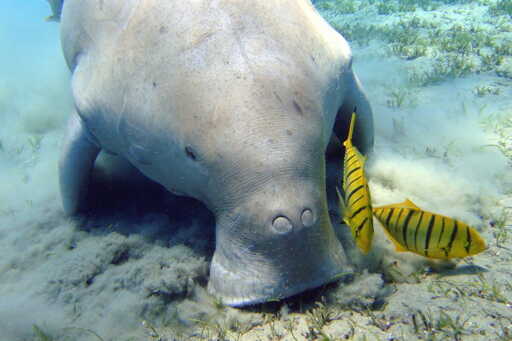
Drone technology is providing important new insights into the lives of dugongs, while also revealing the vital role they play in managing seagrass meadows, one of the ocean’s most important carbon sinks. Often referred to as sea cows, dugongs (Dugong dugon) are marine herbivores that can grow up to 3 meters (10 feet) long and weigh up to 420 kilograms (925 pounds). They feed almost exclusively on seagrass in shallow coastal waters across a wide range in the Indian and southeastern Pacific oceans. However, their population spread was revealed to be extremely uneven in an August 2025 report, published by the Convention on the Conservation of Migratory Species of Wild Animals (CMS) and touted as “offering the most comprehensive global update on the status and conservation needs of dugongs in over two decades.” By far the largest concentration of dugongs is in Australia, where an estimated 166,000 live in the country’s coastal waters, the CMS report shows. Other hotspots include the Arabian Gulf, the Red Sea, and Indonesia, while around 300 dugongs live along the coast of Mozambique, their last stronghold in Africa. But elsewhere the picture is less healthy. The IUCN, the global wildlife conservation authority, has listed the dugong as globally vulnerable to extinction for more than 40 years now. Some jurisdictions, such as the French territory of New Caledonia and Japan’s Nasei Islands, have listed the dugong as endangered. In 2022, research declared the species extinct in China. According to Helene Marsh, a professor of environmental sciences…This article was originally published on Mongabay
From Conservation news via This RSS Feed.