

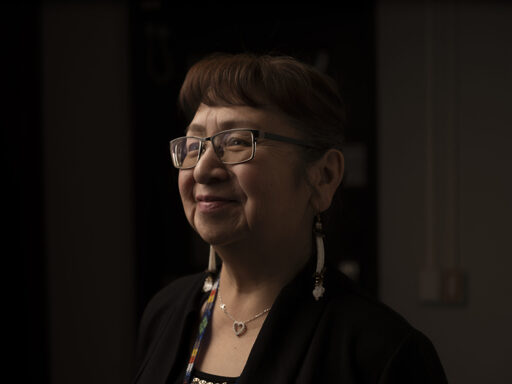
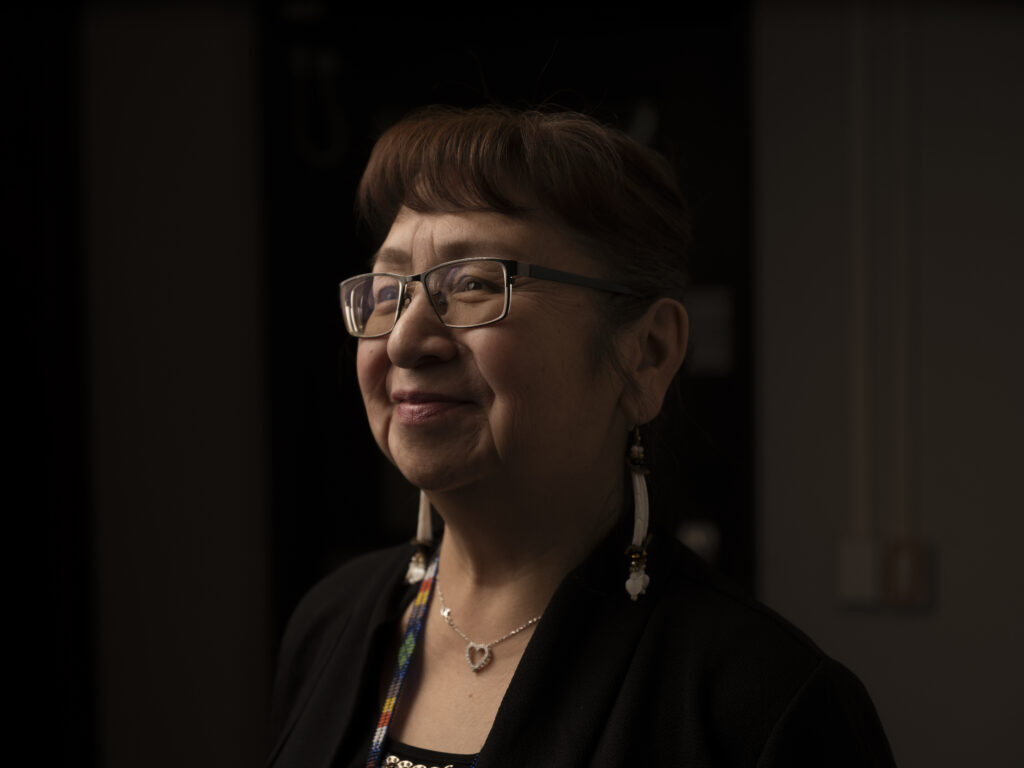
Language teacher Dorothy Thunder at the University of Alberta in Edmonton on Friday, March 20. Photo by Amber Bracken
As rain patters outside, Dorothy Thunder is sitting in her office at the University of Alberta, where she teaches nêhiyawêwin, the Cree language.
The grey, gloomy day contrasts with the warm atmosphere inside her headquarters in amiskwaciwâskahikan (Edmonton) — with bright and beautiful artwork surrounding her, Dorothy is gracious and open as she speaks about her work.
For more than two decades, Dorothy has been working to revitalize and pass on the Plains Cree dialect that she is fluent in. She works as an instructor and translator, and she has mentored many students on their journeys to also become Cree instructors.
To Dorothy, working with Cree is a deeply powerful experience — and one that she is eager to share with others. Whenever she hears it, “it goes into my veins, very deep into my veins, into my blood,” she explains, her long beaded earrings framing her face.
“It’s a very, totally different feeling for me when I hear the language, because it was my first language and I barely hear it anymore,” she said.
“Unless I’m with my siblings or I’m back in the community or with kêhtê-aya, the Elders … Maybe I’m feeling off balance, but then I hear the language. It just soothes my spirit all over again. I feel whole again.”
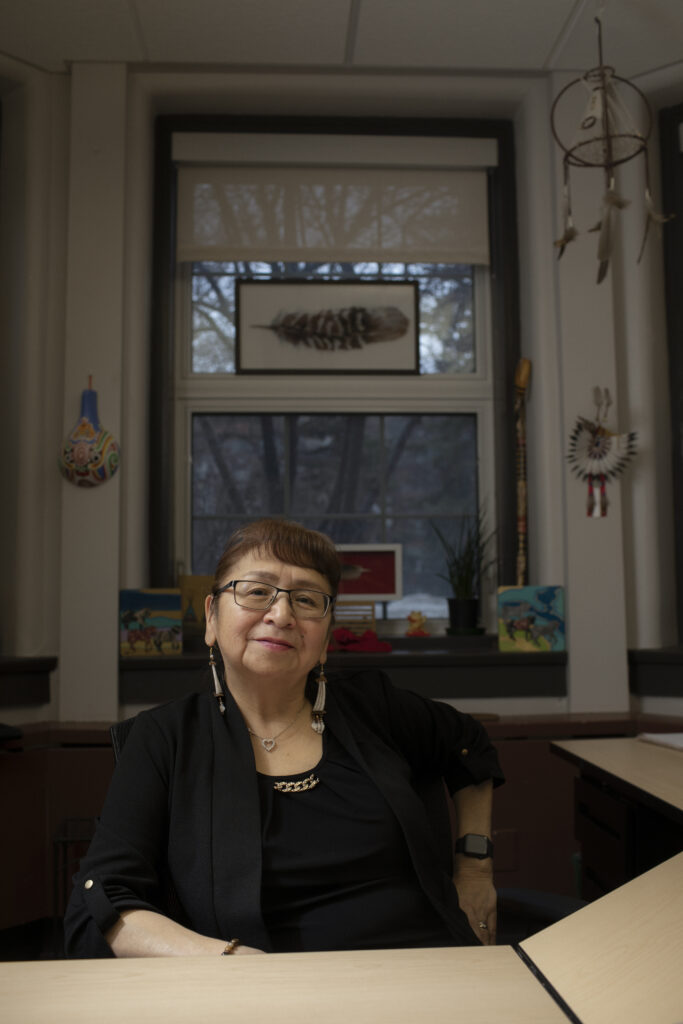
Language teacher Dorothy Thunder at the University of Alberta in Edmonton on Friday, March 20. Photo by Amber Bracken
Dorothy is from the Little Pine First Nation in Saskatchewan. Though she grew up speaking Cree, Dorothy attended day school as a child, where she was forced only to speak English.
She spoke about seeing other children being abused for speaking Cree — including her brother, who she recalled watching being hit with a strap for speaking the language.
“And then I had to just be quiet. Otherwise, I was made to stand in a corner. Like maybe two hours,” Dorothy said.
“And I was so terrified of the teacher because I didn’t understand what they were saying sometimes,” she shared.
However, when she returned home from the institution in the evening, she and her family would still speak Cree to each other.
“So I learned it at home from my nikâwiy and my nôhtâwiy, my mom and my dad, my late moshom and kokom,” she said.
“And everybody in the home spoke Cree, so there wasn’t any English in the home until we went to school.”
Dorothy shared that she had older sisters who went to residential schools and weren’t able to come home as often or speak Cree, which resulted in language loss.
Even today one of her older sisters still struggles with remembering the right Cree word for certain situations, so Dorothy’s family helps her.
“I remember my late mom and me and my sister were sitting in ceremony and she was asked to lead the pipe,” Dorothy recalled.
“And when she was doing that, she forgot how to say a certain word. And then my mom would nudge me to tell her. And then she said: ‘It’s okay. The Creator knows what I’m trying to say.’”
Journey to the U of A
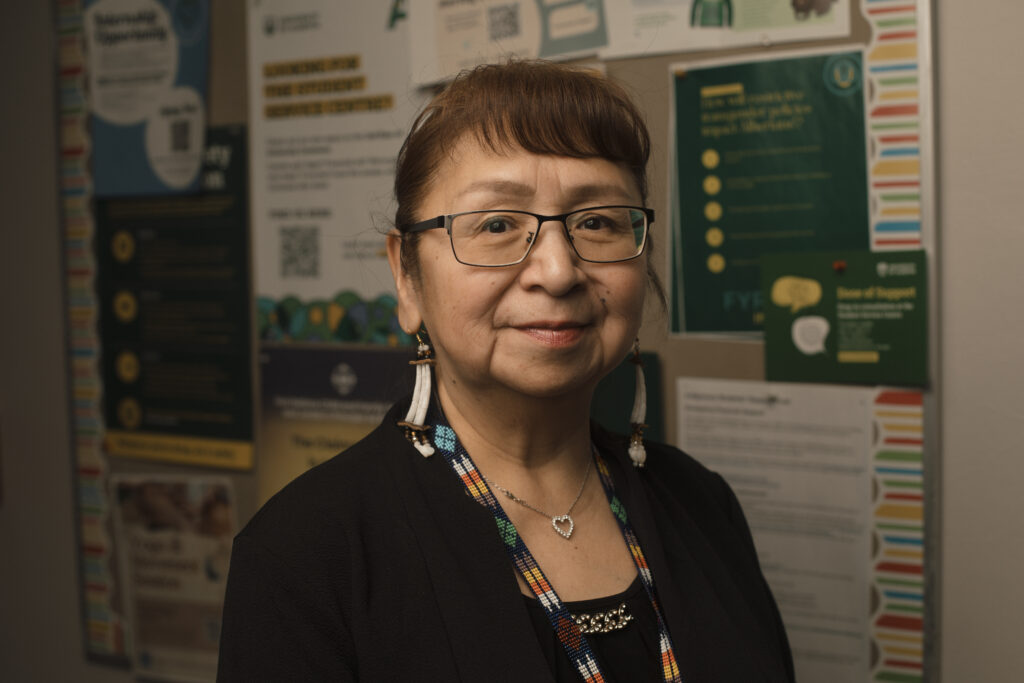
Language teacher Dorothy Thunder at the University of Alberta. Photo by Amber Bracken
After graduating high school, Dorothy went to college and got a job in banking. Dorothy’s sister was attending the Concordia University and College Entrance Program in Edmonton and invited Dorothy to also apply.
While she was there, a Cree instructor from the U of A — Donna Paskemin — came to Concordia to talk to students about the university’s Faculty of Native Studies, then known as the School of Native Studies.
After hearing about the Cree language program, Dorothy decided to apply there for a Bachelor of Arts degree.
After her fourth year in Native Studies in 2002, Dorothy was asked if she would like to try and teach Cree language classes at the school. So she started teaching Cree under the guidance of Donna.
But then in 2009 Donna told Dorothy she would be leaving to go to the First Nations University of Canada in Regina — leaving Dorothy without an in-person mentor.
“I was like: ‘What?! You can’t just leave me!,” Dorothy recalled, laughing.
“And she’s like: You have my number. If you have any questions. Anything, anytime. So just phone me.’ And I thought: ‘Oh my goodness! Am I really gonna do this?’”

Dorothy Thunder’s office at the University of Alberta. Photo by Amber Bracken
Since then, Dorothy has continuously been teaching Cree at the U of A and she also ended up developing her own textbooks to help teach the Cree language. She also completed a Master of Sciences degree in Linguistics in 2015.
In addition to teaching the language at the U of A, Dorothy also teaches Cree through various community classes. One of them being the nêhiyawak Language Experience.
“So last year, we did a seven day camp on the land. And it’s very beautiful just to be on the land,” Dorothy said. The camp included nature walks, medicine picking, attending sweat lodges and powwows.
Dorothy noticed that when she teaches Cree to students, they would sometimes tell her “there was always something missing.”
“And I didn’t know what it was. But now I’m starting to feel whole again because you’ve given the language to me,” she recalled.
Jordan Royal, a Cree and Dakota man, took Cree classes with Dorothy while completing his undergraduate degree. Now he is following in her footsteps — he works as a Cree language instructor at U of A with plans to begin a Master’s degree in linguistics in Fall 2026.
Dorothy will be one of the supervisors for his research in psycholinguistics. He said Dorothy has been integral to his understanding of the Cree language.
“She’s been a big mentor for me,” Jordan said in an interview.
“It’s nice to have someone that you can just talk with about the language,” he added. “You can always go visit her. You can always rely on the fact that she will be there and she’ll be willing to help you.”
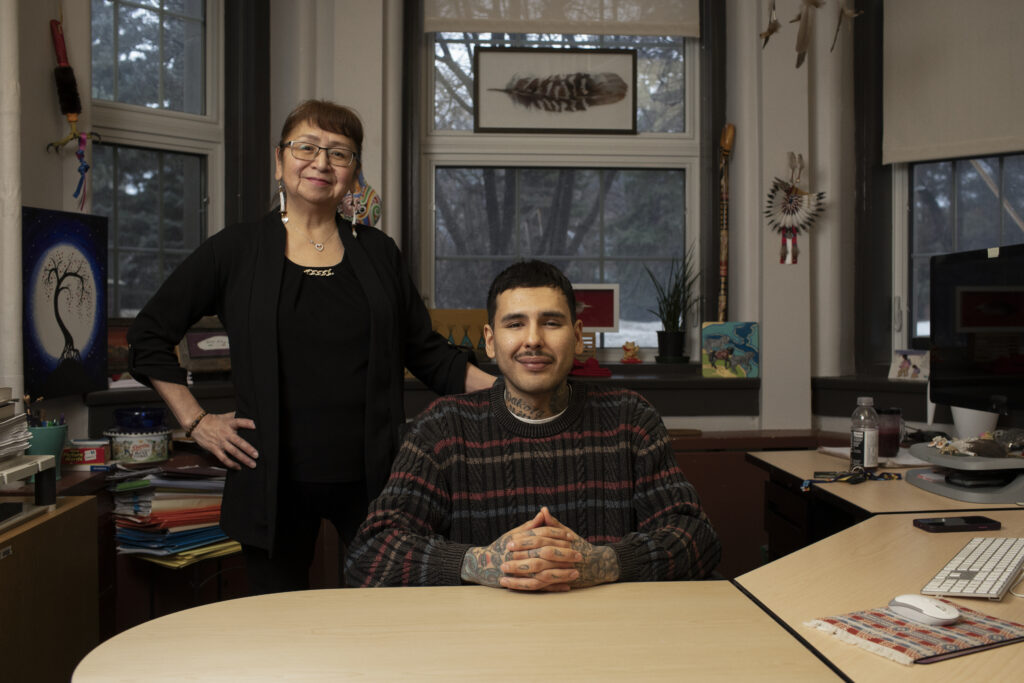
Dorothy Thunder with Jordan Royal, who is teaching with her, at the University of Alberta. Photos by Amber Bracken
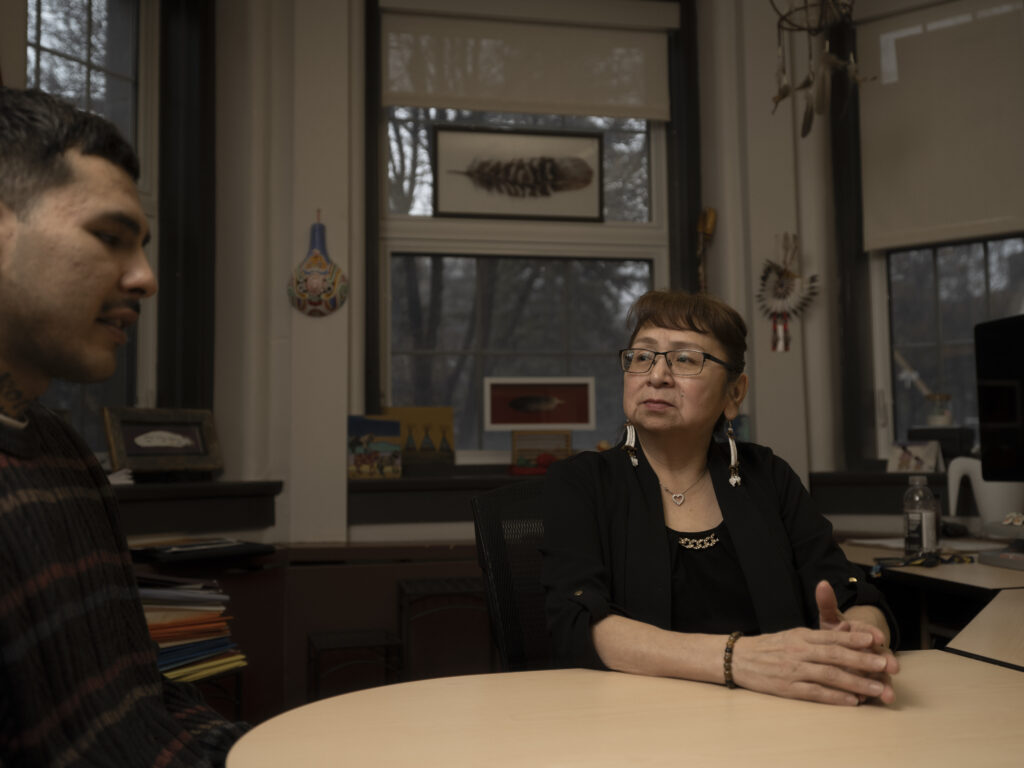
He explained that he worked as a teaching assistant for Dorothy after he completed a class in Advanced Cree. During the 2025-2026 academic year, he was asked to teach Dorothy’s usual Cree classes while she was on sabbatical.
“The opportunity showed up and she asked me if I would like to teach the class while she was away,” Jordan said. “And it’s been a great year and she’s just been a help too. I can always reach out to her and ask her for any guidance when it comes to teaching the class in her stead.”
Dorothy also spoke about how she is planning a Mentor Apprentice Program in Cree for a small group of students.
“So we could make bannock, we could make stew, and go on a walk down by the River Valley,” she said, “but it’s going to be all in Cree.”
As a translator, Dorothy has transformed many English language works into Cree — including the books This Land is a Lullaby, Auntie’s Rez Surprise and Remember Who You Are — and she provides translations and voiceovers for media and other agencies.
“It’s really important work to be able to see our language out in the industry, whether it’s TV, whether it’s the radio,” Dorothy said. She explained that people who are learning Cree as a second-language sometimes try to look for videos and various mediums to learn.
Language is relational, based in kinship
The Cree language has the most speakers of all of “Canada’s” First Nations languages, with an estimated 75,000 speakers across its dialect groups, according to the University of Saskatchewan.
Plains Cree, Woodland Cree and Swampy Cree are common dialects on the central prairies, while Moose Cree and Eastern Cree are more common in “Ontario” and “Quebec.”
Dorothy explained that she has worked with other Cree dialects before.
“It wouldn’t be easy for me to switch my dialect to their dialect, but I could still understand them,” Dorothy said. “So we both talk our own dialects and we understand each other.”
Dorothy explained that the Cree language is very rich and complex, and interconnected with the land and culture. And Cree culture is very focused on relationality and kinship, and that is also expressed through the language.
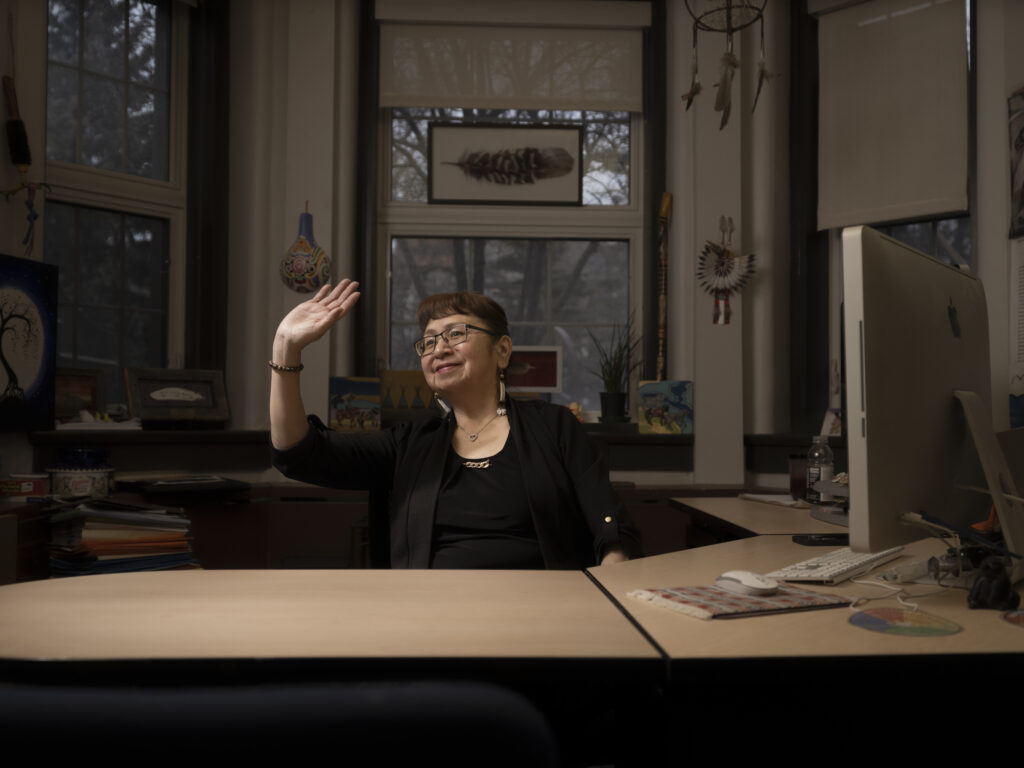
Dorothy Thunder waves to a visitor. Photo by Amber Bracken
“We have that family value system, the kinship system,” Dorothy said. “Very close-related is very important … As an aunt I’m still responsible for my nieces and my nephews as my own children. When my father passed away then my uncle had to step into his role.”
Dorothy emphasized how close bonding between family members is very important — and that the importance is conveyed through the Cree language.
“Even today my own brother calls me nimis, my older sister. Not by my name. That would feel weird, right? Like that kind of closeness, that kind of bonding,” Dorothy said.
She spoke about the animate nature of the Cree language, and how “in thenêhiyaw worldview everything has a living spirit.”
In the Cree language, objects are either animate or non-animate. If an object is animate that means it’s alive and has a spirit — so humans, rocks and trees are all considered animate.
In the Cree language, everything that is alive and animate is referred to in the same way. To refer to a human is the same way that someone would refer to a star or an apple.
“The rock, it’s a spiritual thing for us. It’s our messenger to the Creator, right? So we call it a living thing. Same thing with the trees. That’s a living thing as well.”
Dorothy spoke about a workshop she led where she was teaching students about animate and non-animate objects. She brought objects to the workshop, including a stick. The students asked her why the stick was inanimate, while the tree was animate. “I said: Yeah, once you chop [the tree] down, it’s inanimate.”
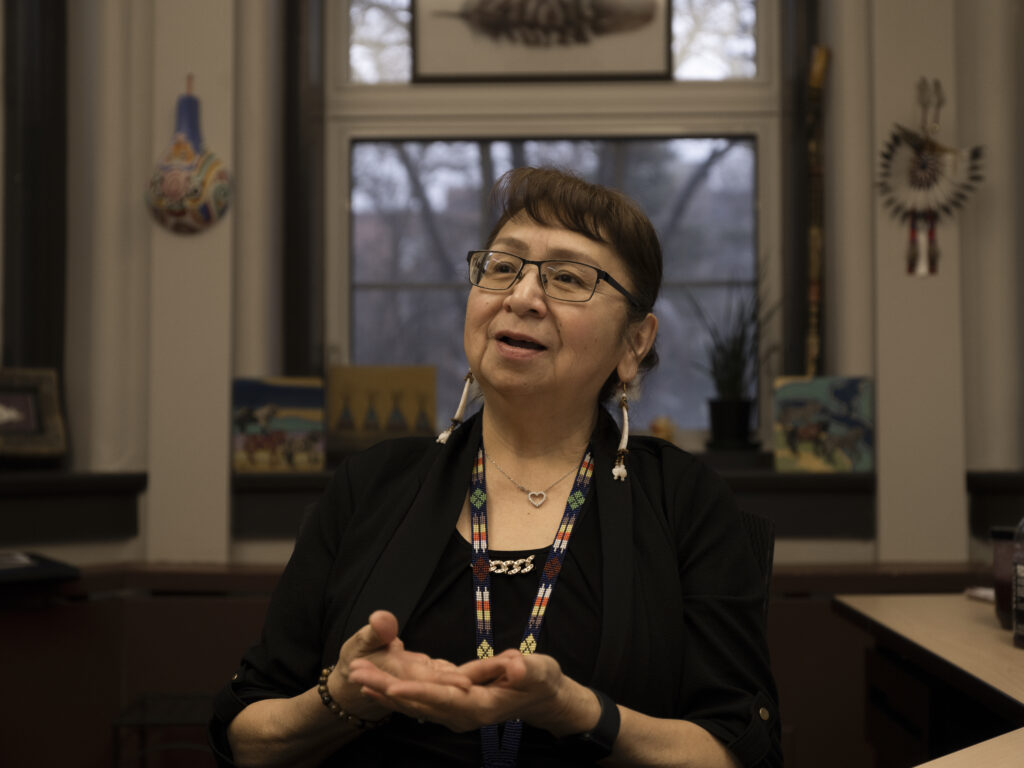
Dorothy Thunder at her desk at the U of A. Photo by Amber Bracken
As a fluent speaker of Cree, Dorothy wouldn’t even think about whether something is animate or not in the Cree language. It was just something she knew. But, students would sometimes ask her if something like an apple was animate or not. So in class she would sometimes test whether something was animate or not.
“And I would gauge it by saying: wâpam for animate, and then wâpahta for inanimate,” she said.
“And I always hear niwâpamâw picikwâs, an apple. So it’s going to be animate. We wouldn’t say niwâpahten.”
Another aspect of the Cree language is that there is no gender distinction.
“We wouldn’t be able to know if it’s a male or female that we’re talking about,” she said.
“It doesn’t matter unless you had a name attached to it.”
Importance of Elders and Youth
Dorothy feels it’s important to pass the language on — especially to Youth.
She spoke about how many Elders are passing on and taking knowledge of the culture and language with them.
“So it’s important for us to try to pass on whatever they gave to us and pass it on to the younger ones,” she said. “Especially language. We need to pass that on.”
She spoke about a form of the language known as Old Cree, and how the older generation of Cree speakers use Cree words that are disappearing from the vocabulary of some of the younger generations.
“Part of my work this year was to go out there and listen to the Elders and try to get the old words that I don’t hear,” Dorothy said.
“And then I will write down the words and I’ll look in the dictionary and they’re not there. So that’s part of the work I was doing. And then coming up with sentences on how to use that word. So much more of that still has to be done.”
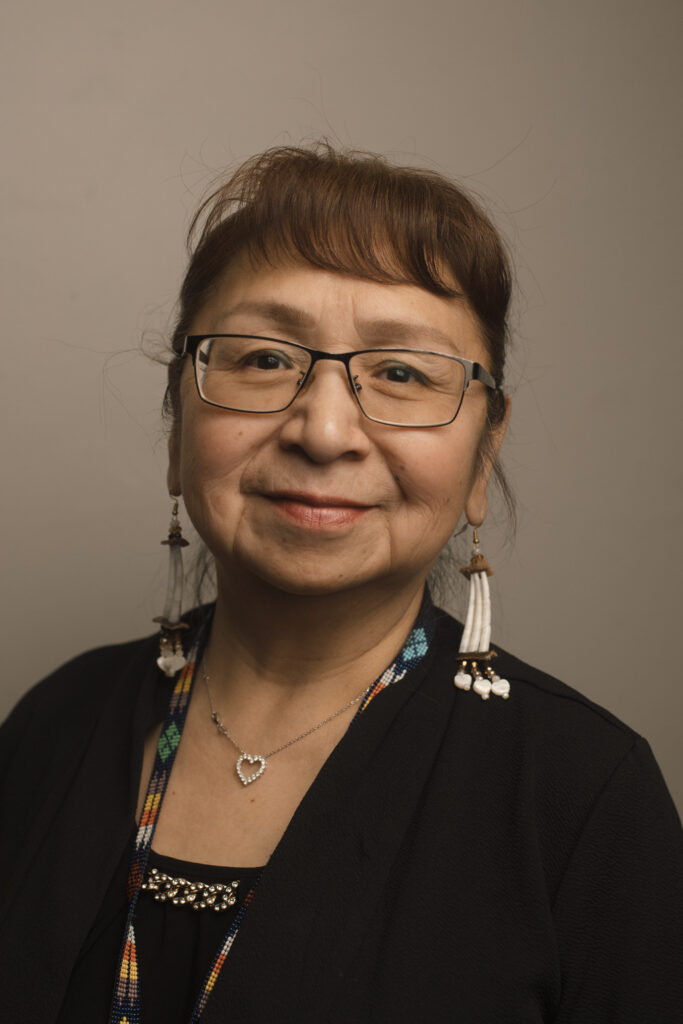
Photo by Amber Bracken
Dorothy explained how the Elders are typically very gentle and welcoming in their instruction of the language and culture. And that the Elders say the language and teachings will come to you when you’re ready.
“So it’s very beautiful to be able to have all of that. And to be able to share it with everyone.”
Youth that are disconnected from language and culture can lead to them developing negative coping mechanisms in their lives.
Dorothy shared how a long time ago, it was very uncommon to hear about things like suicide, alcoholism and drugs.
“But we taught [the Youth] about ceremony. We taught them about the importance of family using the language. And the language captures them because it’s a spirit, and then they listen and they’re like, ‘okay,’” she said.
“But, now losing the language, they’re confused with everything else. So now everything is coming full force. There’s so much chaos in some of their lives.”
Dorothy spoke about how she had some students who were 60s Scoop survivors, and they were very lost and trying hard to see where they fit in.
She told them: “You fit in anywhere. You’re more than welcome to learn what you want in your life. You can have it.”
When Dorothy takes students out on the land, she said the students sometimes didn’t know about the ceremonies that existed there. Ceremonies such as the horse dance, tea dance, sun dance and the giveaway ceremony.
The students tell her: “This is where I should have been, kayâs, a long time ago.”
Author’s note: As someone who spent 13 years in the Canadian child welfare system, I didn’t really have an opportunity growing up to learn my traditional languages which are Cree, Saulteaux, and Stoney Nakoda.
When I was studying at the University of Alberta, I was able to learn Cree more extensively through their classes. There are three levels of Cree classes that are year-long courses. I took my first year of Cree classes with Nicole Lugosi-Schimpf and then I took Intermediate and Advanced Cree with Dorothy Thunder as well as an independent study.
Writing this piece about Dorothy was a very beautiful and impactful experience for me, and I’m grateful I had the chance to share it.
The post Through teaching and translation, Dorothy Thunder breathes life into nêhiyawêwin appeared first on Indiginews.
From Indiginews via This RSS Feed.