

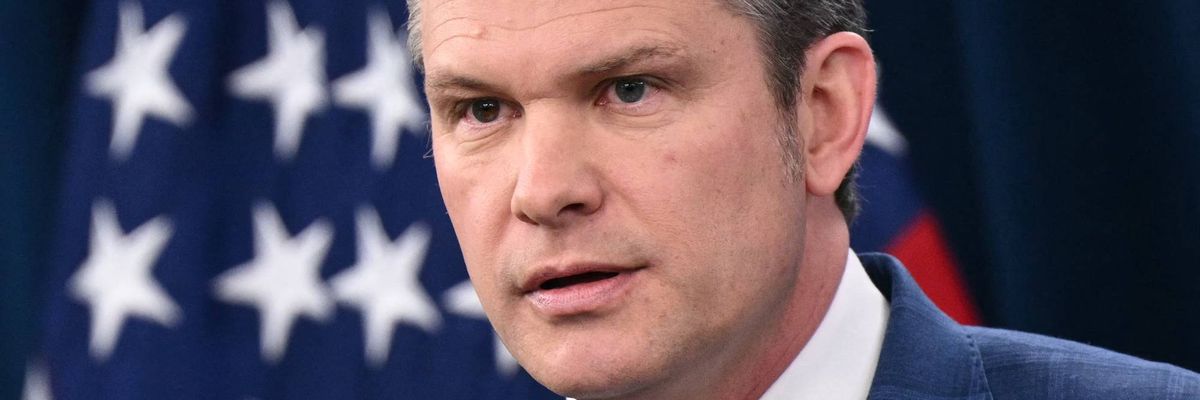
As Republicans and several Democrats in the US Senate gave the go-ahead for the US to send more bombs and military equipment to Israel for its attacks on Gaza and Lebanon on Wednesday, the Trump administration was continuing what it claims is an effort to rid Latin American countries of drug traffickers—killing three people aboard a vessel in the eastern Pacific Ocean in the US military’s third boat bombing in three days.
The US Southern Command posted a video on social media of the bombing, which it said targeted a boat that was “transiting along known narco-trafficking routes in the Eastern Pacific and was engaged in narco-trafficking operations.”
As with the 50 previous attacks on boats in the Pacific and the Caribbean Sea, the military did not publicize any evidence that the boat was carrying drugs or that its passengers were “narco-terrorists.”
A small number of the at least 177 victims of the Trump administration’s boat bombings have been identified. The Associated Press reported in November that Robert Sánchez, who was killed in the Caribbean, was a 42-year-old fisherman who made $100 per month and had started helping cocaine traffickers navigate the sea due to economic pressures. Juan Carlos Fuentes was an out-of-work bus driver who also worked as a “drug runner” to make ends meet.
The families of at least two victims have filed legal complaints over the killings of their family members, saying they were fishermen.
Adam Isacson of the Washington Office on Latin America has compared the boat bombings, assuming they have targeted people involved in the drug trade at all, to "straight-up massacring 16-year-old drug dealers on US street corners.”
On Wednesday, Isacson noted that while Trump, Defense Secretary Pete Hegseth, and Secretary of State Marco Rubio have defended the boat bombings as attacks that will protect Americans from the flow of drugs like cocaine and fentanyl into the US—with the president informing Congress that the White House views the country as being in an “armed conflict” with drug cartels—data from US Customs and Border Protection (CBP) shows little evidence that the strikes are stopping drugs from reaching the US.
“CBP’s seizures of fentanyl at the US-Mexico border had been declining, often sharply, since mid-2023. But since early 2025, the declines stopped,” said Isacson. “Halfway into fiscal 2026, seizures are almost exactly half of 2025’s full-year total: a flat trendline.”
Following Wednesday’s bombing, at least 14 people have been killed in boat strikes in five days.
Brian Finucane of the International Crisis Group emphasized Wednesday night that “despite the administration’s rhetoric and bogus legal theories, the supposed armed conflict with ‘narco-terrorists’ appears to be entirely make-believe.”
Under international law, drug trafficking is treated as a crime, with US law enforcement agencies in the past intercepting boats suspected of smuggling drugs and arresting those on board. A coalition of rights organizations sued the Trump administration in December, demanding documentation of the White House’s legal justification for the boat bombings and arguing that for any organization to be considered part of “armed conflict” with the US, it must be an “organized armed group” that is engaged in “protracted armed violence” with the country.
“Murder,” said Finucane, “is the general term for premeditated killing outside of armed conflict.”
From Common Dreams via This RSS Feed.
Why didn’t Trump’s Justice Department release all the Epstein Files, in accordance with the law?