

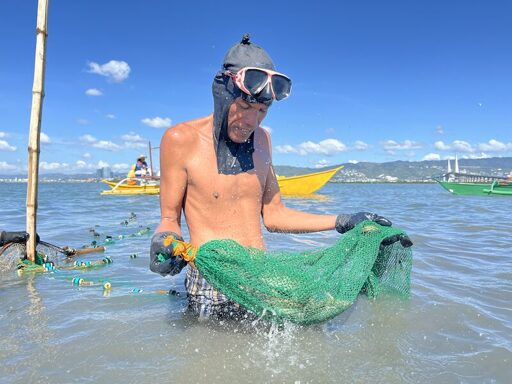
The loss of fishing grounds due to reclamation and urban development without community consultation has forced some small-scale fisherfolk to fish outside their municipalities.
By Cris Fernan Bayaga
Bulatlat.com
CEBU CITY – Fisherfolk in Cordova, Cebu are experiencing significant decline in fish catch due to the construction of the Cebu-Cordova Link Expressway (CCLEX) by Cebu Cordova Link Expressway Corporation (CCLEC).
Members of the Pundok sa Pobreng Mananagat sa Bangbang (PPMB), an Cordova-based alliance of fisherfolk, attribute the dwindling catch to the degradation of marine habitats and the disruption of fish migration routes. They said that portions of the bridge and its causeway obstructed natural passageways, resulting in decreased fishing productivity.
In 2020, the alliance denounced the low headspace of the structure initially built by CCLEC which hampered their daily fishing activities.
Fisherfolk from Barangays Bangbang and San Miguel raised concerns over the difficulty of navigating their boats through the area directly in front of their docking sites, making it harder for them to access their fishing grounds.

A fisherman from Cordova stands behind the revised bridge passageway, which has low head clearance. (Photo by Cris Fernan Bayaga/Bulatlat)
Miguela Pogoy, wife of the late former PPMB chairperson Elizar Pogoy, recalled that at the height of the pandemic her husband faced state-sponsored attacks because the alliance criticized the lapses in the initial construction of the passageway.
She said that after an agreement was reached with the CCLEC and the local government unit (LGU) of the Municipality of Cordova to address the fisherfolk’s concerns over the structure, two unidentified individuals visited their home and warned him against joining actions similar to those previously done by the alliance.
According to Pogoy, her husband was also asked to write down his name and affirm that he would no longer take part in such activities. The said unidentified individuals forced him to affix his signature, and due to fear for his safety and that of his family, he was compelled to sign his name against his will.
In a December 2024 report by Lanog, the student-led publication of the College of Communication, Art, and Design at the University of the Philippines Cebu, student journalists who visited the fisherfolk communities documented the continued red-tagging of several alliance members.

Fisherfolk from Cordova continue to rely on traditional fishing methods at night. (Photo courtesy of Lanog)
Among those reportedly subjected to such attacks were Sanchez and Selma Degamo, both active participants and organizers of protests.
While the corporation later agreed to reconstruct the initially built causeway segment that blocked their route and even provided compensation to affected residents, the consequences of the bridge’s construction extended far beyond what financial assistance could address.
The waters that once served as a dependable source of food and income had already been altered. Fishing routes were disrupted and breeding grounds remain to be disturbed.
Pogoy said that they were told at first that the corporation would only build pillars as support for the bridge and that it would not affect their daily activities.
However, she said that they were deceived as the majority of the construction left them with a very limited route to pass through. This left them with no other choice but to live with such changes.
Orland Baguio, a fisherfolk from Bangbang, agreed with her sentiments because even after the passageway was repaired, their docking area has also been reduced from its original space.
He said that the port is now overcrowded, as two barangays were made to share a single docking site, with only two boats allowed to enter and leave at a time.
“We also have to reroute our usual fishing routes, making our trips longer because of how the bridge was built. In fact, where the CCLEX now stands used to be one of the primary spots where fish would flock,” he said.
This rerouting significantly affected their gasoline consumption, as they now have to search for alternative routes and more efficient fishing grounds located farther than their usual areas due to the changes in fish habitats.

A fisherman steers his boat around rocks in shallow waters as he makes his way to the fishing grounds, a route made more difficult by the bridge’s location. (Photo by Cris Fernan Bayaga/Bulatlat)
PPMB chairperson Imbiong Baguio said that the fisherfolk were never consulted during the planning stages of the bridge’s construction.
“Before it was built, even with just around three hours of fishing, each boat could bring in 12 to 15 kilos, more than enough for the day. Now, within the same three hours, there are times when we come back with nothing, or with only around five kilos,” he said.
Joseph Notarion said that since the construction of the CCLEX, they have been forced to resort to other fishing practices just to continue putting food on the table.
One of these methods is the use of fish nests, locally known as gango which make use of nets, wooden twigs, and rocks to catch fish.
“Prior to the construction of CCLEX, when I used gango, fish would start gathering in these nests within two to four weeks. Now, even after a month, the catch often amounts to only a few kilos, less than five, compared to around eight kilos or more before,” he said.
For him, small-scale fisherfolk are careful stewards of marine life, taking only what is enough and ensuring that their methods do not harm the ecosystem.
However, he said that the construction of the bridge disrupted coral habitats and altered the natural flow of the water, further contributing to low yield.

Notarion carries a rock used for gango fishing as he retrieves the fish they have caught over the past month. (Photo by Cris Fernan Bayaga/Bulatlat)
Baguio said that, to this day, the lingering effects of Typhoon Tino in November 2025 continue to worsen the struggles faced by the fisherfolk amid the worsening decline in their catch.
“Bagyong Tino really affected us drastically. We lost our nets and three pump boats which we still haven’t been able to repair to this day because no repair assistance was provided. There was no help from the barangay or the LGU; all we received was a sack of rice,” he said.
For him, the lack of support for fisherfolk communities is the reason they continue to voice out their concerns related to their only source of income for decades now.
He said that PPMB will always be at the frontlines of organizing fisherfolk in Cordova, as they have never sought conflict with the LGU or CCLEC. They just want their issues to be addressed.
Amid these concerns, Pogoy remains firm that their alliance will continue to uphold its mandate to denounce any anti-fisherfolk development in their area.
She said that the loss of fishing grounds due to reclamation and urban development without community consultation has forced some small-scale fisherfolk to fish outside their municipalities.

Imbiong Baguio prepares his catch for kinilaw, a traditional raw fish dish marinated in vinegar. (Photo by Cris Fernan Bayaga/Bulatlat)
For her, the December 2023 court ruling that allowed Mercidar Fishing Corporation to operate within the 15-kilometer municipal waters, areas rightfully reserved for small-scale fisherfolk, is the central reason why their alliance continues to defend the rights of vulnerable fishing communities against commercialization.
Read: UP fisheries students push for exclusive waters for small-scale fishers
She said that such expansions worsen their struggles as they cannot compete with commercial fishing operations equipped with advanced technology.
Pogoy also said that the opposition to the building the SeaOil Terminal Storage and Jetty Port Facility in Talisay City in 2024 is an example of how small-scale fisherfolk groups will continue to voice out their concerns and denounce such projects, as they know these will further reduce their fishing grounds.
PPMB urged the government to refrain from reclaiming coastal areas for commercial purposes. They called for projects that prioritize the protection of the marine environment and the expansion of mangrove afforestation which is one of the most effective ways to restore healthier fishing grounds and revive biodiversity in their area. (AMU, DAA)
The post Cebu fisherfolk face declining catch after bridge construction appeared first on Bulatlat.
From Bulatlat via This RSS Feed.