

Caracas, April 15, 2026 (venezuelanalysis.com) – The US Treasury Department’s Office of Foreign Assets Control (OFAC) issued two new general licenses on Tuesday facilitating transactions with Venezuelan state institutions.
for Venezuela on Tuesday: a commercial license (No. 56) and a financial license (No. 57), signaling a partial easing of restrictions while maintaining key controls.
General License 56 (GL56) authorizes US entities to negotiate and sign “contingent contracts” for future commercial operations in Venezuela. This allows firms to move forward with agreements, investments, or projects, though their final execution remains subject to separate OFAC approval.
The waiver maintains important restrictions, including a ban on payments in gold or cryptocurrencies, as well as prohibitions on transactions involving China, Russia, Iran, North Korea, and Cuba. It likewise forbids transactions involving Venezuelan debt and does not unblock currently frozen Venezuelan assets.
For its part, General License 57 (GL57) permits a broad range of financial operations with the Venezuelan Central Bank (BCV), as well as Venezuela’s public banks: Banco de Venezuela, Banco Digital de los Trabajadores, Banco del Tesoro, and entities in which these institutions hold a 50 percent or greater stake.
The allowed transactions include opening and managing accounts, conducting US dollar transfers, issuing loans, and providing banking services. The BCV was sanctioned in April 2019, effectively isolating Venezuela from international financial circuits and increasing costs for basic transactions.
The latest sanctions waivers are expected to facilitate financial flows to the Venezuelan economy, including the transfer of Venezuelan oil revenues that are currently controlled by the Trump administration. US authorities have returned a confirmed US $500 million out of an initial deal estimated at $2 billion, while US and Venezuelan officials have confirmed the purchase of US-manufactured medicines and hospital equipment using Venezuelan funds.
Analyst Hermes Pérez warned that reincorporation into the SWIFT system and establishment of US-based accounts could take several months due to security and technological requirements. Other economists argued that GL57 could allow the Central Bank to stabilize the Venezuelan foreign exchange system.
For several years, a parallel exchange rate between the US dollar and the Venezuelan bolívar has coexisted with the official one set by the Central Bank, often with a gap above 50 percent that fueled distortions in retail activities and currency speculation.
Since the January 3 military strikes and kidnapping of Venezuelan President Nicolás Maduro, the Trump administration has issued several licenses to expand US influence in the Caribbean nation, particularly in key economic sectors such as hydrocarbons and mining.
In parallel, Venezuelan authorities have promoted several pro-business reforms, while multiple Trump officials and corporate executives have come the South American country and held meetings with the acting government led by Delcy Rodríguez.
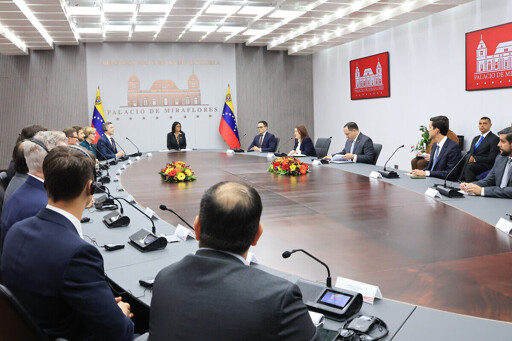
The latest waivers coincided with the visit to Caracas of a US Department of Energy delegation led by Assistant Secretary Kyle Haustveit. Rodríguez hosted the official on Wednesday in a work meeting at the presidential palace.
During a short, televised intervention, Rodríguez argued that OFAC licenses do not provide sufficient “legal certainty” and reiterated calls for Trump to lift unilateral coercive measures against the country.
“An investor requires greater legal certainty. A license does not provide long-term legal guarantees because it is subject to temporality,” she argued. Rodríguez claimed Washington and Caracas have “enough maturity” to establish “long-term” energy cooperation ties.
“We are working very hard on changes that can attract investment, and which can build an energy cooperation agenda with the United States,” she said.
Rodríguez additionally disclosed recent meetings with representatives from ExxonMobil and ConocoPhillips, stating that authorities have “taken into account recommendations” from oil majors in recent legislative overhauls. Both ExxonMobil and ConocoPhillips refused to accept hydrocarbon reforms under former President Hugo Chávez in the 2000s, later securing multi-billion-dollar arbitration awards against the Caracas as compensation for the nationalization of their assets.
Haustveit and the Energy Department delegation were also present on Monday during the signing of agreements with Chevron that granted the Texas-based conglomerate an increased stake in the Petroindependencia joint venture and awarded an additional extra-heavy crude bloc for exploration to the Petropiar mixed company. Chevron owns minority stakes in both joint enterprises with Venezuelan state oil company PDVSA.
Shell, Eni and Repsol are among the other energy giants to have recently advanced in deals with the Venezuelan government under the improved conditions of the new Hydrocarbon Law.
US Chargé d’Affaires in Venezuela Laura Dogu was also present at the Chevron deal-signing ceremony and the meeting with Haustveit’s delegation. However, the White House announced Wednesday that her post will be taken over by veteran diplomat John Barrett.
Barrett, who previously served as chargé d’affaires at the US Embassy in Guatemala since January 21, 2026, was recently accused by Guatemalan President Bernardo Arévalo of interference during judicial elections for the Constitutional Court held in March.
Edited by Ricardo Vaz in Caracas.
The post Venezuela: Trump Administration Issues Banking Licenses as Rodríguez Eyes ‘Long-Term’ US Energy Ties appeared first on Venezuelanalysis.
From Venezuelanalysis via This RSS Feed.