

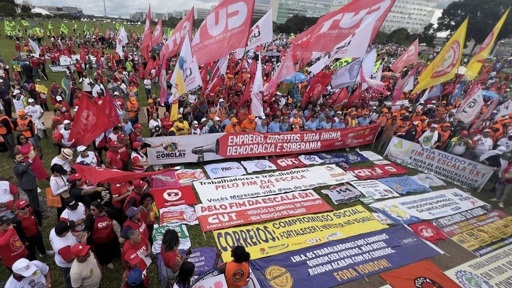
Thousands of workers from all regions of the country filled Brasília on April 15 in a major national mobilization in defense of workers’ rights. The “March of the Working Class”, organized by union federations and social movements, brought together diverse sectors of workers with a series of demands, the main one being the end of the 6×1 work schedule without any impact on wages, and the reduction of working hours.
The demonstrators marched along the Monumental Axis toward the Ministries Esplanade. In the afternoon, the workers proceeded to the Planalto Palace, where they were received by President Luiz Inácio Lula da Silva and federal government ministers to hand over the Working Class Agenda – a document containing 68 priority items for the coming years.
The mobilization takes place at a moment considered strategic by the union movement, following President Lula’s submission on Tuesday, April 14, of a bill to the National Congress proposing the end of the 6×1 schedule, reducing the weekly limit from 44 to 40 hours without wage cuts and adopting a 5×2 schedule. The proposal was submitted under an urgency regime, which requires the Legislature to analyze it within 45 days.
Sérgio Nobre, national president of the Central Única dos Trabalhadores (CUT), declared the day a victory for the working class and reiterated the fundamental role of street mobilization. “There are millions of workers, mostly young people, who are on the margins of union rights, labor rights, and social rights. We need to bring these people into the fold of rights. And we also want public servants – municipal, state, or federal – to have their right to collective bargaining regulated.”
He also highlighted the importance of popular pressure on Congress to “show lawmakers that we are very good at institutional lobbying, but that we are also very good at taking to the streets.”
Political pressure
Present at the event, the Minister-Chief of the Presidential General Secretariat, Guilherme Boulos, criticized attempts by opposition sectors to delay the vote on the proposal. “They know that any congressman or senator who votes against [the end of the 6×1 schedule] will be held accountable at the ballot box. So, Bolsonaro’s party wanted to push [the vote] to after the election so they wouldn’t have to pay the price for being against workers.”
He stated that the bill was submitted with urgency and reinforced the need for swift implementation. “It doesn’t need 5 years – 90 days is enough. Because workers are in a hurry.”
In addition, lawmakers from the government’s base also expressed support for the march. Federal Representative Rogério Correia of Lula’s Workers’ Party (PT) underscored the role of popular mobilization in winning rights. “The struggle makes the law. And today you announced to Brazil that victory will come with the end of the 6×1 work schedule.”
District Representative Chico Vigilante, also of PT, emphasized the importance of the measure for working women. “Brazilian working women often have a triple workload. A woman handles her job, and then when she gets home she has to take care of everything.”
The lawmaker also reinforced that criticism from business sectors of labor rights echoes historical arguments, concluding that, in the end, workers’ demands have brought positive results for the country.
Unions and social movements
Rejane Soldani, president of the Curitiba Municipal Guards Union (PR) and secretary of the União Geral dos Trabalhadores (UGT), was among the many union representatives present at the march. Soldani added that the movement is essential for guaranteeing rights, including decent working hours.
“It is very necessary to reduce working hours and combat the 6×1 schedule, because at the end of the day, the worker sells their time – their life – and they need that time to be of quality. They need time to study, time for their family, time to participate in their community,” she said.
Elisa Mergulhão, from the national coordination of the Movement of People Affected by Dams (MAB), highlighted that progress on essential rights only happens through popular pressure. “This march represents the unity of the working class – unions and social movements – in order to apply pressure,” she stated.
The right to live
Federal Representative Dandara Tonantzin of the PT reinforced the social impact of the proposal for the working population. “The reduction of working hours is a matter of social justice,” she argued.
Vânia Marques, a member of the National Confederation of Agricultural Workers (Contag), also expressed support for the reduction. “It is essential to put this issue on the agenda because workers – men and women – have the right to live, and we will only have the right to live when we have the right to rest.”
On Tuesday, April 14, President Lula officially submitted the proposal to the National Congress, with publication in a special edition of the Official Gazette. “The proposal gives time back to workers: time to watch their children grow up, for leisure, for rest, and for family life. A step toward a fairer country with a better quality of life for everyone,” the president declared on social media.
The bill stipulates that the reduction in working hours would apply to both existing and future contracts, without changes to minimum wage floors and covering different work arrangements. Currently, approximately 37.2 million Brazilian workers have schedules exceeding 40 hours per week – equivalent to 74% of those under the formal labor regime – while roughly 14 million work under the 6×1 schedule.
Next steps
In addition to the reduction of working hours, the march’s agenda includes issues such as combating femicide, raising the minimum wage, achieving pay equality between men and women, and fighting the unchecked misclassification of workers as independent contractors. The document with 68 proposals was delivered to the federal government as the basis for negotiations and mobilizations in the coming period.
The union federations expect Congress to advance the processing of the end of the 6×1 schedule within the urgency deadline. At the same time, the movement reaffirms that popular mobilization will continue to be essential for ensuring the approval of the measures and the expansion of workers’ rights.
This article was written by Ana Beatriz Assenço and Kennedy Cruz and first published at Brasil de Fato.
The post Brazilian workers mobilize in capital to demand an end to six-day work week appeared first on Peoples Dispatch.
From Peoples Dispatch via This RSS Feed.