

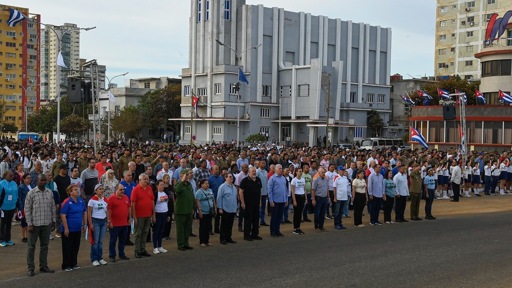
Organizers and members of popular movements across Africa convened on April 12 in a public webinar to reflect on the outcomes of the International Peoples’ Assembly (IPA) solidarity mission to Cuba and Venezuela, from March 9-15, 2026. The session featured Fred M’membe, leader of the Socialist Party of Zambia, who participated in the delegation and offered a first-hand account of the situation in the countries besieged by the US.
The discussion began from a shared understanding that, for over six decades, Cuba has endured a sustained and criminal economic blockade imposed by the United States, one that has had far-reaching consequences across key sectors of life, including healthcare, energy, transport, and agriculture. The effects of these sanctions have been profound, contributing to shortages in medical supplies, disruptions in energy systems, and constraints in food production and distribution.
As the blockade has been tightened in recent years, especially under US President Donald Trump, organizations across the world, including those in Africa, have been in active solidarity with Cuba. Across the continent, organizations and movements have been engaging Cuban embassies, delivering a continental solidarity letter, and responding to the call issued by Pan-Africanism Today for intensified internationalist action. The presentation by M’membe on his first-hand account on the realities facing the Cuban people under intensified sanctions and economic siege was organized within this context. He also helped to ground ongoing discussions within African movements on how to construct solidarity that is not only principled, but also material and responsive.
Cuban internationalism
Despite the immense challenges facing Cuba, M’membe noted that the Cuban people have steadfastly preserved their dignity, revolutionary values, and deep commitment to humanity. For more than six decades, they have stood in solidarity with others across the world not for reward or recognition, but out of principle. Cuba has given its most precious resource – the lives and labor of its people – in support of struggles in Africa, Latin America, and beyond.
Read more: Humanity owes Cuba: unilateral coercive measures and the politics of punishment
“There are, in my view, no better people on this planet than the Cuban people,” M’membe stated. “Their resilience and love for others, even under immense pressure, command the highest admiration.”
Experience in Cuba
During the five-day visit, the delegation engaged widely, with students, workers, and healthcare professionals, as well as leadership within the revolutionary state, including members of the Communist Party and the Cuban presidency.
These interactions revealed both the strength and strain within Cuban society. The schools and social programs they sustain on a solidarity basis remain open, no school has been closed, and no hospital has shut its doors, despite the severe constraints under which they operate. “In our engagements with doctors and patients, it became evident that while the system continues to function, certain medical procedures cannot be carried out due to the material shortages caused by the United States blockade,” M’membe recounted.
He added, “the way the United States is treating Cuba, you don’t know what kind of world this is. Imagine how many countries in this world have grievances with the United States. If they were able to do to the United States what it is doing to Cuba, what would become of the United States, this is a country that has committed so many atrocities, so many wars on other countries in the history of humanity, yet none of its leaders have been captured by anybody, abducted by anybody, or accused of terrorism. There is no other country that has carried out more atrocities like the United States in Africa and Asia. How many of our leaders have been killed and humiliated by the United States in Latin America, in Africa, and in Asia? What they did to Cuba, Venezuela and Iran, what if it was done to them? This cannot be the basis for humanity.”
M’membe also criticized the way in which international institutions, such as the United Nations, are often subordinated to US interests: Is this the way the world should be governed? Can we achieve peace and prosperity in this way?
He questioned the justice and sustainability of such a system, arguing that it perpetuates instability and undermines sovereignty across the Global South.
“What we want is a world where the dignity of every human being matters, where the dignity and sovereignty of every nation, big or small, are respected. We cannot continue in a system that denies this.”
Cuba’s historic role in Africa
The Zambian socialist leader also highlighted Cuba’s long-standing solidarity with African liberation movements. From military support in anti-colonial struggles to training doctors and engineers, Cuba’s contributions have been both material and ideological.
“Cuban blood has been shed on African soil,” M’membe reminded participants. “Their solidarity was never rhetorical, it was practical.”
This history, he argued, places a responsibility on African People to reciprocate in Cuba’s moment of need.
Read more: Angola’s debt to Cuba is unfinished
A central message of the webinar was the urgent need to repay Cuba’s solidarity to the world, with a concrete way being to provide material support in medicine and basic sanitary items. M’membe emphasized, “they participated in our struggles even when they did not have immense resources. They trained our young doctors; they trained our agricultural experts and many other fields. They cooperated with us in many ways, and they have stood by us at all times. We will never desert the Cuban people. We will never abandon our friends in their time of greatest need. What is required with regard to Cuba today is not just words, it needs to be practical. It needs material support, yes; it needs political support; it needs political solidarity, but much more. The support we received from Cuba was not rhetorical; it was practical. When we needed arms to defend ourselves, Cuba gave us those arms. When we needed other resources, Cuba provided them. When we needed them, they gave even their very lives; they did not hesitate to do so.”
Venezuela and revolutionary continuity
The discussion extended to Venezuela, where questions were posed to M’membe on how the country and the party are holding on, as the revolutionary process continues under intense external pressure, including sanctions and destabilization efforts. M’membe described the situation as a form of economic warfare, but reiterated that the revolution remains resilient.
“Revolutions are not events, they are processes,” he noted.
He emphasized that they are responding dynamically to the challenges they face. The type of war that has been unleashed on Venezuela is not something they could have prepared for. It involves advanced forms of technology, and there is hardly any country in the Global South that could easily cope with such conditions. The situation in Venezuela is therefore complex, and as the blockade and pressure continue, the country remains under constant strain.
However, he maintained that Venezuela will continue to struggle under those conditions and ultimately prevail. It is, as he put it, a question of living to fight another day.
In closing, M’membe directed a message to young people across Africa, urging them to remain politically conscious, educate themselves on what is happening around the world, a better world does not come on its own, we have to struggle for it and be responsive to injustice and have hope for a better future.
The post Cuban solidarity with Africa was “never rhetorical, it was practical” appeared first on Peoples Dispatch.
From Peoples Dispatch via This RSS Feed.