

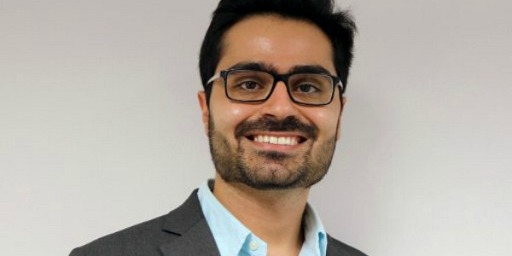
Janine Jackson interviewed the Center for International Policy’s Sina Toossi about the US/Israeli war on Iran for the April 10, 2026, episode of CounterSpin*. This is a lightly edited transcript.*
https://media.blubrry.com/counterspin/content.blubrry.com/counterspin/CounterSpin260410Toossi.mp3
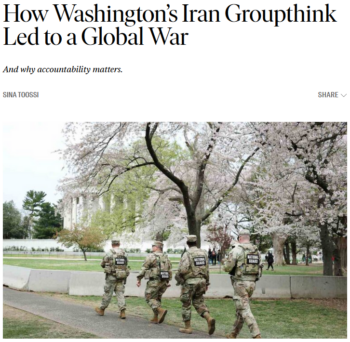
The Nation (4/2/26)
Janine Jackson: Crass and belligerent from day one, Donald Trump still manages to turn corners that surprise you. The reckless violence inflicted on Iran, the tweets threatening to end a civilization, to bomb power plants and bridges, seem like the senseless actions of a power-drunk tyrant. But as our guest has written, that Iran is the target is not just the result of Trump or Hegseth or Kushner throwing darts at a map. It grows from decades of distorted and misleading storytelling about Iran, reflected in US policy.
Sina Toossi writes about Iran and US/Iran relations. He’s a senior nonresident fellow at the Center for International Policy. He joins us now by phone. Welcome back to CounterSpin, Sina Toossi.
Sina Toossi: Thank you for having me.
JJ: If you look at the pundits on television, for example, you will find a sort of consensus that there were miscalculations, and that the war on Iran might be unfortunate—but the Iranian “regime” has to go. So the war has to go on.
Yet recent polls show at least 28% of Americans saying they don’t want war on Iran, but those people aren’t really reflected in media’s conversation. It’s very frustrating, but this disconnect on Iran, as on other issues, this disconnect between a substantial amount of the public and the experts we see isn’t new, is it?

Sina Toossi: “Iran is a country that, on a bipartisan basis, has been a bogeyman for America for many decades now, and has been demonized across the mainstream media.”
ST: It is not. And most of the polls I’ve seen show a much higher percentage of Americans actually who have been opposed to this war, between 50 to 60%, and some polls have seen even upwards of 70%.
But regardless, yes, Iran is a country that, on a bipartisan basis, has been a bogeyman for America for many decades now, and has been demonized across the mainstream media for a long time. And not to say that the government there or the regime there is a good government, and they’ve had hostility towards the US as well, since the 1979 revolution. But US and Iran relations, at many points, had prospects to improve, for them to come out of this hostility that they’ve been in. Trump really put the two countries on a path to war in 2018, when he left the negotiated deal that Obama struck in 2015 over the nuclear program.
And we’re in this situation now where, yes, there’s many hawkish voices across the spectrum who’ve been advocating for this conflict, but it’s really become an undeniable strategic quagmire for the US, and for any rational interpretation of American national security interests or national interests, just in the Middle East, where Iran, you know, the regime has not collapsed. It’s withstood pretty much everything the US and Israel can throw at it, short of a ground invasion, and short of this catastrophic escalation that Trump threatened to destroy all the power plants.
And Iran also hit back throughout the region, hitting US bases, Israel, energy infrastructure and, most importantly, the Strait of Hormuz closure. This war has ended in a ceasefire for now, and there’s new negotiations that are going to start, but they view themselves as in a stronger position than they were before the war.
So it really has been a strategic setback and quagmire for the Trump administration, and even for this bipartisan war party that we’ve had that has really advocated for these interventions in the Middle East for decades now. And this is a culmination of a lot of their efforts and advocacy also reaching a dead end and backfiring.
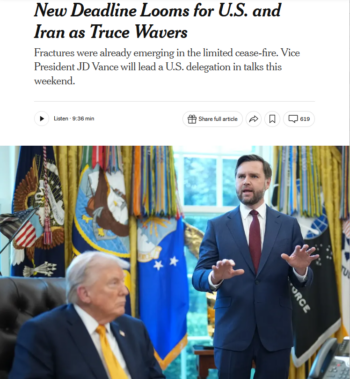
New York Times (4/8/26)
JJ: I should note that we’re recording on April 9, and the New York Times has a front-page piece that leads, “President Trump faces new diplomatic tests as he prepares for weekend talks with Tehran.” And there are doubts about the durability of the ceasefire, it says. I know that it’s just mainstream journalistspeak, but “faces new diplomatic tests” seems like a denatured way to describe a man who’s just threatened to end a civilization.
But the overall story is that there are fractures in the ceasefire agreement. There’s unclarity on what it even says. Iran says Israel’s attacks on Lebanon violate it; the White House says, that’s not even in there.
But at a certain point, we are told that the White House is striking an “optimistic tone.” And I guess I just wonder, at the level of language, at this point, what are we supposed to think “optimism” means for the Trump White House? And why should that imply that anyone else should feel optimism? It’s just hard to respond to these strange, “this is normal” stories that we’re reading.
ST: Absolutely. And Trump has this knack or propensity to twist the reality, and to make it fit with his own political ends. And so he’ll frame anything that he’s doing in this conflict as a great victory, or he destroyed Iran’s navy.
But the fact is that when he launched this war, ambitions were very clearly stated. It was clearly aimed at regime change. We’re getting Iran to surrender and capitulate on its core means of deterrence, like its missile program, its nuclear program, its regional allies. None of that has happened, and the Strait of Hormuz has now, for the first time, given Iran real leverage over the US and the global economy. And now we’re back at these negotiations.
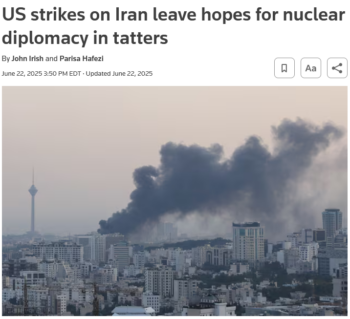
Reuters (6/22/25)
But as you said, there’s this huge gap in trust, where Iran had been negotiating with the Trump administration heading into this war, was negotiating with them heading into the war last summer. Both times they came under surprise attack. Last summer it was Israel that attacked in the middle of those negotiations, this time the US and Israel both attacked. And so there’s zero trust going into these negotiations.
But what there is is just hard power, this kind of hard leverage that each side has over the other one. Like Iran has the Strait of Hormuz, has this ability that it’s withstood everything the US and Israel can throw at it, and it’s still there. And so the US obviously has these very severe economic sanctions that have been on Iran for many years.
So this is the quid pro quo that’s basically on the table, that Iran wants the economic horizon, it wants to come out of this pressure and isolation it’s been under. At the same time, the US wants to get these nuclear concessions out of Iran, wants normalcy to return to the Strait of Hormuz.
So there’s many serious divisions between them, but I think the nature of this conflict has, at least for now, put them on this path to try to see if they can get a deal. But like you said, it’s very difficult to be optimistic, and the ceasefire is proving very fragile.
This is obviously one of the most serious ones right now, where actually the Pakistani mediator, the prime minister of Pakistan who mediated the ceasefire, said himself in his tweets that announced the ceasefire, Lebanon was included.
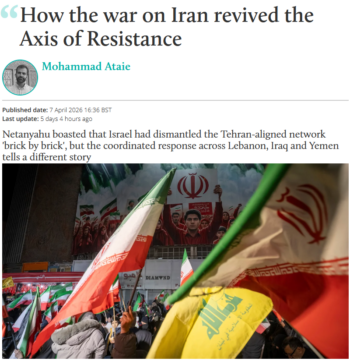
But Israel is trying to sabotage this. They’ve been opposed to this ceasefire, and now they’re launching this massive attack, bombardment of civilian areas in Lebanon yesterday.
The Nation (3/1/26)
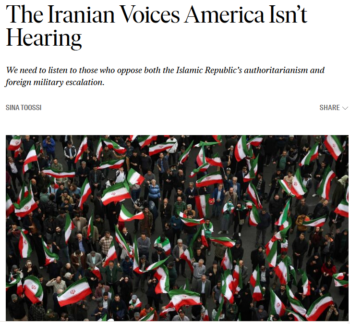
JJ: As we see in other cases, so-called “ordinary Iranians” are talked about a lot in the media, but rarely listened to. And so it’s not hard to see why many folks can be persuaded that a country of 93 million is somehow univocal, or somehow all caught up in a mass delusion of some sort. In March, you wrote a piece for The Nation, “The Iranian Voices America Isn’t Hearing.” Just what or who gets lost when we see Iran painted in such broad strokes?
ST: So the way we tend to view a country like Iran, this demonized other, and this rival adversary of the US that is portrayed in our media and culture, really for many decades now, is as a kind of black-and-white actor. There’s this authoritarian, totalitarian regime, these oppressed people, and the oppressed people want to be liberated and free and welcome US intervention.
That is not at all the reality of the situation. The reality is that there’s been a strong pro-democracy movement in Iran for over a century, that the Iranian people have struggled for more representative governance, and they’ve had ups and downs, various governments that have come and gone. But in the current era, that came to power in 1979, that has been very authoritarian and repressive, and especially in the past 10 years, it’s grown more repressive as the conflict with America has heated up. And we’ve seen these waves of protest and these brutal crackdowns.
But with that said, the opposition movement within Iran, the homegrown domestic, organic opposition that’s grassroots-led, the civil society there, they have a long record of being both against authoritarianism of their own government and pushing for reforms and fundamental political change, as well as [against] foreign intervention.
Middle East Eye (4/7/26)
And so, yeah, in my Nation article, I really tried to highlight these voices. People like Mostafa Tajzadeh, the former deputy interior minister turned outspoken dissident who’s been a political prisoner for over a decade now; various independent labor unions that have a track record of bringing people to the streets, teachers unions, bus worker unions; these are the real civil society groups in Iran that have pushed for change, and they’ve all been emphatic in both opposing the repression and authoritarianism in their country, and this is reflected in all their advocacy, as well as opposing military intervention by foreigners, and viewing war as very unhelpful to the cause of democratic change in Iran.
And so this war has also proven that, that this idea of the thesis that the Iranian people would welcome this, that the regime would collapse, it just needed one more push, that did not happen. If anything, the Islamic Republic rallied its base, its base grew more radicalized. Many other Iranians on top of that base were angry at this war, and major solidarity cut across the political spectrum there.
And, again, it’s not black and white anyway. So, of course, there are people who are so desperate, and hope that this war could lead to something better, but ultimately you saw that Trump and Netanyahu didn’t launch this war caring for the Iranian people. And so they’ve attacked all these civilian targets, everything from universities, to critical infrastructure, to hospitals, to historical sites in Iran have been damaged. And even a synagogue in Tehran the other day that the Israelis acknowledged they bombed, and they said it was a mistake or whatever.
But so this is the reality of war, and unfortunately war cannot lead to democratic change, as many of the advocates of these US interventions in the Middle East have long argued. It has a track record of resulting in much more instability and chaos and suffering for the people of these countries, like Libya, Iraq, Afghanistan, now Iran. And so that’s proven to be the case here, that now we’re in a ceasefire, that government is still there. There’s more hardliners in power. It’s rallied its own social base, and so there’s no democratic change that’s come out of this war.
JJ: All right. I’m going to end on that note for now. We’ll stay in touch.
We’ve been speaking with Sina Toossi from the Center for International Policy. They’re online at InternationalPolicy.org. The articles we’ve been referencing are at TheNation.com. Thank you so much, Sina Toossi, for joining us this week on CounterSpin.
Sina Toossi: Thank you for having me. Appreciate it.
From FAIR via This RSS Feed.