

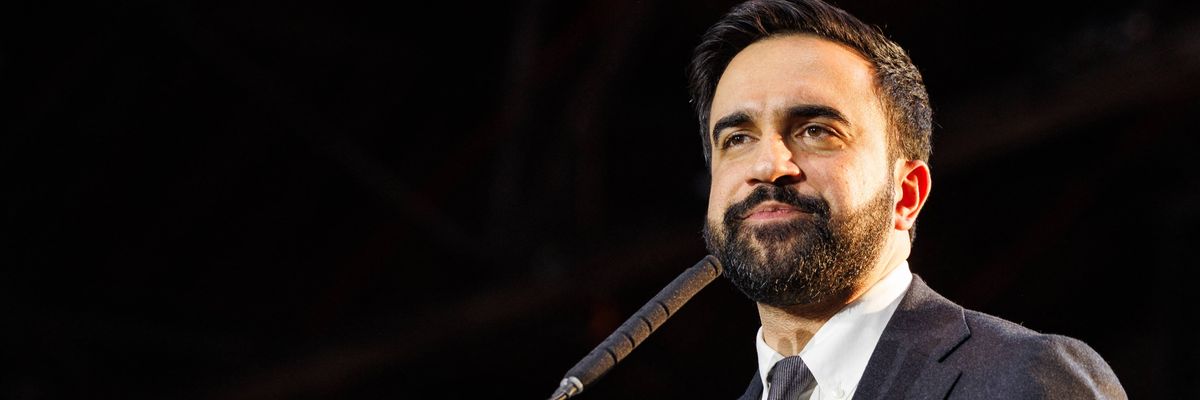
New York City Mayor Zohran Mamdani is using Tax Day to remind Americans that the nation’s tax code is “rigged” to protect the superrich while making the case for a more equitable system.
In a Guardian op-ed co-written with Nobel laureate in economics Joseph Stiglitz and Paris School of Economics professor Gabriel Zucman, New York’s democratic socialist mayor lamented that the world is living with greater wealth inequality than ever before, with just 0.0001% of the global population holding the equivalent of 16% of global wealth—more than the bottom half of humanity.
Mamdani and the economists attributed the global surge in inequality in large part to America’s “regressive” tax system, which has grown dramatically more favorable to the wealthy over the past half-century.
As wealth concentrates, so does power — the power to influence elections, shape policy, tilt markets and define the terms of public debate.Taxing billionaires is not radical.What is radical is allowing a system where extreme wealth exists alongside widespread hardship.
[image or embed]
— Mayor Zohran Kwame Mamdani (@mayor.nyc.gov) April 15, 2026 at 11:05 AM
Compared to 1960, when the 400 richest Americans paid roughly half their incomes in taxes, they now pay about 24%—helped by a combination of lower marginal tax rates and loopholes that allow billionaires and corporations to shield their wealth and effectively pay a smaller share of their incomes than everyone else.
This inequality was further exacerbated by the massive GOP tax law signed by President Donald Trump last year, which a report by Americans for Tax Fairness found gave the wealthiest 1% of households an average tax break of $9,000.
While the Trump administration promised earlier this year that the average American family would receive a $1,000 tax refund from the legislation, Corey Husak, director of tax policy at the Center for American Progress, found that the average refund was just $346 higher than the previous year—and that even that figure was heavily inflated by the benefits accrued by the richest earners.
Meanwhile, those gains were more than wiped out by the added cost of Trump’s tariffs and the dramatic cuts to the social safety net passed by Republicans, which have led to spiking health insurance costs and thrown millions off Supplemental Nutrition Assistance Program (SNAP) benefits.
“We can disagree about how progressive tax systems should be—the extent to which the rich should pay more tax, relative to their income, than the rest of us,” Mamdani, Stiglitz, and Zucman wrote. “But there is no justification for a regressive system in which the superrich contribute less than the rest of us. This is how inequality is deepened and sustained.”
The authors praised efforts in other countries to combat rising inequality. One initiative they highlighted was a 2% tax on the wealth of those with more than €100 million ($117 million), a proposal championed by Zucman. A version of the measure was passed last year by France’s National Assembly but stalled in the Senate after being blocked by centrist and right-wing parties.
But the initiative still has momentum around the world. This weekend, Spanish Prime Minister Pedro Sánchez and Brazilian President Luiz Inácio Lula da Silva will meet with the leaders of several other nations, including Mexico, Colombia, and South Africa, to discuss adopting similar taxes.
Meanwhile, in the US, a proposed ballot initiative for a one-time 5% billionaire tax in California—aimed at recouping losses from Trump’s Medicaid cuts—appears overwhelmingly popular, with around two-thirds support according to a poll last month, despite aggressive lobbying by billionaires to stop the measure.
Mamdani has pushed for a similar measure in New York City to help balance the city budget and fund universal childcare and affordable housing.
On Wednesday, Democratic New York Gov. Kathy Hochul announced that she was backing a so-called “pied-à-terre tax,” which applies a surcharge to anyone with a second home valued over $5 million in New York City. Mamdani’s office has estimated that it will raise $500 million annually.
In early 2026, consumer prices and housing costs have soared far faster than wages can match. A January poll from KFF found that 82% of adults said their overall cost of living had increased over the past year, with around two-thirds saying they worried about affording healthcare for themselves and their families, and nearly a quarter saying they were worried about affording food and rent.
In response to this economic precarity, more than 62% of Americans said in a January YouGov survey that they felt billionaires are taxed too little, and more than half said that wealth inequality is a problem.
“The idea that billionaires should pay higher tax rates than working people is not radical,” the authors of the Guardian op-ed said. “What is radical is allowing a system where extreme wealth exists alongside widespread hardship—and where those billionaires can in effect opt out of contributing to the society that made their success possible.”
From Common Dreams via This RSS Feed.
Tax or execute them. I am ok with either.
Taxing them out of their riches and forcing them to live amongst the rest of us would probably be more than plenty for them to off themselves in droves
thats why schumer and his dino acolytes laid off the political attacks against him, he was drawing to much attention to the uniparty(gop and DINO)
A 99% tax on a billionaire’s net worth (which is not even how income taxes are done) would still leave them with $10 million. That’s more than enough for anyone to give extremely well.
Since the taxes are instead based on their annual income, it would have basically no perceivable effect on them. Other than “line doesn’t go up as steeply”.
I’d go a step further even, I want wealth caps
Nobody has the right to, say, more than 10 million dollars, especially when other people go to bed hungry, still.
After 10 million your tax level goes to 100% and all your income will continue to go to taxes until your worth drops below that level
You could construe violently and systematically exterminating billionaires as a slightly radical method of self-preservation.
But taxing them?? They can fuck all the way off.

