

By World BEYOND War, April 14, 2026
Civil society organizations condemn Carney’s efforts to make Canada’s economy dependent on weapons finance, while Canadians bear the cost of global instability
LINK TO LETTER: worldbeyondwar.org/dsrb-letter
MEDIA CONTACT: Rachel Small, World BEYOND War, rachel@worldbeyondwar.org
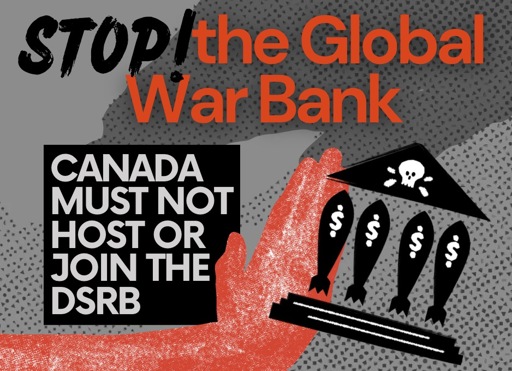
TORONTO, ON – As Canadians face rising grocery bills, soaring gas prices, overstretched healthcare systems and deepening education costs, all intensified by the economic aftershocks of Western military escalation with Iran, a growing list of organizations is launching an open letter rejecting Prime Minister Mark Carney’s push to position Canada at the centre of a new multinational institution dedicated to financing weapons and war.
The letter forcefully opposes Canada’s participation and leadership in the proposed Defence, Security and Resilience Bank (DSRB) and rejects any effort to establish its global headquarters in Toronto. Signatories include a broad array of pro-democracy, labour, legal, environmental and social justice organizations–from the Canadian Centre for Policy Alternatives and the Council of Canadians, to the Canadian Association of Professional Employees (CAPE) and Canadian Federation of Students Ontario, to Greenpeace, Justice For All Canada, and World BEYOND War.
“The last thing Canada needs is a new military financial institution that is designed to fund and accelerate a global arms race and funnel public money directly to weapons manufacturers. It is depraved, it is grotesque, and ordinary people will be the ones forced to pay for it,” said Rachel Small, Canada lead for World BEYOND War. “Today, organizations across sectors are coming together to reject Canada’s commitment to profiteering from perpetual war in the guise of economic development. We reject the DSRB war bank. Not in Toronto, not in Canada, not on this planet.”
Prime Minister Carney has been jockeying for Canada to play a leadership role in the new international war bank, with Toronto poised to host the global headquarters. A few weeks ago, at the end of March, Canada hosted the first of a set of negotiations to launch the bank with 18 countries in attendance. Prime Minister Carney has also been lobbying G7 countries to join the bank. Germany and the UK have thus far rejected participation. The proposed war bank promises to provide a steady flow of public and private funds to weapons manufacturers to facilitate a rapid expansion of military production.
Civil society groups warn that the DSRB would take needed public funds away from communities and redirect them to a permanent pipeline for weapons production, locking Canada into a war economy. “At this moment of deep economic strain, the prime minister has a choice about the kind of economy Canada wants to invest in: He can choose an economy rooted in care—one that ensures people have what they need, strengthens public systems and protects the natural world—or he can choose to anchor our future in militarization, war financing and the profits of arms manufacturers,” says Sheila Sampath, Head of Nature and Biodiversity at Greenpeace Canada. “The proposed Defence, Security and Resilience Bank makes that choice stark. In advancing the DSRB, he is making a clear bet on a war-fuelled future and laying the groundwork to embed war production at the centre of our economy.”
“As students continue to be intentionally priced out of postsecondary education, it is appalling to witness this government and many postsecondary institutions welcome the presence of a Defence, Security and Resilience Bank headquartered in so-called Canada”, said Cyrielle Ngeleka, Chairperson, Canadian Federation of Students-Ontario. “The intentional erosion of public education has left working class people facing increased precarity — this government must prioritize public services, not economic gain through militarization. Students across the province continue to make their demands abundantly clear: warmongering and weapons production have no place in our public education system.”
Another key concern is the anti-democratic nature of the institution. Opponents argue that the DSRB would be able to sidestep regulations and democratic oversight, and that it would be a way to bypass public pressure and divestment campaigns. DSRB leadership has pitched the bank as a solution to what it calls the “challenge” of the Canadian public preferring government spending on healthcare, education and public infrastructure over military spending. While the financial sector might see public interests as a challenge to bypass, politicians are elected to represent the interests of their constituents and serve the public good.
“Once you start handing public funds to arms dealers, they turn around and use part of it to advocate for wars and military escalation,” says Dru Oja Jay, Executive Director of the Council of Canadians. “It’s one of the fastest ways to override the will of the people and hand the keys to profit-hungry billionaires—and that’s before we even talk about the devastation that wars cause.”
“According to the multinational corporations and banks behind the DSRB, such as JP Morgan, governments like Canada spend too much on healthcare and education, and the DSRB will work to avoid this by subverting the parliamentary budget process. They are telling us plainly: democracy is an obstacle to their profits,” notes Manden Murphy of the Toronto Association for Peace and Solidarity. “Under the cover of phoney Canadian sovereignty and lies about job creation, this War Bank will result in a wealth transfer of billions of dollars from working people to multinational arms corporations and banks, while locking Canada into escalating violence and permanent war footing.”
The post MEDIA RELEASE: As Canadians Struggle with Rising Cost of Living, Civil Society Organizations Denounce Canada’s Plans to Lead New DSRB “War Bank” appeared first on World BEYOND War.
From World BEYOND War via This RSS Feed.