

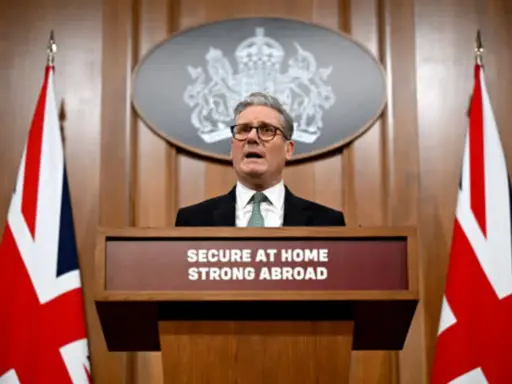

Keir Starmer has written some drivel about the future of UK security post-Iran. Published in the No. 1 paper of imperialist liberals, the Guardian, Starmer’s essay named some of the crises of recent years. Yet despite his article’s warlike undertones, various hawkish pro-war figures have slammed him since.
Why?
Well at the heart of this is a debate on war spending which has a familiar dynamic: it’s a row between members of the British establishment about how cutting welfare is justified to wage war. Starmer, who embodies middle class managerial politics, complained about middle class managerial politics in his 9 April article [emphases added]:
Britain has been buffeted by crises for nearly two decades now. And from the 2008 financial crash, through austerity, to Brexit, Covid, the Ukraine war and Liz Truss, the response from Westminster has always been the same. Manage the crisis, find a sticking plaster and then desperately try to reassert the status quo.
He added:
The war in Iran must now become a line in the sand, because how we emerge from this crisis will define all of us for a generation. And instead of hoping to return to the world of 2008, we will forge a new path for Britain – one that strengthens our energy, our defence and our economic security in a new age.
He was clearly teeing up his big plan to militarise the UK, which the legacy media duly picking up on 10 April 2026.
Starmer missing the basics
Several things stand out here. Firstly, Labour’s disastrous War on Terror interventions are missing from Starmer’s assessment. Secondly, it sounds like Starmer is teeing up a rejection of the status quo he represents. He then proceeds to accept the status quo more or less entirely under that favorite professional managerial class/NGO PowerPoint buzzword: resilience.
He said:
That’s why resilience has been at the heart of my government’s approach – our approach to the conflict in Iran, yes, but also our approach to preserving the national interest at home.
Needless to say ‘resilience’ is not an answer to the issues he has outlined. Focusing on building resilience is to accept that the problems of today are unchangeable. They are certainly not. And, in any event, the essay has done nothing to stave off criticism from his own party, former generals, and others.
‘Malnourished’ navy
Former British army general Richard Barrons was quick to put the boot in, saying that US defence secretary Pete Hegseth has been right to mock the Royal Navy recently:
Hegseth had said on 31 March:
Last time I checked, there was supposed to be a big, bad Royal Navy that could be prepared to do things like [clear the strait of Hormuz] as well.
Clearly Hegseth was smarting from the total failure of the US to beat Iran in it’s ridiculous war of choice. Nevertheless, Barrons said:
Like many others I hung my head in sorrow. But I couldn’t argue with him because although the Royal Navy and the Royal Air Force and the army are, in their bones, outstanding institutions, they are simply too small and too undernourished to deal with the world that we we now live in. And the review says this.
Interestingly, Barrons recently told an audience at the establishment thinktank Chatham House that increased US belligerence would now be the pattern in world affairs:
We’ve been wondering for a while what sort of world we were now living in because we understood we were not in the comfortable world of the post-cold war era and what we used to call the rules-based international order.
This US government, he added, would “do what it thinks it can” on the basis that it has “the power to do it”.
And there really aren’t too many other complications around that.
Former NATO chief
An ex-Labour defence minister and NATO boss is also taking a swipe at Starmer’s war spending habits – or lack of them. Lord George Robertson is said that Starmer is:
not willing to make the necessary investment.
And where, according to Robertson, should the money come from? You guessed it:
We cannot defend Britain with an ever-expanding welfare budget.
The BBC said Robertson pronounced:
There is a corrosive complacency today in Britain’s political leadership. Lip service is paid to the risks, the threats, the bright red signals of danger – but even a promised national conversation about defence can’t be started.
He also accused “non-military experts in the Treasury” of “vandalism”. Which sounds like a pitch for more military control of the economy.
The BBC reported:
Lord Robertson’s apparent suggestion that the government could find money by reducing the welfare bill may be one that is shared by the Chancellor Rachel Reeves.
Barron, Robertson and Dr Fiona Hill – a British-born former advisor to US presidents – whose comments are doing the rounds today were the joint authors of Starmer’s 2025 Strategic Defence Review (SDR).
There’s no doubt that the world is a dangerous place today. That is primarily because of the increasing belligerence of a fading US empire and its allies. But those problems are not impossible to solve. It will just take a bit more imagination than corporate waffle about ‘resilience’. And, this argument is one within the British establishment. It is about how – and to what degree – workers can be made to pay for war and military projects. And it should be seen as such.
Featured image via the Canary
By Joe Glenton
From Canary via This RSS Feed.