


Dan Ninham
Special to ICT
When the home team finally arrives on the basketball court, cheers erupt from even the opposing fans.
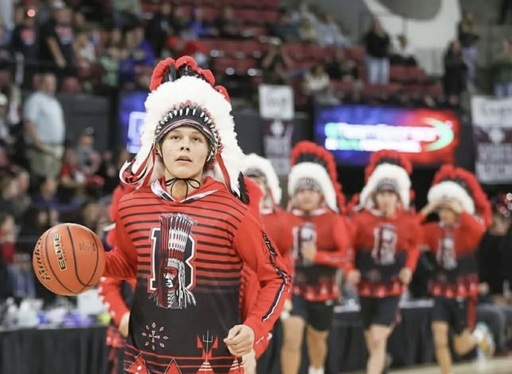
Running single-file around the gym before beginning their layup routine, the Browning High School Indians wear the headdresses of their ancestors, the warriors of the Northern Plains, as they prepare for the game ahead.
The headdresses are part of a pre-game ritual that is more about the competition than the ceremonial or battle purposes of the old days, but they nonetheless stir the players and the crowds.

The logo for Browning High School shows the straight-up War Bonnet.
Credit: Photo courtesy of Browning High School
“The fans are excited to observe a first-hand cultural and historical expression by the headdress-wearing basketball players,“ Browning Principal Sandi Campbell, a Gros Ventre citizen and Blackfeet descendent, told ICT.
“The community cheers louder, stands longer and is more pumped from the beginning of the game,” Campbell said. “The phones are out, there’s laughing, smiling and pride from all. Visiting teams are amazed and want to capture it. The energy and pride is indescribable…
“When the headdresses come out, the gym is always lit and energized.”
Browning, based on the Blackfeet Indian Reservation in Montana, is not the only school that adds Native culture to its sports. The nearby Heart Butte High School Warriors, also on Blackfeet territory, wear straight-up War Bonnets in their game preparations, and other Native schools incorporate headdresses into their sports teams.
Browning does not limit them to the basketball court. Headdresses also appear on the wrestling mats, and the boys’ cross country team wore them when they were photographed with their state champion trophy. Traditional headwear and clothing is also worn during special occasions during the school year.
“The headdress is a part of our culture as Plains Natives,” Browning Athletics Director Kellen Hall, Blackfeet/Cree, told ICT. “Having a headdress was a sign of leadership, and it meant you had certain societal rights. For warriors, it was a sign of coup stories you earned.”
“Runners wear War Bonnets in warm-ups. Wrestlers wear them during grand march at state. Girls wear head bands.”
‘Modern-day warriors’
The Northern Plains warriors’ broader cultural identity connected ritual to ceremonies, and the traditional headwear connected with face and body paint and leather clothing.
“We have transitioned this right into our modern-day warrior with our sports athletes,” Hall told ICT. “Our late great chief, Earl Old Person, gave our athletes the right to wear these bonnets in battle or the playing field/court.”
Sports fans who view the cultural practice of wearing traditional regalia in the athletic arena are encouraged to understand the significance of the tradition.

The Poplar High School Indians boys basketball team wear War Bonnets at the 2024 Montana state basketball tournament. It was the first time in 20 years they’d worn the headdresses.
Credit: Photo courtesy of Randy Perez
“This ritual connects our community as it brings pride to our heritage as Umskapipikunni people,” Hall said. “A ritual that has us striving for excellence, doing so with poise, and making our responsibilities collective, are exactly what we want from our youth. These qualities are a great example of what our rights as a tribe bring.”
“This is what I believe our identity is when we are able to be ourselves,” he said.
Campbell, the Browning principal who was born and raised in Birch Creek on the south side of the Blackfeet reservation, said the tradition builds support in the community.
“It’s about representing themselves and the school with pride,” Campbell said. “The little kids can’t wait to get to the high school so they can get the chance to also represent our school and community.”
Holding to traditions
Heart Butte High School is about 28 miles southeast of Browning High School, a smaller school in Heart Butte, Montana.
The straight-up War Bonnet worn by its athletes can also be found on the front of the warm-up shirts of the Browning boys’ basketball team, Hall said.
“This is our traditional headdress,” he said.

The Heart Butte High School basketball team in Montana wears straight-up War Bonnets before games and during special events.
Credit: Photo courtesy of Alden Spoonhunter
Cultural appropriation doesn’t apply in the Northern Plains territory to the headdresses worn by the young men and women in the athletic arenas. Non-indigenous teams and schools are not allowed to copy the cultural practice in their athletic programs.
“I hope this tradition of our War Bonnets help the state of Montana understand that we are the history of Montana,” Hall said. “We are still here and we are still practicing our ways. These protocols and orders of our societies have been around since time immemorial and our oral stories tell us so.”
“I hope our community recognizes that we are resilient through our ways, and teaches our youth we have a destination through the devastation as we move forward in life with American society,” he said.
The ritual has an impact on players and fans alike.
“When our athletes wear our War Bonnets the atmosphere is electric and you can feel all of us gleaming with pride,” Hall said. “Elders, mothers, fathers, aunties, uncles, cousins, athletes, all sharing a moment that signifies togetherness. A feeling so impactful you can’t wait to witness or do it again.”

Actress Lily Gladstone of the Blackfeet Nation wears a standup headdress that she received during a ceremony in her honor in Browning, Montana, on March 26, 2024. Credit: Photo Hunter D’Antuono via Flathead Beacon
The straight-up headdresses were unique to the Blackfeet, although other tribal people also had them. According to Hall, the Blackfeet have a women’s straight up War Bonnet Society, and a girl wrestler for Browning High recently wore a headdress in the team photo in pre-competition.
“She’s one of the best wrestlers in the state and she took it upon herself to make a statement,” Hall said.
Another statement was made when the Blackfeet Nation tribal elders honored actress Lily Gladstone with a stand-up headdress a few years ago. Gladstone was the first Indigenous person to win a Golden Globe award for best actress and she also received an Oscar nomination for her acclaimed role in the film, “Killers of the Flower Moon.”
The Poplar High School Indians boys basketball team wore War Bonnets at the 2024 Montana state basketball tournament. It was the first time they’d been worn for 20 years.
“I didn’t know about War Bonnets until game time,” photographer Randy Perez, Assiniboine Tribe of Fort Belknap Indian Reservation, told ICT. “Apparently a War Bonnet was worn by a relative 20 years before.”
Community impact
The Wyoming Indian High School Chiefs in Ethete, Wyoming, on the Wind River Reservation, also incorporate headdresses into sports.
“We use our school headdress mostly for celebrating our student’s athletic and academic accomplishments,” said Craig Ferris, Northern Arapaho/Northern Cheyenne, head coach for the boy’s basketball team who also works in the school district as a home school coordinator.
“It was to show how proud and grateful we are of our students and athletes and their efforts,” Ferris said. “We also like to show and give our youth and future generations something to strive for.”

Adriano Brown, Northern Arapaho and Navajo, leads off the Wyoming Indian High School cross country team on his horse.
Credit: Photo courtesy of Randy Tucker
Ferris has been head boys’ basketball coach at the high school for 21 seasons and has won seven state championships.
“It brings a sense of pride and community to our youth while keeping us connected to our history and a way to honor our culture and ancestors,” Ferris said. “We hope that our youth will want to continue to work hard and make it their own personal goal to reach those types of accomplishments and efforts. With our opposing teams we hope to show our pride and how important our youth is to our community.”
In a first-round game in early March, the Wyoming Indian girls basketball team defeated Shoshone 50-35. This was a milestone of milestones for Head Coach Aleta Moss, a Northern Cheyenne citizen. It was career win number 719 for Moss,who has had a 38-year head coaching career. Win number 719 was the new Wyoming coaching record for all-time wins.
The Lady Chiefs don’t wear traditional headwear, but they do wear sublimated geometric printed warm-up uniforms.
“Sometimes our boys’ teams will wear headdresses for special occasions like winning state championships,” Moss told ICT. “We also have a horseback rider who leads our [cross-country] meets with a headdress on.”
Adriano Brown, Northern Arapaho and Navajo, is the mascot for Wyoming Indian High School.
“It started when the school reached out to me to ride and lead the cross country riders out,” Brown told ICT. “They wanted someone to portray the ‘chief’ …and the school wanted to bring our culture into our sports in any way they could.”
He continued, “My job is to lead the cross country runners before every race. I usually start by getting ready and taking my horse down to the cross-country track. I warm him up and get him used to all the action so he’s not so jumpy when it’s time to start the events.”
He appreciates the impact it has on the community.
“Doing what I do shows that we at my school are proud of our Native American heritage,” Brown said. “We hope to enlighten non-Native people about who we are. I would want the fans to understand that even though it’s not really a tradition, it still is really important to show who we are whenever we have the opportunity to, and to keep it going.”
The post ‘When the headdresses come out, the gym is always lit and energized’ appeared first on ICT.
From ICT via This RSS Feed.