

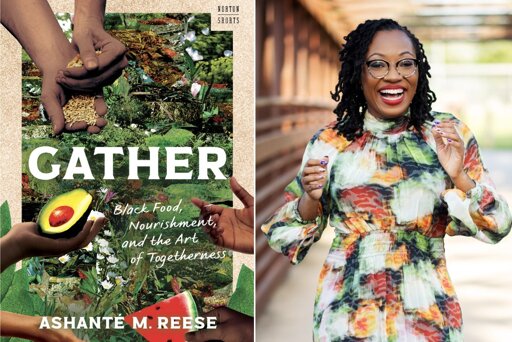
The following is an excerpt from Gather: Black Food, Nourishment, and the Art of Togetherness. Copyright © 2026 by Ashanté M. Reese, who is also a Civil Eats advisory board member. Used with permission of the publisher, W. W. Norton & Company, Inc. All rights reserved.
If you’re anything like me, ideas about nourishment and phrases like “food justice” weren’t a part of your vocabulary growing up. Even with the early experiences in my grandmother’s kitchen that taught me about the role of food in building and sustaining community, I rarely thought about food as something political. This changed after seeing the urgent, immediate inequalities I saw when I moved away from my small town in east Texas.
My first concrete lessons in food inequity came from eleven- and twelve-year-olds. When I finished my undergraduate degree, I moved to Atlanta to teach at Coretta Scott King Young Women’s Leadership Academy, a predominantly Black single-gender public school that was founded the year I joined the teaching staff. Most of our students came from neighborhoods that had some of the highest poverty and crime rates in the city. They also experienced some of the highest rates of food insecurity, and had the least access to fresh, healthy food—a trend that persists, according to a 2023 study conducted by Megan Winkler and her colleagues at Emory University’s Rollins School of Public Health.
“Gathered around a table on a random school night, we mused about what it means to be healthy, to feel confident and nourished, to feel included in society.”
On one occasion, I took a few students to a grocery store and then served them dinner at my home. While we sat at the dining room table together, they changed the whole trajectory of my life by simply pointing out that the food they had access to in their neighborhood was significantly inferior to what I had in my neighborhood less than five miles away.
Those students asked a number of questions: Why does your neighborhood have the nice grocery stores? Why do you have so many more kinds of fruits and vegetables than we do? They also had critiques: It’s like they don’t care if we have options? and How are we supposed to eat healthy if everything around us is unhealthy? Gathered around a table on a random school night, we mused about what it means to be healthy, to feel confident and nourished, to feel included in society.
Their questions became my questions, and their critiques were guideposts for my own curiosity when I returned to graduate school to study anthropology. I became obsessed with learning how cities work, and how macro-level forces shape the everyday realities of people like my students and their families. I took an internship at the Johns Hopkins Center for Health Disparities Solutions to understand the relationship between residential segregation and health outcomes, and I sought mentorship from sociologists who were experts in urban design and inequities. I learned that my students’ observations were not an anomaly.
Predominantly Black urban neighborhoods in the U.S., regardless of income, have fewer food resources than their white counterparts. As I’d learn, this lack of provisioning has major impacts on long-term health. Sometimes referred to as obesogenic environments, neighborhoods with less access to fresh produce and grocery stores, or that lack sidewalks and green space, are risk factors for obesity, diabetes, and hypertension. When people have easier access to fast-food chains and liquor stores than grocery stores or farmers markets, that impacts the decisions people make about what they’ll eat.
“Neighborhoods with less access to fresh produce and grocery stores, or that lack sidewalks and green space, are risk factors for obesity, diabetes, and hypertension.”
For example, my middle school students in Atlanta could walk to a corner store with burglar bars on the window or a fast-food restaurant in the same amount of time it would take me to reach my choice of four grocery stores. Relatedly, many of their parents worked long hours and weekends, making time a factor in how and when they shopped for groceries. In contrast, while I was in graduate school, I supported myself by babysitting for wealthy families in the Washington, D.C. area. After school, there was one place that these kids always wanted to go: McDonald’s. There was one place that parents almost always said it was okay for me to take them: McDonald’s. These kids, mostly wealthy and mostly white, were never the poster children of the childhood obesity epidemic. They weren’t the imagined victims of the fast-food industry. They, unlike the students I taught in Atlanta, were just kids with choices.
What I learned from these experiences was that there wasn’t anything inherently different about the kind of choices kids would make if given the opportunity. The main difference was the range of choices they had. For my students, that landscape was limited. The experiences of my students directly challenged the myth that poor people and people of color are more inclined toward unhealthy foods. Instead, the structures that shaped their world—the facts that healthy grocery stores were further away, their parents often worked overtime at low-wage jobs, and fast food was the least expensive option—funneled them toward foods that weren’t the healthiest options.
To convey that these problems are structural and not caused by individual choices, activists and scholars use the term “food apartheid,” which they define as the system of racialized inequality in food access. The idea of food apartheid forces us to zoom out and consider how many systems are deliberately built to work against certain consumers based on race and geography.
Karen Washington, longtime food justice activist and cofounder of Black Urban Growers (BUGs), plainly stated that food apartheid “looks at the whole system, along with race, geography, faith, and economics. You say ‘food apartheid’ and you get to the root cause of some of the problems around the food system. It brings in hunger and poverty. It brings us to the more important question: What are some of the social inequities that you see, and what are you doing to erase some of the injustices?” This question is at the heart of the food justice movement, a movement that aims to expose inequalities that shape our food world and to work toward equity.
“The idea of food apartheid forces us to zoom out and consider how many systems are deliberately built to work against certain consumers based on race and geography.”
Food justice has received a lot of attention and support over the past twenty-five years, though its origins are arguably much older. Some point to the Black Panther Party’s Free Breakfast for Children program and Fannie Lou Hamer’s Freedom Farms Collective in Sunflower County, Mississippi, in the 1960s as early experiments that formed a foundation for the food justice movement. In Food Justice, the first full-length book about the subject, published in 2010, Robert Gottlieb, cofounder of the Urban and Environmental Policy Institute at Occidental College, and Anupama Joshi, cofounder of the National Farm to School Network, characterized food justice as “ensuring that the benefits and risks of where, what, and how food is grown and produced, transported and distributed, and accessed and eaten are shared fairly.”
Inherent in their definition is a sense of shared fate—a counter to a version of food consumption that overemphasizes individual choice. Gottlieb and Joshi helped us understand that a justice orientation toward food requires us to shift the benefits and risks such that the blessings and burdens are more equitably shared. Many organizations and researchers have built on this approach, with most diagnosing the problems in the food system as stemming from the prioritization of profits over people’s wellbeing while also providing direct aid and access to impacted communities.
For over fifteen years, I’ve witnessed this work in real time. In D.C., the Green Scheme established gardens at housing projects so that residents could build self-sufficiency. When money was low, one of the residents would pick whatever was left in the garden to make a huge pot of soup to share with others. In Atlanta, a group of Black farmers founded the Southwest Atlanta Growers Cooperative (SWAG), to provide more produce in southwest Atlanta. All over the country, I’ve encountered individuals and organizations who haven’t waited for food environments to change on their own. Instead, they’ve set out to change things themselves.
What was once a grassroots movement rooted in principles that emphasized growing community control over food systems is now firmly mainstream, with thousands of organizations across the country. Mainstream means more people listening, more people paying attention to the problem, more opportunities to address the inequalities we so desperately want to eradicate. But there’s also a risk for cooptation, with the most radical components of the movement being sidelined either because of pragmatism (prioritizing the work that can get funded) or discomfort. For the early architects, food was always political and thus, so too was food justice—a direct affront to unfair systems.
“There’s also a risk that those who are creating visions for what they believe food justice is do so without relationships with or input from the communities they want to serve.”
But as the movement has grown, what is considered justice in regard to food is increasingly nebulous. Sometimes, the urgency of providing healthy food eclipses the equally important need to build new infrastructures such that one day, food inequalities will no longer exist. That is a huge, daunting task that won’t happen overnight. But we can’t lose sight of it even as we meet the needs of communities who require immediate support.
There’s also a risk that those who are creating visions for what they believe food justice is do so without relationships with or input from the communities they want to serve. This disconnect might prioritize “healthy food” while wholly missing the mark on the reality that justice is a collaborative effort that must include vision and leadership from the communities being served. As food justice has firmly taken its place in the mainstream, “food” and “justice” aren’t always in alignment. In fact, sometimes they’re at odds. Radical dreams also cost a lot of money and require a lot of effort. But what if the challenges we face are invitations to redefine where and how we seek value?
In almost every class I teach, I tell students that part of what we’re experiencing in an unjust food system is a crisis of scale. Our current, corporatized food system prioritizes increasing size and reach, consolidation, monopolization, and standardization not only across the country but across the world. The industrialized food system has grown too big and requires inequality to sustain itself. The challenge with scaling up is that the bigger the scale at which something operates, the harder it is to infuse it with values that everyday people espouse and the harder it is to make it accountable for the lives it touches. On the other side of the equation, the further away something is from people’s bodies and lived experiences, the harder it is for them to imagine that they can have any impact on it. The produce in our grocery basket is often grown across the world, picked by people we’ll never meet in places we’ll never go, and the problems of hunger and access seem unimaginably vast. Even if we wanted to change those systems, where would we start?
Thinking at a large scale can feel overwhelming. Luckily for us, that isn’t the only register at which we can find inspiration or practice our values. Our everyday lives present unlimited opportunities to construct justice and liberation in our food system and otherwise. No matter the size of the action, the point is that liberation doesn’t just happen. We have to work toward it in everything we do. If nothing else, that is what I hope you learn from the people and gatherings in this book. The values we practice and the rituals we build in our everyday lives hold keys to how to transform our food system. People like my grandmother understood the power of togetherness. We must take the lessons they offer us more seriously.
***
Gather is an effort to bring those early lessons in nourishment that I gleaned from my grandmother and home community together with everything I’ve learned about food justice over the past fifteen years. Where can we look for fresh inspiration as we continue to imagine a liberated food system and liberated lives? What would it look like if we espouse a more expansive definition of nourishment? What would we have to let go of? What would we need to cling to? Without government funding and programs that place justice at the center, can we still build the (food) worlds we want to see? These are some of the questions I grapple with daily.
The answers aren’t neat or easy, but I think we’re closer to them than we think. One of the core arguments of this book is that everyday ways people get together to meet the physical and social needs of others comprise a masterclass for how to hone the values that are less quantifiable. Who better to learn from than the experts themselves—everyday people who put nourishment into practice as a way of life.
It is imperative that we put nourishment at the center of food justice movements. We can take inspiration from organizations like the National Black Food and Justice Alliance (NBFJA), which is leading some of the most exciting, expansive work right now, ranging from offering direct support to Black farmers to establishing centers for the study and practice of Afroecology at historically Black colleges and universities (HBCUs). Each year, they celebrate this work with an annual gathering, an event that nourishes everyone to continue the arduous work of building better infrastructures.
“It is imperative that we put nourishment at the center of food justice movements.”
We must also take inspiration from everyday people like those featured in this book. It is a loving calling in, an invitation for us to reconsider what we are fighting for, how we’re fighting for those things, and how those people’s knowledge and ways of being are embedded in our visions for the future. I’m not saying our food justice movements have failed. I’m saying we’re at an impasse, and we’ve got to look beyond the echo chambers that currently define what is important and what is at stake.
I turn toward Black gatherings to reframe our understanding of what is possible in the food world, by looking at what is already happening when Black people gather around food. It is an attempt to write about a belief I hold deeply, a belief that has held me deeply: there is no inherent deficit in Black people. In fact, if we look closely enough, if we are curious enough, much of the magic and creativity that happens when Black people gather can be transformative not only for us but for the entire world. Gather starts from the premise that death, destruction, and denial are not the only ways to index Black life. By looking at the spaces where Black people gather, we can also witness the beauty of Black aliveness—in all its goodness, contradictions, love, and capaciousness.
Visit Blackgathering.netto listen to the interviews recorded for Gather and to see photos and videos of the gatherings featured in the book.
The post Excerpt: ‘Gather: Black Food, Nourishment, and the Art of Togetherness’ appeared first on Civil Eats.
From Civil Eats via This RSS Feed.