

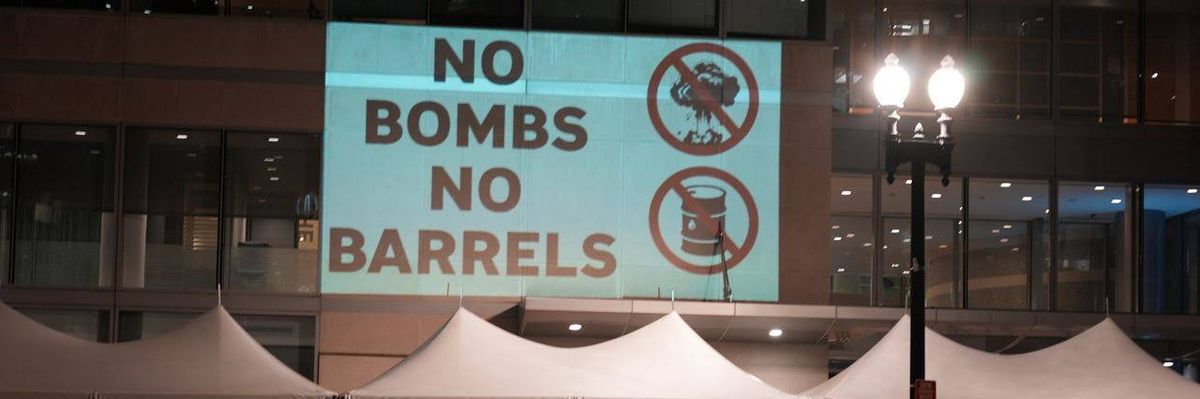
As the Spring Meetings of the International Monetary Fund and World Bank Group were held in Washington, DC during a two-week ceasefire between the United States, Israel, and Iran, over 130 civil society groups this week urged global governments to “secure a permanent end to the wars in South West Asia and break the chains of fossil fuel dependence.”
The joint statement was coordinated by Fight Inequality Alliance and 350.org, which has been advocating for a windfall profits tax on oil and gas giants since the US and Israel launched their illegal war on Iran in late February, and the Iranian government responded by restricting traffic through the Strait of Hormuz, which sent fossil fuel prices soaring worldwide.
“While people struggle to afford food, fuel, and basic necessities, fossil fuel companies are profiting massively from the chaos. The IMF itself has warned of the risk of a global recession,” said 350.org managing director Savio Carvalho in a statement.
“Governments gathering in Washington have a clear responsibility: End this illegal war, stop the flow of destruction, and make the profiteers pay,” Carvalho argued. “Taxing windfall oil and gas profits could provide immediate relief to families and invest in the clean, affordable energy systems we urgently need. They profit, we pay. It’s time to fix it now: no bombs, no barrels.”
A permanent end to the war—which has killed people across the region—is the first demand of the open letter. The second is a windfall profits tax on fossil fuel giants, with the revenue being used “to guarantee public services, and provide immediate support to families and precarious workers hit hardest by soaring food and fuel prices.”
Martha Tukahirwa, Fight Inequality Alliance’s Africa coordinator, explained that “while thousands are killed in the war in Iran, millions of people across Africa are being crushed by soaring fuel prices that have made even the simplest meal unaffordable. In Nigeria, diesel has surged over 60%. In Malawi, the poorest households are forced to choose between cooking and eating.”
“In Zimbabwe, the cost of public transport has soared, making it impossible for working people to earn a living,” Tukahirwa continued. “This is no accident—fossil fuel companies and commodity traders are reaping massive profits from this crisis while our governments stand idle. Tax these obscene profits and redirect the money to shield our people from hunger and hardship. The time for half measures is over, the time for bold action is now.”
The letter’s third demand is to “make food and energy secure for all.” The war has impacted the availability of not only fuel but also fertilizer. The coalition called on governments to “invest public money in sustainable local farming and homegrown renewable energy, and stop harmful handouts to weapons, fossil fuels, and fossil fertilizer.”
The groups—which also include ActionAid International, Corporate Europe Observatory, Council of Canadians, Friends of the Earth International, GreenFaith, Greenpeace Japan, Make Polluters Pay, Oxfam in the Pacific, War on Want, and more—called for urgently rolling out “renewable energy solutions for farms, homes, schools, and clinics to protect them from this and future energy crises.”
Rev. Fletcher Harper, executive director of GreenFaith, said that “our faiths call us to make peace with people and the planet alike, and to hold the powerful to account. Letting fossil fuel giants pocket windfalls while families struggle is a moral failure. Taxing windfall profits to provide energy relief is not radical. It is basic justice.”
The fourth and final demand is to cancel debt payments for Global South countries, and agree to fairer debt rules. The coalition stressed that “after paying interest to Wall Street lenders, bankers, and rich governments, many Global South countries have no money left over to protect their people from this crisis.”
As part of the debt demand, the coalition also urged governments to “support informal workers, farm laborers, women, and older people, and guarantee universal access to healthcare, education, and public transport.”
David Archer, head of programs and Influencing at ActionAid, pointed to civil society’s push for a United Nations treaty for restructuring sovereign debt.
“Billions of people across the Global South are living in countries already facing a debt crisis. This war will make their lives even harder, leading to rising prices and rising interest rates,” Archer said. “We need urgent action to cancel debt and to take the power over debt away from the IMF and rich countries—through developing a UN Framework Convention on Sovereign Debt.”
From Common Dreams via This RSS Feed.