

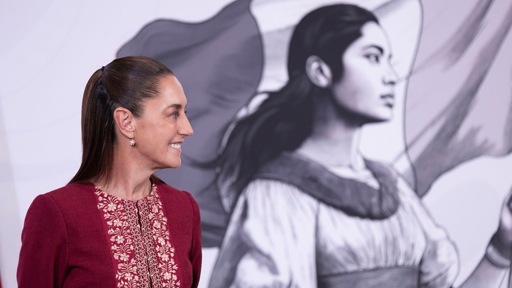
Last week, Mexican President Claudia Sheinbaum announced the creation of a universal health system for the entire country. During her morning press conference on April 7, Sheinbaum emphasized the importance of ensuring that all Mexicans can receive care regardless of their insurance status or even if they are uninsured.
“Today we are announcing something very significant: A Presidential Decree will be issued in the coming days – today or tomorrow – establishing the Universal Health Service in Mexico. The goal is that, when we leave office, any Mexican man or woman will be able to seek treatment for any condition at any healthcare facility and be received,” said the Mexican president.
She added that the shared database will be used for implementation, marking the start of the process to issue credentials to all Mexicans; the process (which will include an app for electronic devices) will begin with people over the age of 85: “What is the advantage of this? It streamlines the system… This is a historic step we are taking, moving toward Universal Health Care.”
The timeline presented by Sheinbaum outlines that by January 1, 2027, the exchange of services between institutions should begin, with these institutions offering the following medical services: “1. Universal emergency care and continuity of hospitalization; 2. Care for high-risk pregnancies and emergency deliveries; 3. Implementation of the Heart Attack Protocol with cardiac catheterization services; 4. Implementation of the Stroke Protocol for cerebrovascular events; 5. Universal access to care and diagnosis for breast cancer; 6. Continuity of care for conditions such as kidney failure, cancer, and transplants; 7. Vaccinations; 8. Primary care consultations for prevention and acute conditions with prescription of medications.”
The exchange of specialized medical services will begin in the second half of 2027. By 2028, the Mexican government plans to implement universal coverage for prescriptions, outpatient specialty care, and referral-based hospitalization.
Specifically, the goal of the Universal Health System is to unify various health services provided by the Mexican government in a centralized manner. In this way, the Mexican Social Security Institute (IMSS), the Institute for Social Security and Services for State Workers (ISSSTE), and the Health Service of the Social Security Institute for Welfare (IMSS-Bienestar) – the three main institutions that form the foundation of the federal government’s services – will work in a coordinated manner.
“If in a state there is sufficient equipment in one institution but a shortage in another, what we seek is to share them to avoid overcrowding and improve care,” said the Mexican president regarding the rationale for unifying the various federal health institutions.
Read more: 400,000 in Mexico City’s Zócalo celebrate one year of Claudia Sheinbaum’s government
The project had already been initially planned during the administration of Andrés Manuel López Obrador (2018–2024), Sheinbaum’s predecessor and political ally. Now the monumental task of registering more than 120 million Mexicans – regardless of the institution with which they are affiliated – must begin, followed by the process of digitization and information sharing among the various institutions.
In this way, the progressive governments of the National Regeneration Movement (MORENA) party continue to build a federal state that actively addresses basic medical, educational, and other needs, while other governments in the region, adhering to neoliberal doctrine and the guidelines of the International Monetary Fund, are committed to diminishing the role of the state and reducing its responsibilities, including those related to health, education, and housing.
The post Mexico moves toward a universal health system appeared first on Peoples Dispatch.
From Peoples Dispatch via This RSS Feed.
You must log in or # to comment.