

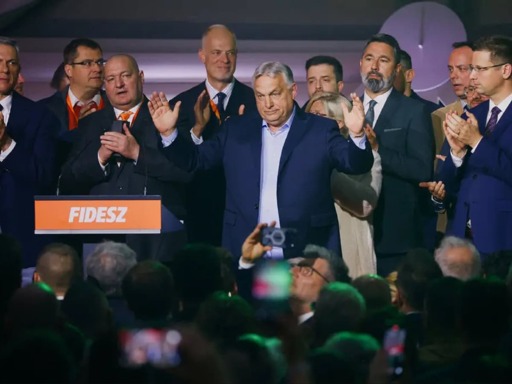

Last night, 12 April, Hungarians voted to to oust far-right prime minister Viktor Orbán. Orbán, at the head of the Fidesz Party, has maintained a stranglehold on the central European country for over 16 years.
In his place, an apparent two-thirds majority of voters backed Péter Magyar of the Tisza Party. Magyar was formerly a Fidesz insider and an ally of Orbán. However, the victorious challenger broke from Fidesz to join Tisza in a shock turn in 2024.
Whilst Orbán was an authoritarian tyrant, Magyar’s victory isn’t exactly an unmixed victory for the left across Europe – his politics are still right-wing; the point of comparison is simply more outright in its extremism.
Orbán was also a close ally of Trump, Putin, Netanyahu and their respective regimes. His fall from power could signal a turning point for both Hungary and the EU – especially given that Magyar has campaigned on a closer relationship with his country’s neighbors.
Putin, war and peace
Hungary’s last election took place in 2022 – just weeks after Russia began its full-scale invasion of Ukraine. At the time, Orbán weaponised remarks from the opposition stating that Hungary could deploy troops in support of Ukraine.
Framing the election as a choice between war with Russia and continued peace, Orbán secured a comfortable two-thirds majority. However, according to Policy Solutions polling, the number of Hungarians who fear their country joining the war against Russia has halved over the last few years.
Magyar told a BBCinterviewer in Budapest of his fracturing from Fidesz:
After a while, I became more and more critical, openly and just among friends. I can tell you that the Fidesz we see today is very, very different from the one I joined in 2002.
I was always told by the politicians it’s necessary to keep power – I accepted it for a time. But of course, the turning point was in 2024.
When Magyar took over Tisza just weeks ahead of the 2024 European Parliament elections, the party was virtually defunct. However, campaigning against corruption within Fidesz, Tisza secured 29.6% of the vote, and seven seats in the EU Parliament.
Whilst this was a sign of Magyar’s potential, it was still well behind Fidesz on 44.8%.
The Orbán-Putin alliance
Since then, Magyar has hammered Orbán’s close ties to Putin in his campaigning. Fidesz has regularly vetoed both loans to Kyiv and sanctions on Moscow in the European Parliament. For example, he blocked a €90bn loan to Ukraine from the EU just last month.
Earlier this month, Bloomberg published a transcript of a call between Orbán and Putin on 17 October, in which the former called his country a ‘mouse’ waiting to help the ‘lion’ of Russia. Orbán reportedly told the Russian dictator that:
Yesterday our friendship rose to such a high level that I can help in any way. In any matter where I can be of assistance, I am at your service.
Worse still, Hungarian foreign ministerPéter Szijjártó – also of Fidesz – has recently been accused of updating Russian allies on confidential EU meetings. Polish PM Donald Tusk stated:
The news that Orbán’s people inform Moscow about EU council meetings in every detail shouldn’t come as a surprise to anyone. We’ve had our suspicions about that for a long time.
‘This would amount to treason’
At the time, Magyar said of Szijjártó that:
If confirmed, this would amount to treason, which carries a potential life sentence. A future Tisza government will immediately investigate the matter.
As such, it’s unsurprising that Ukrainian PM Volodymyr Zelensky has welcomed Magyar’s ‘resounding victory’ in yesterday’s elections as a success for the ‘constructive approach’. Likewise, Ukraine’s foreign minister Andrii Sybiha hailed the opportunity for a ‘new chapter’ in Budapest-Kyiv relations.
However, whilst Zelensky celebrates, Magyar’s attitude can probably be better described as ‘not pro-Russian’, rather than actively pro-Ukrainian.
Russian oil
Take, for example, Magyar’s attitude to Russian oil. Whilst most EU states slashed their usage of Russia’s fossil fuels following the war on Ukraine, Slovakia and Hungary maintained their supplies. This, of course, drew criticism for helping to fund the assault on Ukraine.
Whilst Magyar has criticised Orbán’s failure to diversify Hungary’s energy mix, he’s stopped far short of a statement that he’d drop Russian oil altogether – let alone send troops into Ukraine. Rather, Magyar described his attitude towards Moscow as ‘pragmatic’:
Pragmatism means that we have no say in Russia’s internal affairs, and they don’t have any say in our affairs. We are both sovereign countries, and we respect each other, but we don’t have to like each other.
The new Hungarian leader has advocated to create infrastructure to bring in fuel from a range of sources. However, he added that:
this does not mean that we must stop using Russian oil tomorrow. It means that the European Union’s resources must be used well.
As such, whilst Magyar’s victory – and, more pertinently, Orbán’s defeat – has shaken Hungary’s status as Russia’s closest ally within the EU, it would be incautious to declare this a direct victory for Ukraine and Zelensky.
However, Tisza’s triumph does mark a turning point for EU-Budapest relations. It also shows that even countries that have long been held by far-right autocrats are susceptible to change. That message will likely be an unwelcome one for the likes of Orbán’s allies – whether Putin, Trump or Netanyahu.
The Canarywill have more coverage on the potential impacts of the Hungarian election over the coming week, as the story unfolds.
From Canary via This RSS Feed.