


The true measure of any society can be found in how it treats its most vulnerable members.
This phrase is often attributed to Mahatma Gandhi in various forms, and has long endured regardless of its exact origins.
Thinkers from John Stuart Mill to philosophers of ancient Greece have expressed similar convictions. Even a decade ago, the United Kingdom’s ambassador to the United Nations, Sir Matthew Rycroft, used remarkably similar language.
Today, however, we find ourselves in a period marked by an increasingly unapologetic ruling elite, whose priorities rarely align with those of the people who entrusted them with power.
Exploiting fear and uncertainty
Between 2008 and 2013, the world experienced the most profound crisis of global capitalism since the Great Depression of the 1930s. As in earlier eras of turmoil, far-right populists seized upon this instability to advance their ideological agenda.
When people feel overwhelmed or fearful, their capacity for rational decision-making weakens. Psychology teaches us that we experience uncertainty and unpredictability as stressful. In such states, fear becomes a guiding force. This makes societies susceptible to simplistic promises, just as they were in the 1930s and 1940s, when charismatic ideologues offered simple solutions to complex problems.
Many of us experienced this stress response over the weekend, given the USA’s and Israel’s actions in Iran. The world is much less certain, and significantly less predictable, than it has been in a long time. To add to the stress response, today’s signalling by the Starmer government that the USA may use our bases overseas in their illegal war against Iran demonstrates, clear as day, that we (and the rest of Europe) are but a US vassal state. We also lack control over our very own destiny.
A familiar class war
At the same time, the public has been confronted with troubling reminders of how political power was wielded during the financial crisis – a pattern that hasn’t changed much today either.
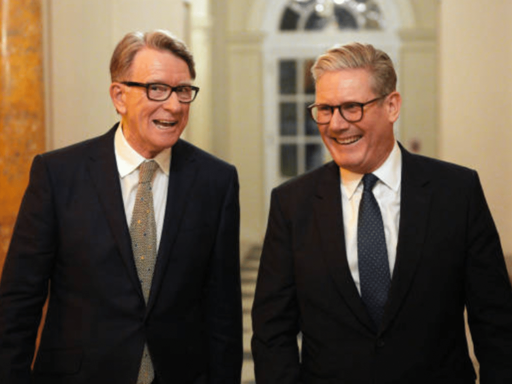
The former British business secretary during the crash, Peter Mandelson, is said to have shared highly confidential and sensitive information at a time when the country was on its knees financially. These reports describe scenarios in which privileged access to state knowledge facilitated trading and speculation by members of the billionaire class.
Many people remember the period as one of mass unemployment, collapsing pensions, home repossessions, and severe psychological strain. Some even took their own lives under the pressure. Against that backdrop, revelations suggesting that a senior political figure may have circulated insider information have understandably intensified public anger.
Mandelson has expressed regret in various interviews, but the question remains whether he is truly remorseful or simply concerned that these matters have resurfaced. And where does this leave Keir Starmer, who was borne of the same political circle? Is he genuinely troubled by the implications, or merely worried that the public is now paying attention? Today we are all distracted by Starmer dragging us into Israel and the USA’s war on Iran, without a mandate. But the stench of Mandelson remains.
One standard for them, another for us
Recent releases of documents related to Jeffrey Epstein have further eroded public trust.
What once would have been dismissed as fringe conspiracy theory has now entered the realm of documented allegations. It is unsettling to see correspondence and photographs suggesting proximity between political leaders and a man publicly accused of orchestrating one of the most widespread trafficking operations of recent history.
In the United Kingdom, revelations about figures associated with the New Labour era have only deepened this sense of disillusionment. When elected officials appear entangled in networks that benefit the already wealthy, it becomes difficult for the public to believe that they are being served with honesty or integrity. Expressions of regret ring hollow. What matters is not whether individual politicians claim ignorance; it is whether their actions align with the principles they profess to uphold, and whether they care about the electorate and even international law.
Starmer and Farage in billionaires’ pockets
Keir Starmer presents himself as a leader intent on restoring public trust. Instead, many view him as the inheritor of a project that distanced the Labour Party from the ideals of Keir Hardie, Clement Attlee, and Nye Bevan.
When Jeremy Corbyn briefly revived the party’s traditional socialist identity, it sparked a struggle for its direction. For critics on the left, Starmer’s rise represented the reassertion of a right-of-centre faction determined to reshape Labour into a party comfortable with corporate interests and foreign policy positions that mirror those of powerful allies. The purge of left-wing leadership candidates and the adoption of policies perceived as hostile to protest and civil liberties have strengthened the belief that the party has abandoned its roots.
This disconnection has created fertile ground for figures like Nigel Farage, who presents himself as the voice of the ordinary worker. Many, exhausted by established politics, find his direct style appealing, even though he has himself been mentioned in the Epstein files in various controversial contexts.
Farage offers a simple story, and for those who feel overlooked and betrayed, simplicity can be seductive. Yet his proposed solutions aim at the vulnerable rather than the powerful. Farage and his cabal care little for the plight of the working class beyond how they can manipulate the narrative to serve their own interests.
Class warfare in full view
The working class has endured repeated blows.
The economic crash of 2008 transferred wealth upward. The COVID-19 pandemic, though managed with necessary lockdowns to protect public health, resulted in another enormous shift of wealth from ordinary people to large corporations. Government spending preserved economic systems, but the benefits of that spending flowed disproportionately to powerful companies rather than the people who continued to work through fear and hardship.
Today, living costs have soared, wages have stagnated, and labour rights in several countries have been eroded. Greece and Argentina now enforce working days of 12-to-13 hours – a stark indicator of how far conditions have deteriorated. Across Europe, many people find themselves worse off than they were two decades ago.
This is a form of class warfare carried out in full view.
At the same time, the public is saturated with images of suffering, corruption, and injustice, so relentlessly that many become numb. This desensitisation allows compromised governments to push through authoritarian legislation with limited resistance. Even established media organisations now face pressure from wealthy individuals who demand total compliance. As traditional media weakens, social platforms serve as engines of propaganda where misinformation thrives. The spirit of Joseph Goebbels lives on in digital echo chambers that promote division, racialised narratives, and distrust, often through automated content designed to provoke and polarise.
No accountability
Meanwhile, those responsible for economic suffering escape scrutiny. Wealthy offenders are treated as aberrations, while desperate people crossing seas are treated as existential threats. It is easier for many to accept a narrative that blames outsiders than to confront a reality in which the greatest harm has been inflicted from above rather than below.
But what happens when the scapegoats disappear?
What happens when Muslims do not impose religious rule, when migrants do not destroy national identity, and when the promised cultural collapse never arrives? What happens when the law of the jungle replaces international law and leaders of sovereign nations are kidnapped, assassinated, and eliminated in the interests of global capital, with no change in material or living conditions for any of us?
When the public realises that their living standards continue to fall despite these groups being marginalised or exterminated, the truth becomes impossible to ignore.
Repeating the past
History shows that societies which crush the many for the benefit of the few eventually face reckoning. Pre-revolutionary France and the final years of the Russian Empire offer clear examples.
After the Second World War, Europe enjoyed decades of relative stability because working people were given opportunities, social protections, and a genuine stake in society. That world no longer exists. We now inhabit an age shaped by the legacy of Margaret Thatcher, who famously declared that society does not exist. Her successors have built a world where the individual must fend for themselves, where empathy is discouraged, and where suffering is compartmentalised and normalised.
Most of us can still go home at night, close the door, and sleep comfortably. But this comfort may be temporary. Dwight Eisenhower famously proclaimed that the only place of total security is a prison. Freedom requires a willingness to face uncertainty, yet we seem increasingly willing to trade that freedom away. As the slice of the pie offered to ordinary people continues to shrink, the question becomes not only how small it can get, but how long we will we continue to accept it from within these growing prison walls.
From Canary via This RSS Feed.