

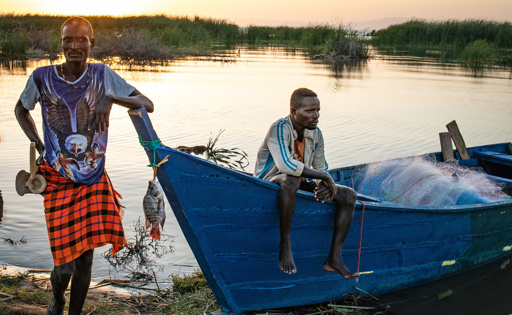
KOMOTE, Kenya — At sunrise on Komote Island, 36-year-old James Lekubo walks his two children down a rocky hillside to the water’s edge, where they clamber into a small fishing boat with a couple of dozen others to journey across a stretch of lake that didn’t exist a few years ago. On the other side lie their school and the nearest clinic — services that were previously within walking distance. Lekubo is a member of the El Molo, Kenya’s smallest and most marginalized ethnic group, who have lived here along the stark eastern shores of Lake Turkana for centuries. But in more recent years, the world’s largest desert lake has begun to turn against them, threatening not only their traditional livelihood but the very fabric of their cultural identity. According to a 2021 report by Kenya’s environment ministry, over the preceding decade, Turkana’s water levels rose by several meters, expanding the lake’s total surface area by around 10%, largely due to heavier rainfall in the Ethiopian highlands that feed it via the Omo River. Since then, the lake has continued to grow, submerging up to 1,000 square kilometers (about 390 square miles) of the surrounding landscape — an area half the size of London — including roads, grazing land, ancient burial sites, and even entire villages. Primary school children getting off the boat that now ferries them to school. Image by Christopher Clark for Mongabay. Lekubo watched helplessly as Komote was gradually cut off from the mainland. “Most people left…This article was originally published on Mongabay
From Conservation news via This RSS Feed.