

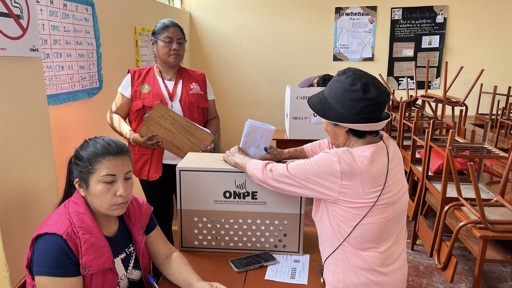
Elections were held in Peru on April 12. The country’s chronic political crisis (eight presidents have occupied the presidential office in 10 years) has given the election some very peculiar characteristics. Upon arriving at the polling stations, Peruvians were faced with a huge number of ballots, where they not only had to choose their future members of congress (who will be divided into two chambers) and Andean parliamentarians, but also had to choose among 35 presidential candidates, a record number.
Just as political analysts had warned, the large number of presidential candidates led to such high fragmentation of the vote that any candidate leading in the polls could advance to the runoff with less than 20% of the vote. Furthermore, it was suspected that it would take several days to determine which two candidates would compete for the Peruvian presidency.
Both predictions have come true. Peru’s National Office of Electoral Processes (ONPE), the institution in charge of the elections, continues to update the data coming into its headquarters. As of 3:47 pm (Lima time), and with 55.9% of the ballots counted, the two front runners who will advance to the runoff are right-wing Keiko Fujimori of Fuerza Popular (FP), who is projected to receive 16.9% of the vote, and Rafael López Aliaga of Renovación Popular (RP), who currently has 14.55% of the vote. Close behind, with 12.81% of the votes, is Jorge Nieto Montesinos of the Partido del Buen Gobierno (PBG).
Nearly 27 million Peruvians were eligible to cast their votes. In Peru, voting is mandatory for people between the ages of 18 and 70. More than 1 million votes come from overseas constituencies. The final amount of participation is still being determined.
The potential runoff candidates
Keiko Fujimori is the daughter of the dictator Alberto Fujimori (in office from 1990–2000), and has advanced her political career in the shadow of her father’s political legacy. For a significant segment of Peruvian society, he was the man who ended the civil war in Peru; to his critics, however, he was an authoritarian leader who implemented a drastic and devastating neoliberal program (known as the “Fujishock”) and was also guilty of corruption and extensive human rights violations.
The controversial figure of Fujimori has caused his surname to become a polarizing factor in Peruvian society, which, evidently, allows Fujimorism to maintain a loyal electorate. Keiko, for her part, has built a significant political career: since 1994, she accompanied her father at official events as First Lady, which gave her enormous visibility from a very young age. In addition, she has been a presidential candidate on three occasions (2011, 2016, and 2021) and advanced to the runoff in all of them (though she always lost due to the enormous resistance the Fujimori surname provokes), insisting on the need to accelerate neoliberalism in Peru and take a hard line against crime. After learning Sunday’s results, Keiko Fujimori said: “We receive the results with gratitude and deep humility, but also with great responsibility.”
If this trend continues, Fujimori will face her fourth runoff election, this time against the former mayor of Lima (2023–2025), Rafael López Aliaga, alias “Porky”, an ultra-conservative politician who is a member of Opus Dei. Some have called him “the Peruvian Bolsonaro” due to his ideological proximity to politicians such as Argentine President Javier Milei, Chilean José Antonio Kast, and former Brazilian President Jair Bolsonaro himself, with whom López Aliaga signed the Madrid Charter, a commitment by the radical right in Spain and Latin America.
The ultra-conservative candidate has promoted his image as a businessman with several major companies, although several of his critics have accused him of allegedly committing money laundering, which has been investigated by Peru’s Public Prosecutor’s Office. He has declared himself opposed to the legalization of abortion, euthanasia, same-sex marriage, and same-sex adoption. What he does advocate for is the death penalty and the implementation of a more radical form of neoliberalism in the South Pacific country.
However, López Aleaga cannot yet be certain that he will advance to the runoff. He is closely followed by Jorge Nieto Montesinos, a Peruvian sociologist and politician who served as minister of culture under the right-wing government of Pedro Pablo Kuczynski, for whom he later served as minister of defense.
Nieto Montesinos drew the attention of many anti-Fujimori activists when he resigned from his post at the ministry after Kuczynski granted a pardon to Alberto Fujimori, despite being the nephew of the former dictator’s convicted advisor, Vladimiro Montesinos Torres. Nieto’s detractors, however, accuse him of allegedly receiving illegal funds from Odebrecht, the Brazilian construction company, a matter that has been investigated by the Peruvian Prosecutor’s Office.
Irregularities in the voting process
Most candidates have harshly criticized Peru’s electoral authority. Election Day was marred by several irregularities. Thousands of people were unable to vote due to various circumstances: a lack of distribution of election materials, delays in setting up polling stations, and difficulties accessing the polling stations.
This forced authorities to extend the closure of polling stations by several hours for 60,000 voters in Lima, the capital. ONPE President Piero Corvetto apologized to Peruvians for the difficulties caused, which he said were due to the company Servicios Generales Galaga. In light of these events, candidate López Aleaga has called for Corvetto’s resignation.
The widespread dispersion of the vote has also made it very difficult to know for certain how Peru’s legislative branch will be structured. For now, it appears that the biggest beneficiaries will be the parties of the three candidates who are leading the others in the presidential race. This implies that the legislative majority will lean to the right, although the intense rivalry between these political and economic groups could create a situation of instability similar to that experienced in recent years, in which every president faces a high risk of being impeached by a parliament that is always on the lookout.
The post Peruvian elections: Right-wing candidates to face off in the runoff appeared first on Peoples Dispatch.
From Peoples Dispatch via This RSS Feed.