

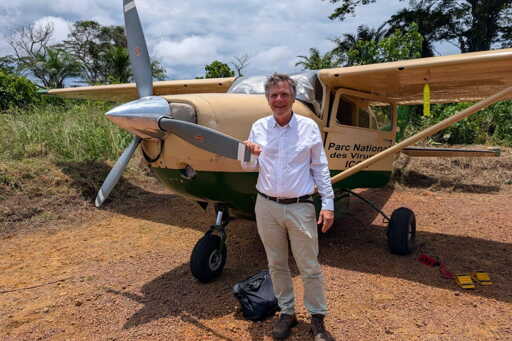
In eastern Democratic Republic of the Congo, discussion of conservation often centers on loss: forests cleared, wildlife depleted, conflict spreading across landscapes that once supported some of the richest ecosystems on Earth. At Virunga National Park, those pressures are concentrated. The park, Africa’s oldest, contains glaciers, volcanoes, forests, and wetlands within a single protected area. It also sits within a region shaped by decades of instability, where armed groups, informal economies, and weak governance are part of daily life. Virunga National Park. Image courtesy of Bitini Ndiyanabo Kanane. Emmanuel de Merode, who has led Virunga since 2008, does not begin with ecology. His training is in anthropology, and that shapes how he describes the park. The condition of wildlife, he suggests, follows from deeper forces. Forest loss, poaching, and insecurity are not simply environmental problems. They emerge from how people earn a living, how authority functions, and how money and resources circulate. In eastern Congo, conservation cannot be separated from the economy. For many communities around Virunga, the choices are immediate. Clearing forest for agriculture or producing charcoal can generate income that supports a household. The benefits of conservation are harder to see and often accrue far beyond the region. The imbalance shows up in daily decisions about fuel, food, and access to land. As de Merode describes it, the system asks some of the poorest populations to bear the cost of protecting assets valued globally. The pressure on the park is reinforced by conflict. Since the mid-1990s, eastern Congo…This article was originally published on Mongabay
From Conservation news via This RSS Feed.