

By Becca Renk Foster – Apr 10, 2026
Holy Burial
“I don’t like the music,” my daughter whispers to me.
Suddenly, a cymbal crashes, followed by tuba and trombones droning a death dirge. I peer through the incense to make out the slow movement of men burdened by an impossibly heavy bier carrying the image of Christ crucified. It’s Good Friday, and we are watching the Holy Burial in the León Cathedral.
“You’re not supposed to like it,” I tell her. “Jesus is dead, this is his funeral. The music is meant to fill you with dread and sadness.”
In Nicaragua, a small country that has seen much suffering, Holy Week carries a special importance. Centuries of colonization and invasions, 50,000 killed by a cruel dictatorship, another 50,000 killed by U.S. proxy war, and generations of crippling poverty have all left their mark. In this context, commemorating the suffering of Jesus takes on great meaning for Nicaraguans, the majority of whom are Christians.
Although Nicaragua has endured terrible hardship, the country has survived and is even thriving. Today, access to free health care has extended life expectancy, free education has created new opportunities, the economy is growing and the country is at peace. Christ’s resurrection is a powerful symbol of hope, and this resilient country identifies strongly with it.
Perverse Accusations
Perhaps this is why the baseless accusations of religious repression made by U.S. Deputy Secretary of State Christopher Landau have fallen flat here. On 31 March, Landau posted on X:
“[O]nce again this year, the Ortega-Murillo dictatorship is denying Nicaraguans the right to profess their faith in this manner by banning such public processions. Nicaragua has historically hosted some of the most beautiful and famous processions in the region (for example in Granada and Leon) and I look forward to the day when our Nicaraguan friends reclaim their religious freedom.”
In response, the Nicaraguan government issued a statement denouncing Landau’s remarks as part of a politically motivated disinformation campaign encouraging hatred.
“These perverse accusations,” the statement continued, are “accusations that any human being, Nicaraguan or not, can also refute based on the realities of our country and our devoted, believing and faithful people.”
Anyone With Eyes To See
Nicaragua’s religious freedom was, indeed, hard to miss this week. As my family and I traveled around the country, the signs were everywhere.
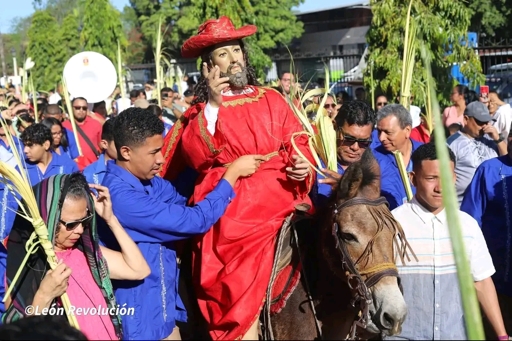
While Protestants held raucous Pentecostal singing sessions, prayer meetings and revivals, Catholics held a procession for every occasion. On Palm Sunday in León, the image of Jesus in a cowboy hat rode atop a real mule; boats carried the faithful on the Aquatic Stations of the Cross in the Isletas of Granada; young men wrapped their heads in cloth for the Procession of Covered Faces in Ometepe; on Maundy Thursday farmers carried offerings of flowers, fruit, and chickens in Masaya and Diriá; and on Friday, parishioners held a graveyard service in Bilwi.
Overall, 4,139 religious activities were celebrated throughout Holy Week with the participation of one million Nicaraguans.
While addressing 150 priests gathered for the Chrism Mass in Managua on Maundy Thursday, Cardinal Leopoldo Brenes commented on turnout among the faithful.
“The people, with complete generosity and freedom, have been able to come to their churches and are living out their faith, which I believe is the most important thing.”
Pharisees
Such plentiful evidence easily disproves Landau’s feeble attempt to discredit the Nicaraguan government with the international Christian community. These attacks are not new: since the failed U.S.-led coup attempt in 2018, frustrated coup mongers have tried to manufacture international outcry by trotting out allegations of religious persecution at regular intervals.
These accusations seem to be based exclusively on the work of one person, Martha Patricia Molina, who in 2022 published a report documenting alleged instances of persecution of the Catholic Church in Nicaragua.
This report, which largely cites Facebook posts and Molina herself as sources, is now re-published annually with a few dozen additional instances of “persecution” added by Molina from her self-exile in Texas. Notably, this report is usually the only “evidence” cited by international media to corroborate allegations of religious repression.
Why is this erroneous document so widely cited? One clue may lie in the fact that in 2024, Molina had the dubious honor of receiving the International Freedom of Religion Award from the U.S. State Department.
“As always, there are Pharisees who serve foreign interests,” reads the Nicaraguan government’s statement, “false ones who have never been true shepherds nor promoted values such as fraternity or the common good, which this complex world so desperately needs.”
Nicaragua Denounces US Accusations Regarding Religious Freedom
Alfombras in Sutiaba
On Good Friday, my family and I spend several hours enjoying one of the supposedly “banned” activities in León, the traditional sawdust paintings. For decades, families have made elaborate “Passion Carpets” on the streets of the Sutiaba barrio in León.
I talk with 48 year-old Edwin Crespín as he works with his extended family on a sawdust image of Christ in the middle of the street.
“I’ve been doing this since I was 14,” Crespín tells me. “I will keep doing it because we cherish our traditions. I make the design and print it, then we color the sawdust using shoe leather dye, and create the image.”
Further up the street, the artist group “From Sutiaba for the World,” takes a different approach: their design uses corn kernels, sorghum, beans, rice and salt to create a moving image of the Passion of Jesus. The young artists enjoying a meal after making their street mosaic explain that their goal is to maintain their way of life and preserve their cultural identity.
Life is Worth Living
On Easter morning, the sun rises behind us, bathing the mango tree in the churchyard in an otherworldly orange light.
“Because He lives, all fear is gone,” the congregants sing, “and life is worth living just because He lives.”
My family and I are at a multi-lingual Easter service – Spanish, Creole English and Miskito – at the Moravian Church in Managua. All around us, we can see signs of resurrection in nature: tiny green leaves begin to bud on the dry trees, migrating birds build nests among them, mangoes begin to form, and storm clouds on the horizon bring the promise of rain.
After the service, the congregants share a communion breakfast of gallo pinto, hot chocolate and traditional fry bread, celebrating life together in the midst of all the difficulties in the world.
Essence of Christianity
Later, we join the St. Paul the Apostle Christian Base Community for the People’s Mass in the barrio 14 de septiembre.
After a Bible reading, three women around the circle stand and read aloud from folded papers.
“To the women of Iran, who walk their own way of the Cross and yet, continue celebrating life.”
“To the women of Gaza, where the earth trembles with pain and even so, life opens a path among the ruins.”
“To the women of Cuba, who keep homes and communities going in the midst of the blockade.”
These international references are nods to the practical solidarity this Community shows throughout the year. At the front of the church, a photo of a Palestinian mother in a keffiyeh cradling her dead son is in the place of a crucifix. The altar groans under donations of medicine and food that the Community has gathered throughout Lent for Cuba.
“We women of this earth, we are not a chapter in the history of empires,” continue the women. “We are the continuity of life that has survived when empires have fallen.”
These women, and indeed the whole country of Nicaragua, are the resurrection, bringing hope to the world.
BRF/OT
From Orinoco Tribune via This RSS Feed.