

Drop Site is a reader-funded, independent news outlet. Without your support, we can’t operate. Please consider becoming a paid subscriber or making a 501©(3) tax-deductible donation today.
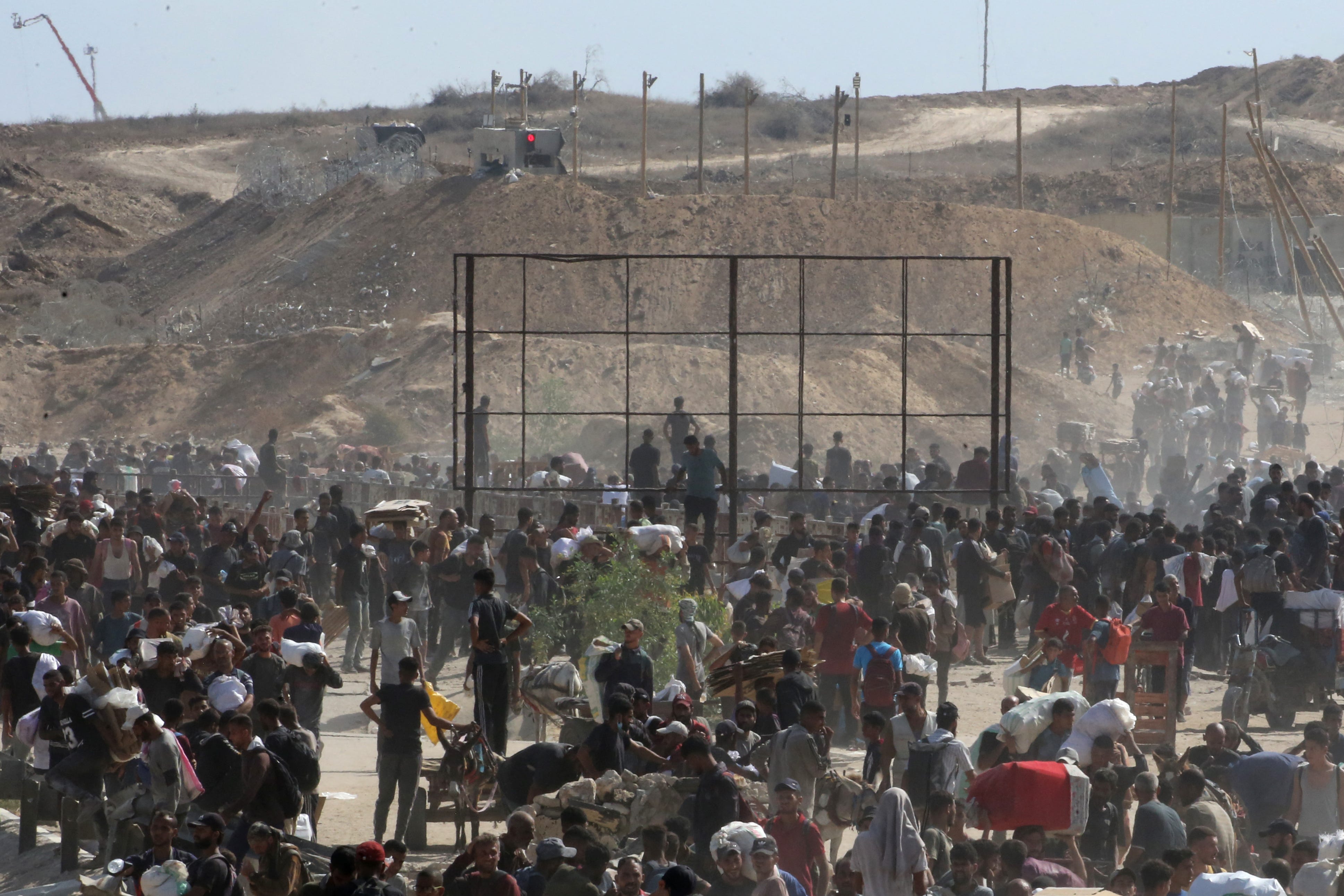
Palestinians gather to receive aid from a GHF aid distribution point at the so-called “Netzarim corridor” in the central Gaza Strip on July 30, 2025. Photo by EYAD BABA/AFP via Getty Images.
On September 25, 2025, David McIntosh filed a report to his bosses at Safe Reach Solutions (SRS) detailing an account of Israeli soldiers gunning down a young Palestinian boy as he was getting food at a site run by the Gaza Humanitarian Foundation (GHF). “There’s no way he survived,” McIntosh told Drop Site News and Middle East Eye in his first interview since returning from Gaza five months ago. “He was murdered. He was straight up murdered.”
At the time, McIntosh was one month into a three month stint working as a contractor with GHF’s logistics partner SRS. Between August and October 2025, he mostly managed Site 4, the only aid site in central Gaza, near the Netzarim corridor. According to McIntosh, Site 4 was more dangerous for aid seekers than its other sites in southern Gaza.
Like thousands of other Palestinians trying to survive an Israeli-imposed starvation campaign on Gaza, the boy—who looked about 12 years old—had come to the site that day looking for food. After he managed to get his hands on an aid parcel, he continued playing atop a sand berm at the site, according to McIntosh.
Members of GHF’s security firm UG Solutions threw a flash bang grenade to warn the boy to leave the area. Minutes later, Israeli snipers shot the boy in the shoulder near his chest. Severely wounded, he struggled to carry himself to a nearby bridge before collapsing.
“He was doing nothing but laughing and joking and they killed him,” McIntosh told Drop Site. “There was no reason they shot him. There is no reason on God’s given earth that they shot that lad.” The boy was left to bleed out for around 30 minutes before a “vehicle came and took him away,” according to the report, which was based on eyewitness accounts of two of his SRS colleagues. The report was part of a daily written briefing he was required to send to his superiors at SRS at the end of every day.
Though the report detailed the likely fatal shooting of a child at a GHF site, McIntosh said he never received a response from SRS and nothing came of it.
McIntosh told Drop Site and MEE that such attacks on Palestinian aid seekers by Israeli soldiers were routine and provided documents and footage to back up his claims. GHF has claimed that the Israeli military has no presence inside its aid sites but the videos McIntosh provided shows the Israeli military positioned in close proximity, demonstrating just how intertwined their operations were.
Video: An Israeli tank stationed close to GHF Site 4 in central Gaza. August 28, 2025. Courtesy: David McIntosh.
The internal documents McIntosh provided also show that higher-ups within SRS were informed about deadly incidents at GHF aid sites and received several complaints about the conduct of Israeli soldiers that risked the lives of their own contractors.
In response to a detailed list of questions, SRS denied any knowledge of Israeli soldiers killing Palestinians at their aid sites but did acknowledge receiving formal complaints of concerns about the IDF’s conduct.
“SRS is not aware of any fatalities caused by Israel Defense Forces (IDF) personnel within GHF sites, as IDF personnel were not permitted access to those locations,” the company said in an emailed statement. “However, during the course of its work, SRS staff escalated any external conduct by IDF personnel that they considered inconsistent with the humanitarian nature of the mission, including through formal complaints where appropriate.”
“If anyone started to move…they would be shot”
On March 2, 2025, Israel abandoned a ceasefire agreement it had signed in January and reimposed a full spectrum siege on Gaza, blocking any food, fuel, medical supplies, or other life essentials from entering the territory. At the end of May, GHF—backed by the U.S. and Israeli governments—was brought in to restart aid distribution. GHF coordinated closely with the Israeli military and deployed security contractors from two U.S. companies.
Between May and October 2025, over 2,600 Palestinians were killed and more than 19,000 wounded at or near the distribution sites and UN convoys, according to Gaza’s Health Ministry. Israeli soldiers were accused in the majority of the shootings, though security contractors also fired on Palestinians at the aid sites, according to the Associated Press, CBS News and other outlets.
The Israeli military has long denied that the attacks on Palestinian aid seekers were the result of deliberate targeting. In statement after statement, the Israeli military has denied killing aid seekers, claiming instead they fired “warning shots” in their attempts at crowd control. GHF has likewise claimed the killings happened outside their aid sites.
Accounts by Palestinian eyewitnesses have long contradicted these claims. Only one security contractor apart from McIntosh has spoken out on the record previously—Anthony Aguilar, a retired Special Forces officer who worked as a security contractor with UG Solutions. Aguilar said he witnessed security contractors firing on crowds.
McIntosh served as a Royal marines commando in the British armed forces. After leaving the army, he worked as a security consultant in the private sector. McIntosh said the opportunity to work with SRS first came from a friend who was working with them in Gaza.
When he arrived in Gaza, McIntosh said he saw Israeli soldiers regularly and indiscriminately fire on unarmed Palestinians seeking aid, use stray dogs for target practice, and fire dangerously close to or directly at the GHF contractors themselves.
Often, Palestinians—mostly men and boys—would gather underneath a bridge located near Site 4 at around 10 p.m., waiting in a dry riverbed until morning when the site would open. Food parcels were set out in huge-plastic wrapped pallets for thousands of starving Palestinians to rip open and grab themselves.
Video: Palestinian aid seekers scramble to get food at GHF Site 4 in central Gaza. September 3, 2025. Courtesy: David McIntosh.
When Israeli soldiers stationed close to the site began their shift at 4 a.m., McIntosh said, they would routinely open fire at the crowds laying on the ground with a near constant barrage of gunshots.
“They light up and have the tanks and they’d have the snipers, machine guns, all in position there, about 20, 30 men, a troop level of men,” McIntosh said. “Now, if anybody started to move in that riverbed from when they got into position up until after distribution, they would be shot,” he added. “Anybody that moved from that riverbed, even to put their hand up, [the Israelis] would shoot them.”
In one incident in September 2025, McIntosh said he saw a platoon of Israeli soldiers positioned at Site 4 fire directly on three Palestinians who were trying to position themselves behind a mound around 10 meters past the bridge where aid seekers would regularly gather. “Running 10 meters forward from that riverbed gets you that extra seconds to get your parcel because there’s not enough aid to feed a thousand people let alone 5,000,” McIntosh said.
The Israeli soldiers opened fire, he said. “Machine gun fire, boom, straight away onto them,” McIntosh said. “Then sniper fire, then a tank round. They’re hiding behind this mound, then a drone comes over, drops a grenade.”
As he did with the boy who was shot by Israeli soldiers, McIntosh detailed the incident in his daily report to his superiors at SRS. While he lost access to the reports after GHF shut down its operations in October 2025, McIntosh said he was able to save a few of them on his personal device, three of which he shared with Drop Site.
McIntosh said SRS never followed up with him about the incidents.
Aid sites under fire
McIntosh said he and his colleagues frequently came under fire from Israeli soldiers, as well.
“They would fire at our camp for no reason. They would fire tank shells over us,” he said. An experienced combat veteran, McIntosh believes the attacks were deliberate. “A trained army should know arcs of angle, where to fire, when to fire and how close. We’ve got mortar rounds literally landing right next to our base. Tank rounds right next to our base. Like the enemy is over there. How are you nearly hitting us? We have rounds from 0.5 rounds hitting inside our base,” he said.
McIntosh also detailed these incidents in his daily reports. In one report provided to Drop Site dated September 10, 2025, he wrote: “At 4.30am the IDF started dropping heavy ordnance around SDS-4, I’d strongly advise for the commanders to check their fire, as shots were falling extremely close to our compound. The ordnance coincided with sustained machine gun fire all the way up to distribution time.”
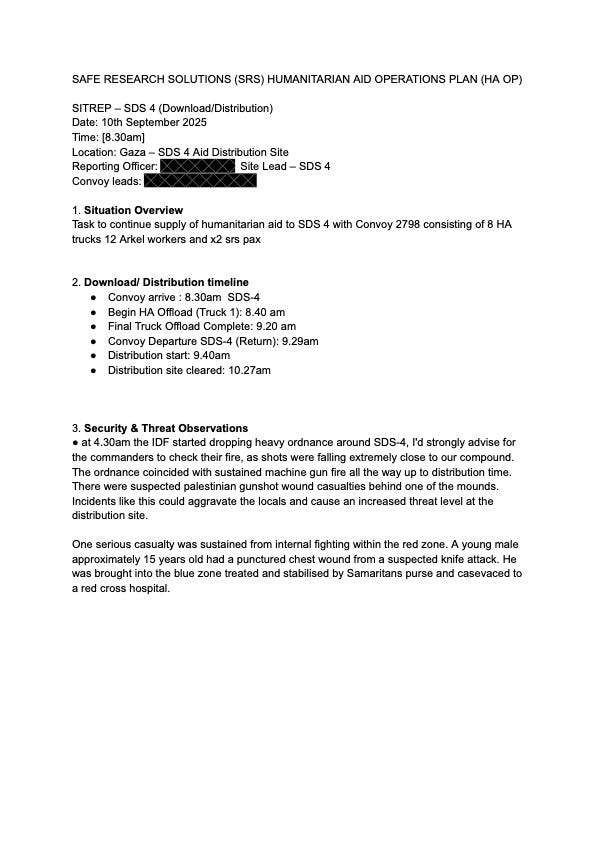
A page from an internal report filed by David McIntosh to his superiors on September 10, 2025. Courtesy: David McIntosh.
In another report dated September 13, 2025, McIntosh wrote: “once again we had problems with the IDF’s use of indirect fire. Blindly firing a tank round straight over our heads mid way through distro skimming the berm and landing in the wadi. Needless to say an unnecessary show of force, completely unprofessional and dangerous.”
McIntosh told Drop Site the shootings hindered their aid operations. One time, he said, “we had to stop a well-needed resupply to us because [the Israelis] were firing on our base. So we couldn’t have our logistical lorries come through.”
When GHF suddenly shuttered its sites in October 2025 as part of the so-called ceasefire agreement, McIntosh switched gears to closing out these operations before going back to the UK the following month.
When asked why he hadn’t spoken out sooner, McIntosh said he was waiting to see if there would be another opportunity to go back to gather more documentation. “I wanted to get as much as possible…so the more time there’s for me, the better.”
McIntosh said he was made to sign a non-disclosure agreement as part of his work contract but said he couldn’t stay silent as a matter of conscience.
“There’s a bigger issue at hand rather than my personal safety…If you document something that is wrong, then you should put it out there,” he said. “I’m exposing war crimes.”
From Drop Site News via This RSS Feed.