

For updates that won’t get filtered by social media algorithms and to support my work, PLEASE subscribe
The FBI has designated an online group, many of its members adolescents or children younger than 13, as an “extremist” threat.
Called “764,” the FBI has labeled the group “Nihilistic Violent Extremists,” a new classification for domestic terrorists created by the Bureau last year, as I first reported.
Publicly, the FBI casts these investigations as a crusade to protect the children from predatory adults. What they rarely mention is that many of the suspects are children themselves. To obscure this ugly reality, law enforcement portrays itself as merely focused on social media and gaming platforms — ones that just so happen to be popular among children, like Roblox.
The focus on child gamers is so great that law enforcement are privately employing Gen Z slang like “clout chasing” and “aura farming” in its intelligence reporting (see below).
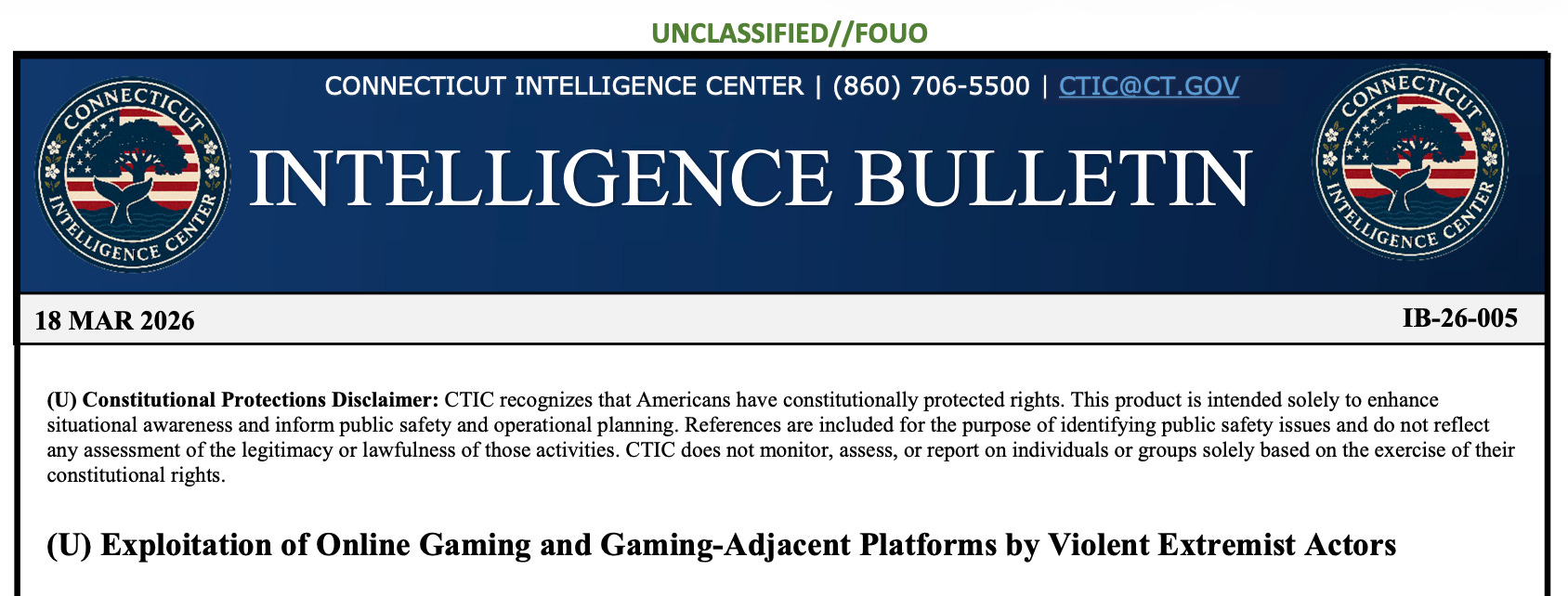
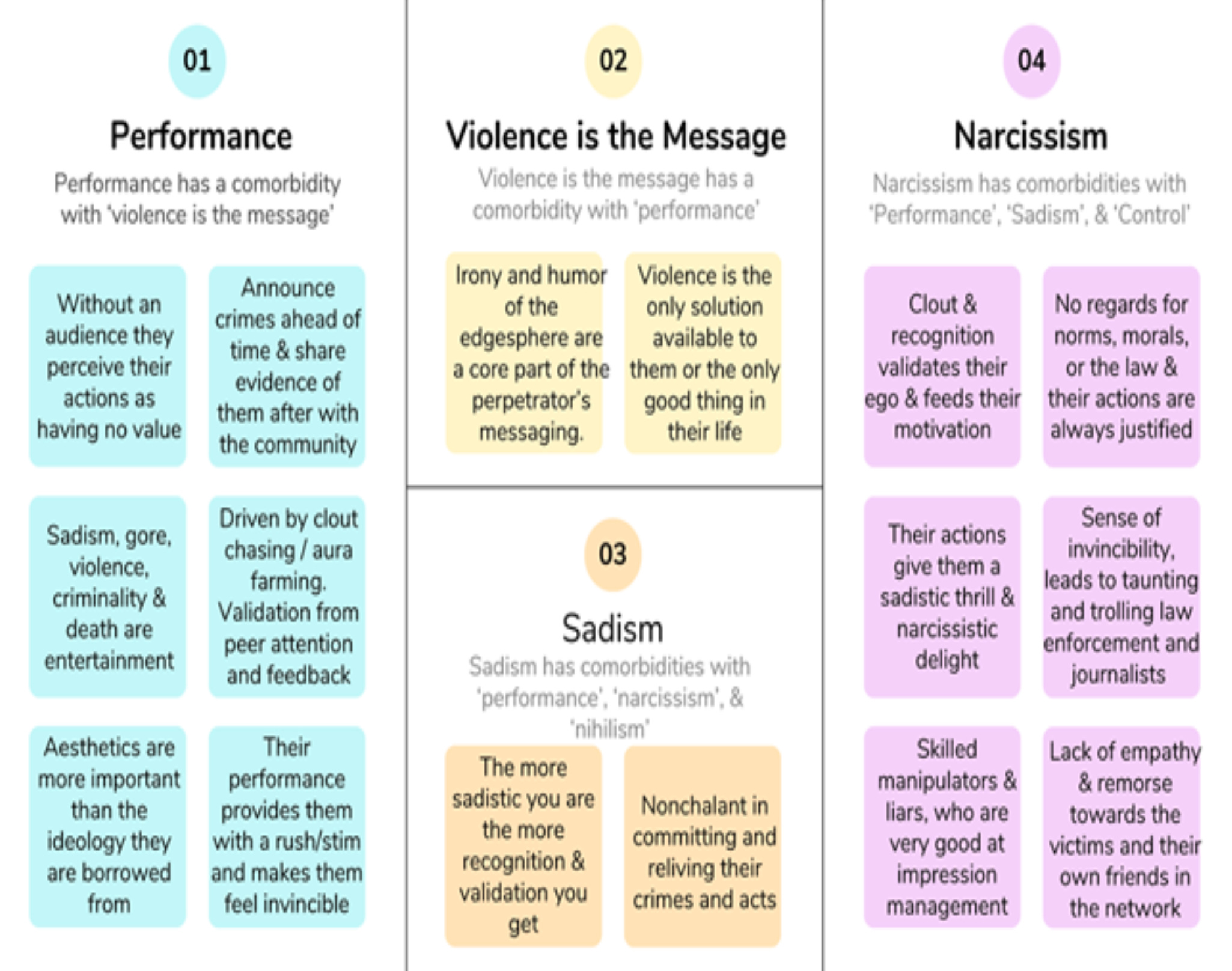
Screenshot of Connecticut Intelligence Center bulletin. Credit: Daniel Boguslaw
Connecticut Intelligence Center bulletin
1.43MB ∙ PDF file
Because minors’ identities are not disclosed in court records, we have no idea how many children the FBI is investigating. (The Bureau has not responded to my request for comment at the time of this writing.)
One rare acknowledgement of the presence of children in these groups came from the FBI’s Boston Field Office, which in February issued a statement referring to 764’s “juvenile predators”; another FBI public service announcement described a similar group’s (“The Com”) members as “between 11 and 25 years old.”
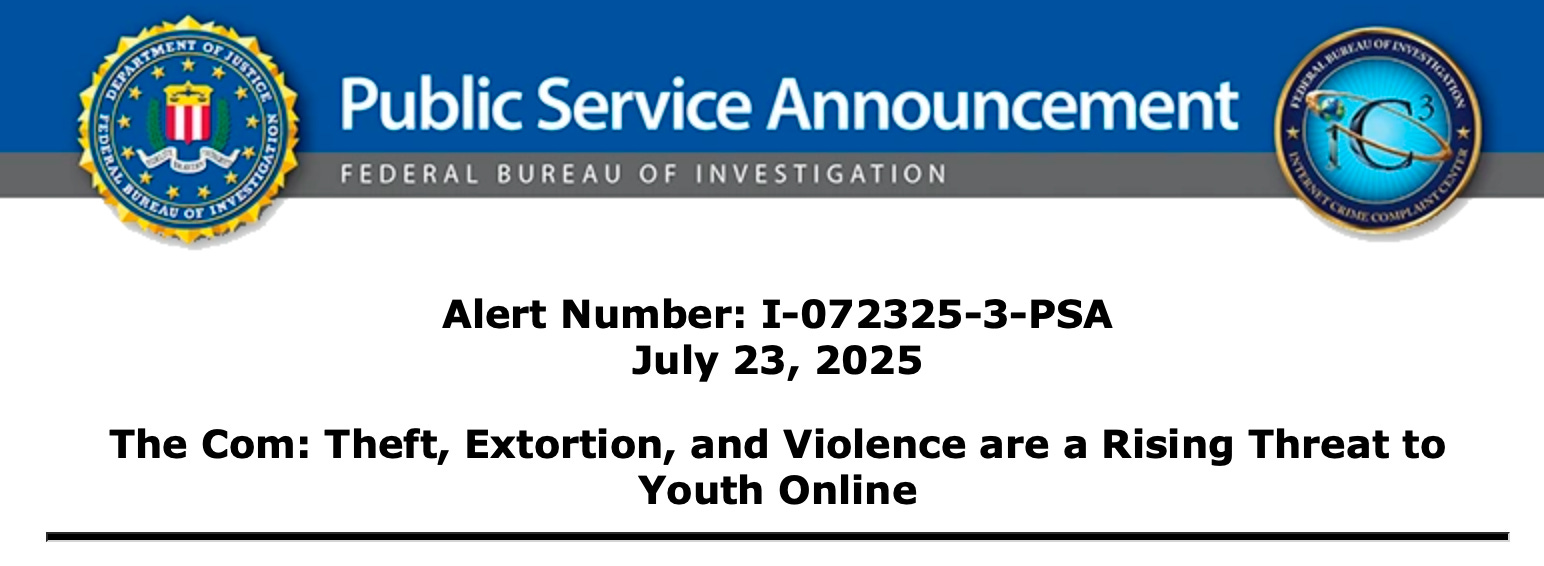
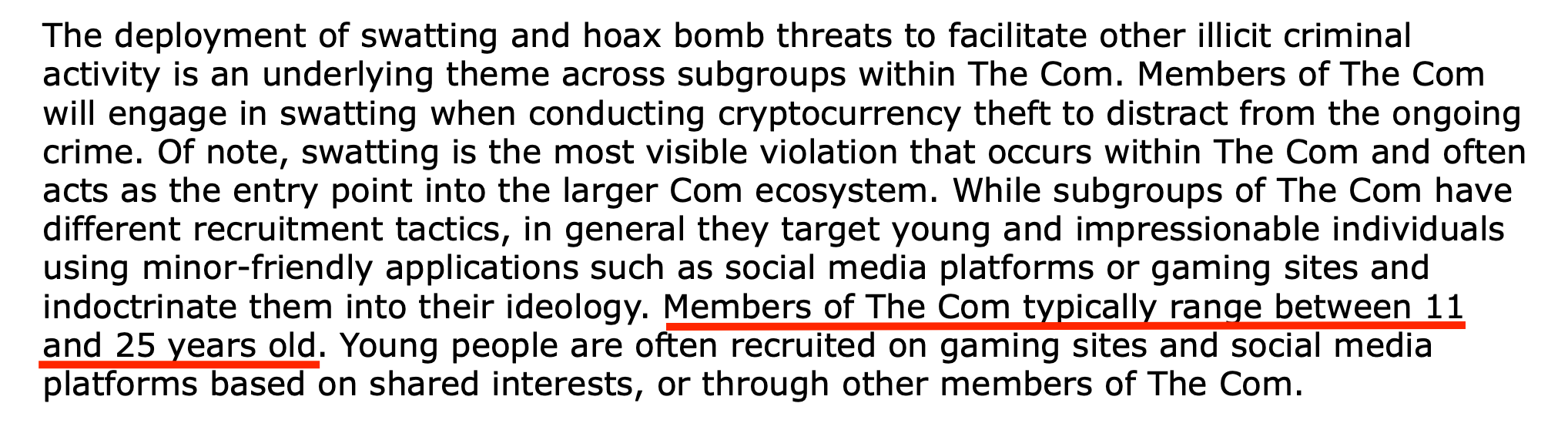
Screenshot of FBI PSA
The Com — short for “the community” — is an umbrella term for the decentralized online networks like 764, known for coordinating harassment, extortion, and the coercion of minors into producing violent or sexually explicit content.
Sick stuff, obviously. But with much of it carried out by minors themselves (some originally victimized by the groups before joining them), is this really terrorism?
The FBI thinks so.
The Bureau defines Nihilistic Violent Extremists (NVEs) as those inspired by “a hatred of society at large and a desire to bring about its collapse by sowing indiscriminate chaos, destruction, and social instability.” This represents a departure from not just past FBI counterterrorism categories, but from the dictionary, which defines terrorism as politically-motivated and nihilists as not believing in anything, politics or otherwise.
Strange as it may seem, this is not some fringe program. The FBI has seen a 300% increase in domestic terrorism investigations, “a large chunk of which are nihilistic violent extremism,” as Director Kash Patel testified to Congress last year.
The FBI also says that all 56 of its field offices are involved in investigating 764 alone, of which it is investigating at least 350 members in the United States. The group was founded in 2021 by then 15-year-old Bradley Cadenhead of Texas.
The reticence of the government to speak openly about all of this is partly constitutional. In the United States, the First Amendment sharply limits the government’s ability to target people based on ideology, association, or demographic characteristics — including age.
Federal counterterrorism law requires a nexus to violence or material support for it; “being a radicalized child” is not a crime. So rather than acknowledging that it is effectively targeting a juvenile population, the FBI routes its investigations through platforms where they congregate. Gaming platforms — Roblox, Minecraft, Discord — have become the main target of government scrutiny. The FBI says it isn’t investigating children; it’s investigating violent criminal networks that happen to recruit on children’s platforms.
The distinction is real obscures the truth: the domestic terrorism apparatus is being trained on pre-teens.
The gulf between how the U.S. government describes its targets became concrete in April 2025, when the Department of Justice unsealed an indictment charging two 764 leaders — Leonidas Varagiannis, known online as “War,” and Prasan Nepal, known as “Trippy.”
The affidavit listed five co-conspirators identified only by their online aliases. One of them, listed simply as “Slain764,” was named in the document as a key participant in the network. Swedish investigative reporting by SVT subsequently identified Slain764 as a 14-year-old boy from a Stockholm Suburb.
In other words, the FBI was investigating a 14-year-old for terrorism.
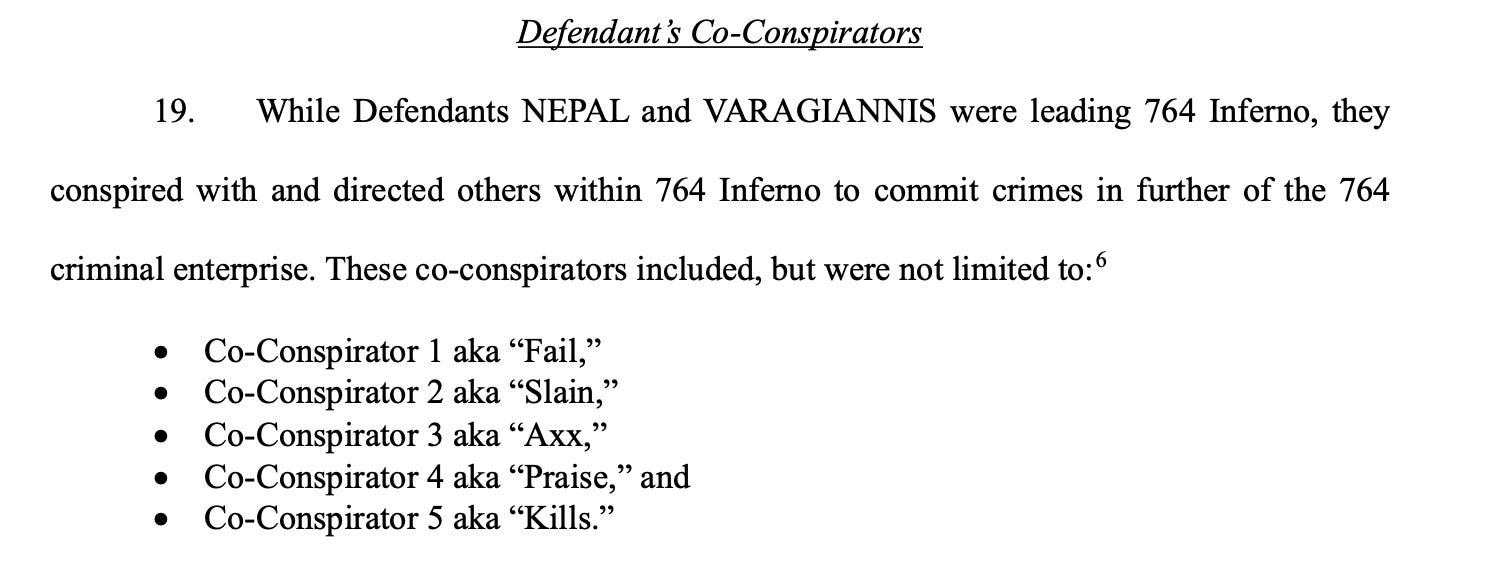
U.S. court filing
The U.S. government’s court filing made no mention of his age. To read it, you would have no idea that one of the named co-conspirators in a federal “terrorist” indictment (or how many of the other co-conspirators are as well).
The FBI’s public tallies of NVE investigations — 350 subjects, 56 field offices, a 300% increase in domestic terrorism cases — tell you almost nothing about how many of those subjects are children. The government is simultaneously claiming a massive juvenile victim crisis while running a parallel investigative apparatus targeting minors that it is, by law and by practice, almost entirely shielded from public scrutiny.
But that’s not the case in other countries that have no First Amendment.
The Five Eyes — the intelligence-sharing alliance comprising the United States, United Kingdom, Canada, Australia, and New Zealand — in 2024 issued a statement titled, “Young people and violent extremism: a call for collective action.”
The statement is possibly the only example in which the U.S. government plainly links terrorism with “minors,” warning even of cases in which the suspect is “not carrying out an attack.” It singles out “seemingly innocuous social media and gaming platforms” like “Discord, Instagram, Roblox and TikTok” as particularly concerning.
Per Five Eyes:
“ … the development of online content and environments has facilitated the entry of minors and young people into violent extremist pathways. This is concerning, as minors are particularly vulnerable to online radicalisation. Online environments provide an avenue for first approaches to minors, including through seemingly innocuous social media and gaming platforms, such as Discord, Instagram, Roblox and TikTok.”
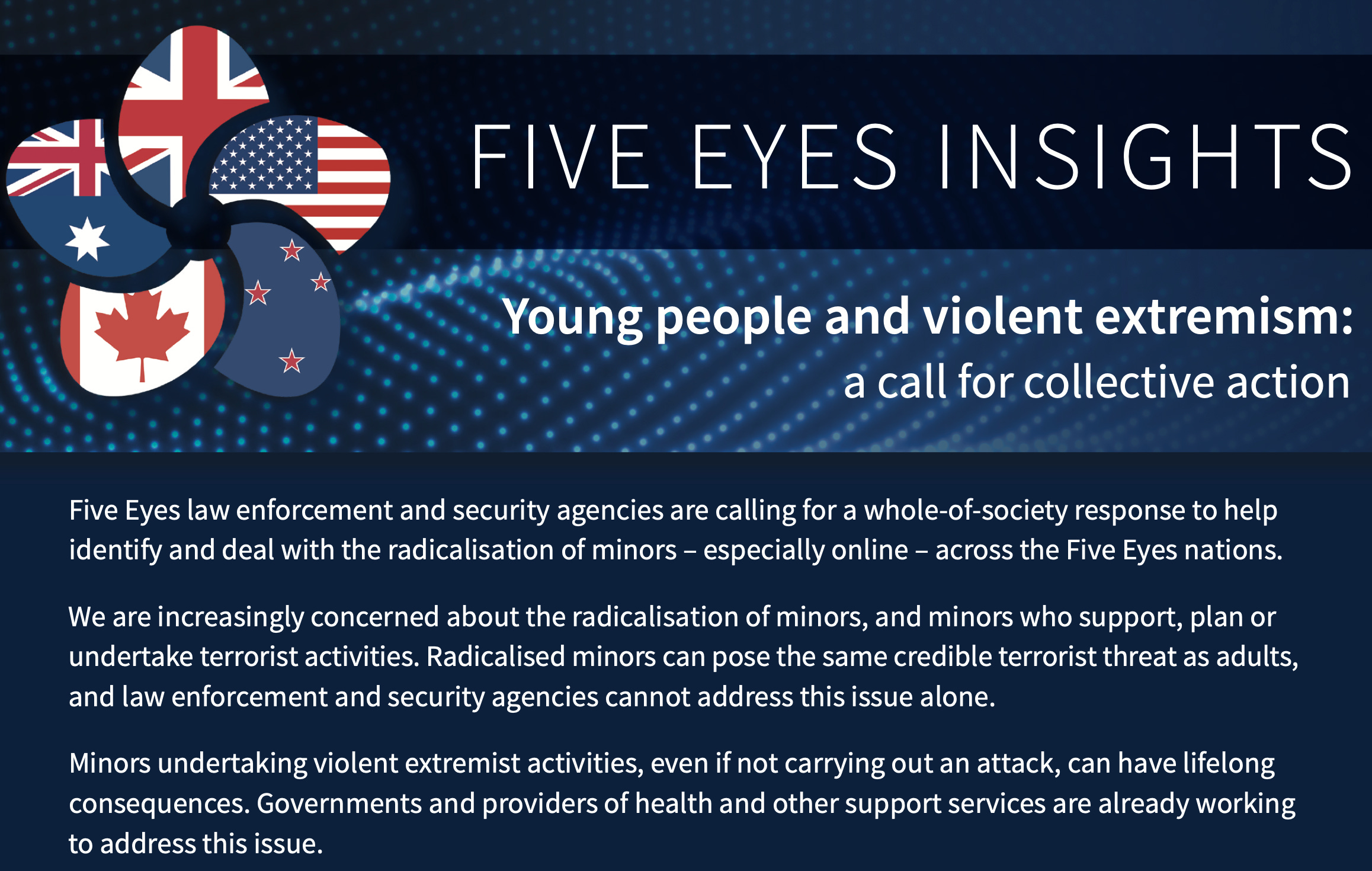
Five Eyes statement
1.71MB ∙ PDF file
The Five Eyes statement goes on to include several case studies in different member countries.
In the United States, there’s the case of a 14-year-old arrested by local police in Arizona on state terrorism charges. In New Zealand, another case exists where “The individual made racist, misogynistic and anti-authority comments.” And in Canada, “The Royal Canadian Mounted Police (RCMP) received information that a social media user had been promoting involuntary celibate (incel) ideology online.”
That last example gets sad fast.
“Through judicial authorizations and subsequent interviews, the RCMP located the minor who had no documented history of violence and no criminal record,” the Five Eyes statement says of the incel case. “The parents stated their son suffered from a developmental disorder, but noted no other health concerns.”
The numbers in these other countries are striking. In Australia, the domestic intelligence agency ASIO reported that one in five of its priority counterterrorism cases now involves a minor — and in the most recent annual reporting period, every single disrupted terrorist attack or plot involved a minor or young person. ASIO Director-General Mike Burgess put it plainly: “As a parent, the numbers are shocking; as an intelligence officer, the numbers are sobering.”
Since 2020, Australian Federal Police and their partners have investigated around three dozen counter‑terrorism cases involving minors. The youngest subject was just 12 years old.
Europe tells a similar story. Europol’s 2025 terrorism trend report found that of the 449 people arrested for terrorism-related offenses across EU member states in 2024, 133 were between the ages of 12 and 20 — nearly one in three. The youngest was 12, arrested for planning an attack. Belgium’s intelligence service reports that roughly one in three individuals in its recent terrorism cases is a minor. A cross‑national analysis drawing on the 2026 Global Terrorism Index concludes that youth and minors accounted for 42% of all terror‑related investigations in Europe and North America in 2025, a threefold increase since 2021.
Seamus Hughes, a senior research faculty member at the University of Nebraska Omaha’s National Counterterrorism Innovation, Technology, and Education Center, says that even many federal agents in the U.S. are uneasy with the shift.
“Interviews with FBI agents around the country reveal a recurring theme: They feel they can’t arrest their way out of this problem, and, even if they could, they didn’t join the counterterrorism section of the FBI to lock up confused kids for decades.”
Pre-teen terrorism is what Europe and the commonwealth have embraced; and it’s what the Trump administration has signed onto with its war on Nihilistic Violent Extremism.
What’s next, toddler terrorism?
Subscribe if you agree toddler terrorism brings a whole new meaning to the “terrible two’s”
— Edited by William M. Arkin
From Ken Klippenstein via This RSS Feed.