

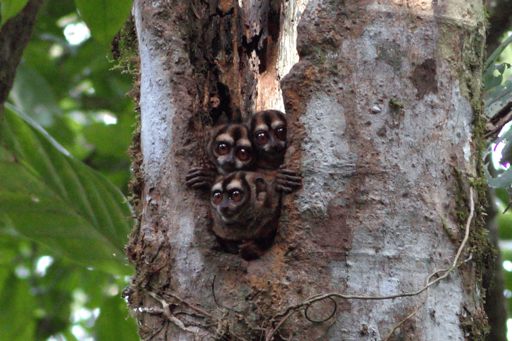
One night, 10-year-old Sebastián Montilla heard a creature moving over a tree branch on his father’s farm in Pijao, Quindío department, one of Colombia’s renowned coffee-growing regions. As he pointed a lantern up to the canopy, he saw a wild creature with big red eyes and a long tail watching him before moving away from the light. It was a night monkey, from the genus Aotus. This brief encounter would decide Montilla’s path. “I became very passionate about those animals, in fact, when I was in school, my favorite pastime was to go outside and lie down under their sleeping place, to watch them do nothing,” Montilla, now a doctoral student in biological sciences at the University of the Andes in Bogotá, told Mongabay in a video call. “I’m very surprised by the fact that [night monkeys] have gone unnoticed for so long, both in the scientific community and in the public sphere,” he added. “It’s astonishing because at midnight they are moving right past our houses and we don’t even notice.” Night monkeys, also known as owl monkeys, are the only primate group in the Americas that have adapted to be active at night. These monkeys have evolved enormous round eyes with retinas 50% bigger than those of daytime-active primates to better capture the scarce light available in their environments. Unlike other nocturnal primate species in Asia and Africa, such as lorises (family Lorisidae), tarsiers (Tarsiidae) and lemurs (Lemuroidae), which tend to be solitary, night monkeys form lifelong monogamous…This article was originally published on Mongabay
From Conservation news via This RSS Feed.