

Naw Sai, 29, was born in a small village in northern Shan state in Myanmar, a country now in the grip of a brutal civil war. As a teenager, he moved on his own to the country’s second-largest city to study at a free school run by monks. At 16, he learned English as Myanmar began to democratise after decades of junta rule. Clever, thoughtful and committed to improving his country, he seized opportunities to work in the burgeoning human rights sector, setting himself on a path to study abroad in the United States.
“I was fortunate,” Naw Sai told Novara Media, with characteristic modesty, to have been awarded a full scholarship to study at Ohio University, just before it all changed; in February 2021, a few months after he was accepted on to the programme, a brutal military coup plunged the country back into a conflict that has lasted for more than five years, with an estimated 93,000 people killed
Now living across the border in Chiang Mai, Thailand, Naw Sai has seen his life diverge from the lives of his friends, who are still in Myanmar. “Some of my friends are still serving in prison, and some of them are fighting against [the junta] for justice,” he said, explaining that all those who stayed have had to flee into ethnic areas to avoid conscription, putting them among the 3.6 million people displaced by the conflict. “There’s a lot of disaster, a lot of challenge,” he said. When a year ago the country was rocked by a powerful 7.7 magnitude earthquake, toppling buildings – especially the self-built houses of the poor – and killing thousands, Naw Sai wondered how a single country can suffer so much.
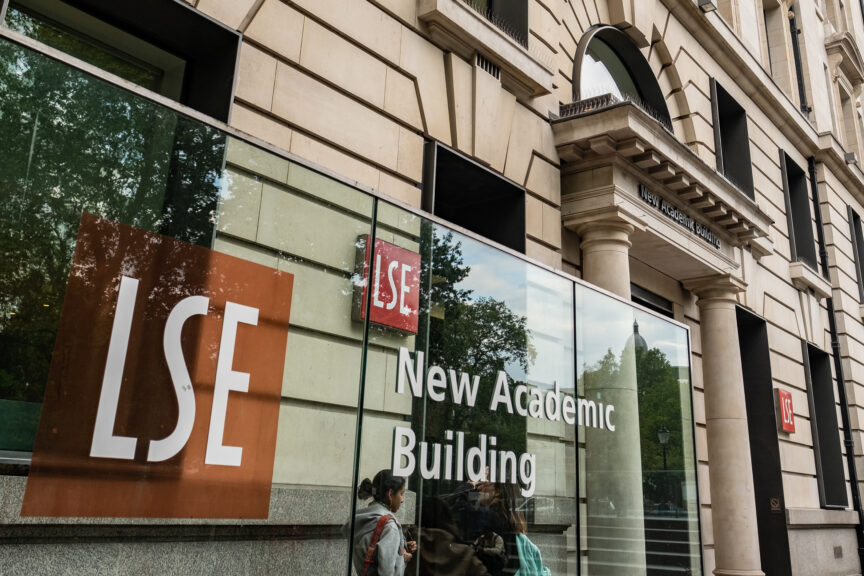
At the start of this year, Naw Sai applied to LSE, to do a PhD in anthropology. His proposal was directly related to the conflict in his home country. “If we are to negotiate for peace in the future, it is important to understand the nature of the region,” he said. His idea resonated with professors, who offered him a coveted place on the deeply competitive course.
Describing Naw Sai as “an experienced researcher” with a “fascinating” project, Professor Hans Steinmuller, an anthropologist of China and Myanmar, said: “We’ve got a very high number of applications for our PhD programme this year – about 120 – and Naw Sai’s proposal was one of the very few that was accepted.”
But Naw Sai never got to celebrate his acceptance to the prestigious London institution. Before the offer had even been formalised, it was withdrawn again, as a result of an ‘emergency visa brake’ announced by the British government in early March. Coming into effect at the end of last month, on 26 March, the new law targets students from just four countries: Myanmar, Sudan, Cameroon and Afghanistan.
“I was in the middle of admission, and then suddenly, this decision from the government came in. It’s sad. It has impacted a lot of students from Myanmar,” Naw Sai said, describing his “grief” at the situation on social media.
Steinmuller confirmed that the university was informed of the ‘visa brake’ just after deciding to accept Naw Sai. He said the decision would directly impact his “life and career”.
As the UK lurches further to the right, with anti-immigration party Reform expected to dominate in May’s elections, Steinmuller described the policy as “yet another example of the home office’s deliberate efforts to create a ‘hostile environment’ for migrants and foreign students; an agenda that panders to the far-right rather than upholding Britain’s reputation as a place of academic excellence and free inquiry”.
“Targeting students from specific countries sends a chilling message to the world’s brightest minds that they are not welcome here,” he said.
What Myanmar, Sudan, Cameroon and Afghanistan have in common, according to the Home Office, is “a surge in asylum claims” since 2021. “Tough action is required as asylum claims from legal routes have more than trebled,” it said in a press release. “Many [asylum seekers] are accommodated at taxpayer expense, with an above average proportion of people from these 4 countries claiming destitution.”
In a statement, home secretary Shabana Mahmood claimed: “Britain will always provide refuge to people fleeing war and persecution, but our visa system must not be abused.” (She failed to identify the alternative routes she would prefer refugees use to arrive safely and legally in the country.)
But rather than seeing a spike in asylum claims as the most obvious thing Myanmar, Sudan, Cameroon and Afghanistan have in common, people who are not part of Keir Starmer’s government are perhaps more likely to note that all four also, and more significantly, share an experience of dire humanitarian crisis.
As in Myanmar, the civil war in Sudan has been ongoing for years, with over 150,000 killed since 2023. The north-east African country is currently experiencing the world’s largest and fastest-growing displacement crisis, with the United Nations recently describing the brutal actions of paramilitary group Rapid Support Forces as “bearing the hallmarks of genocide”.
Cameroon, meanwhile, is facing a severe and neglected humanitarian crisis, resulting from three concurrent conflicts in the country and its neighbour, the Central African Republic. Over two million people are forcibly displaced within the country, with 2.9 million predicted to face food insecurity by this summer. Meanwhile, the UN estimated last year that 45% of Afghanistan’s population – or 21.9 million people – would need humanitarian assistance in 2026, as a result of “years of conflict, compounded by worsening food insecurity, recurrent natural disasters, climate change impacts and large-scale returns of displaced people”. Last month, it reported that the US-Israel-Iran war had added additional strain, further worsening the situation.
While there are many legitimate reasons people from the four targeted countries might wish to claim asylum in the UK, Naw Sai is clear that he had no intention of staying beyond his studies; his project specifically focuses on Myanmar because he intended to return and apply his knowledge in the region. From his perspective, he is being penalised simply for coming from a country in crisis. “This is so unfair and unjust,” he said.
“I feel sad, and frustrated that we are being viewed… with a narrative that we’re just looking for opportunities, rather than wanting to make our countries better.”
Having also been denied a visa by the Australian government last year, after he was admitted on to a PhD programme in Canberra, Naw Sai now intends to work for a year in Chiang Mai, before applying again to more universities in other countries.
“We are trying in every way possible to learn and to support our communities,” he said. “We do not want the things that happened to us before to happen to us again. And our potential is limited by [the British] government.
“It’s really, really sad.”
From Novara Media via This RSS Feed.