

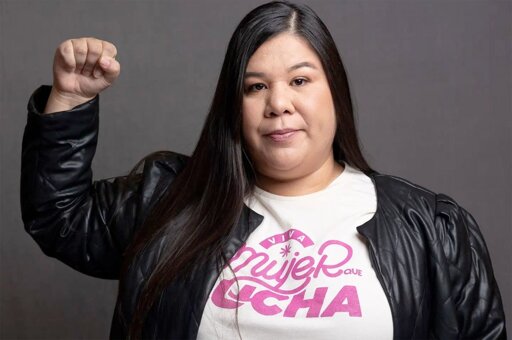
Mónica Ramírez has dedicated most of her life to broadening public understanding of who migrant women are and how often they are overlooked. A civil rights attorney, Ramírez is the founder and president of Justice for Migrant Women. In 2022, she received a James Beard Leadership Award for a project she launched there, “The Humans Who Feed Us,” a series of first-person stories about food-system workers. In February, she won the Elevate Prize for her work to end gender-based violence and promote gender equity.
Ramírez’s multigenerational, migrant farmworker family inspired her life’s work. She often points to how her family’s story changed when farmers offered them a chance to stay in the rural Ohio town where she was born. That stability helped her parents move into work outside the industry and enabled Ramírez to attend school without having to do field labor herself, like her parents, grandparents, and uncles. “Just being able to break that migrant cycle made a big difference in terms of my life choices,” she says.
Ramírez believes the most effective way to bring people together is not through confrontation, but by building common ground.
At 14, she began writing for her local newspaper about issues affecting farmworkers and Latinos in her hometown. After college at Loyola University of Chicago, she earned a J.D. at the Ohio State University’s Moritz College of Law and a master’s in public administration from the Harvard Kennedy School.
Having grown up in a place where people get to know one another in school hallways, church pews, and grocery store aisles, Ramírez believes the most effective way to bring people together in today’s rural America is not through confrontation, but by building common ground.
Civil Eats spoke to Ramírez about how her work has evolved, the importance of humanizing food system workers, and the challenges facing farmworker activism today.
What was the narrative you wanted to shift by launching The Humans Who Feed Us?
I didn’t want to highlight the problems the farmworker community or immigrants face. I wanted to focus on their dreams, because that’s something that everyday people can relate to. My hope was that in creating the project that way, by having these portraits where you can see the individual and read some of their dreams on the cards alongside the portraits, the public would be able to connect with these individuals beyond their work, as people, and be able to say, “I share that dream.”
As you were learning their stories, what themes kept coming up?
Whether they’re fleeing violence or poverty, there was this idea that if they could come to the United States, it would be better. There’s a lot of gratitude. People are very grateful for the opportunities they’ve been given.
But there’s also this underlying theme that they want people to see them. They hear what people are saying about immigrants, and they want their neighbors to know that what they’re doing is for the good of many. They want to be seen and they want to be valued. A lot of them live in invisibility. They’re people who are going to work every day, doing work that literally sustains us. Whether they’re working in a grocery store, at a restaurant, a food truck, or far off in the fields, it’s like society has made them invisible.
What would you want the public to understand about the farmworkers and other communities behind our food?
That they are critical to our everyday lives. And that they’re more than just their work. These are whole people. They contribute in many ways.
Also, if you’re only focusing on their work, you fail to see all the other things that [as human beings] they need support with. It’s important for people to understand [their] struggle right now. There are so many rights that farmworkers and others who are employed in the food supply chain don’t have. Waiters and waitresses still have tipped wages. Members of the farmworker community still don’t have the right to overtime or the right to unionize under federal labor law.
We need consumers to see themselves as partners in this work. They need to be invested in improving the conditions. It’s been almost 90 years since the farmworker community and other food workers were denied the basic rights of other working people under the Fair Labor Standards Act. At the highest level of government, the decision has been made not to improve their rights over all these decades. We have to understand that as consumers and be partners in making the change. It’s not going to change if everyday people don’t get involved.

Mónica Ramírez at the Raizado Festival in Aspen, Colorado, in August 2025. Founded by Ramírez in 2020, the festival is a project of Justice for Migrant Women and celebrates Latine culture, leadership, and community. (Photo courtesy of Justice for Migrant Women)
How do you create common ground when having this discussion with someone who thinks differently? How does doing this advocacy work in rural America differ from in cities?
It really resonates when I talk about what it means to be a good neighbor. It doesn’t matter what your political affiliation is; that kind of language brings people together. We always look for words and ways where we can find common ground and bring people together, trying to connect human to human. That has been at the heart of what’s been successful in our work.
When you’re in a big city, it’s easier to find like-minded people. There’s just more people, and there’s a certain level of anonymity. Here in small-town Ohio, people I see at church or in the grocery store are people who we interact with every day. That’s a big difference between rural America and big cities, because we are not anonymous; people very much know who we are. That makes us a little bit more careful and thoughtful about what we say and do—and makes it a little bit easier to bring people of different political views together. We have had those kinds of bonds for years.
A challenge we have is that we are very isolated. We have to be creative in how we reach people because of the isolation and the information gaps that exist here. But the opportunity is that we have these close, longstanding relationships.
You’ve spent years advocating for migrant women and farmworkers. How has your work evolved?
I think it’s come full circle. I started as a 14-year-old activist telling the stories of my community, and today, many years into my career, I still tell the stories of my community. There is urgency around that because one of the biggest struggles we have is the dehumanization of farmworkers. When you dehumanize a person, it makes it easier to exploit them because you no longer see them as deserving respect or fairness.
What has always been urgent for my work has been addressing the issue of sexual violence. It’s a major problem in the farmworker community. Because of the recent news related to César Chávez, that issue is front and center again. It should have always been front and center, but now it’s reemerged in the public eye. That is a longstanding problem, and there have not been sufficient supports needed to address sexual violence in the farmworker community.
What was your first thought when you learned about the allegations against César Chávez?
My very first reaction was confusion. I just could not have ever imagined that César Chávez would have caused that harm. It took me a little while to try to understand it. I felt shocked and hurt and sad. Mostly, I felt sad for the survivors. When I read about Dolores [Huerta] experiencing sexual violence, I had no idea. I’ve known Dolores for many years and just felt heartbroken. Like in grief, I’ve been through waves of emotions.
When you have a situation of sexual violence, there’s a ripple effect of harm. There’s no way to completely heal that harm, certainly not immediately. From the perspective of someone who’s focused on this work my entire career, what does this process need to look like? What does it mean for what I believed my whole life about the foundation of this movement?
Has this changed how you see leadership and the movement?
One person is not a movement. There were millions of people that have been part of the farmworker movement from all around the world. It has been farmworker community members who have been the heart and the center. Why do we have people that we put in a kind of hero status? People need people to look up to, but there is a danger when you have a singular hero and not his full story.
You can have a visionary [leader], but there are many people that implement that vision. This is an opportunity to say to ourselves: Are we living up to the standards that we are setting? If we’re not, what can we do to change that? How do we make sure that the movements we’re part of, and lead, are spaces with opportunity for many people to rise to the top in leadership?
What gives you hope for the future?
The people we have the honor to serve give me so much hope. With all the odds stacked against them, the rhetoric about immigrants, the negative things that are happening that directly impact their lives, they just keep moving forward, with the single goal of making things better for their families. My hope is that people in society start to understand how much power and vision they have. They know what they need, what needs to change, and we should listen to them and never undermine their power.
The post ‘More Than Just Their Work’: A Farmworker Advocate on Those Who Feed Us appeared first on Civil Eats.
From Civil Eats via This RSS Feed.