

Though Nietzsche infamously declared that God is dead and accused us of being culpable for his death, it is a curious feature of humanity that we ceaselessly strive to seek out the transcendent irrespective of the religiosity of the epoch we live in.
In our age, this quest for transcendence finds its expression in the utopian vision propagated by the Technorati: achieving eternal salvation through transhumanism. The saints of today don’t wear collars; they don black tee shirts and baggy jeans. They don’t preach the gospel of Jesus Christ; they evangelise about code and consciousness-uploading to escape the rust of the flesh. This priestly class for our digital age has constructed a Silicon-coated hyperreality where human finitude and the absurdity of our mortality can finally be overcome. Best of all salvation no longer requires us to embrace death.
This new asceticism—as Nietzsche would call it—is but a pale imitation of its Christian forbear. Nietzsche condemned Christian ascetism for being “the very incarnation of the desire for an existence of another kind”.[[i]] That is, Nietzsche reviles Christian asceticism for convincing the masses to turn away from their ‘fallen’ lives and instead long for salvation in the hereafter. We see much the same poisonous life-denying instincts pregnant within utopian transhumanism.
Where once, man was proselytised to by priests high up in their monasteries to yearn for salvation in a heavenly afterlife, we are now preached to by the prophets down below in Silicon Valley to hanker after a promised techno-utopian future. Indeed, the new transhumanist asceticism is perhaps all the more insidious in that we can foresee a future. Because we possess the capacity to abstract ourselves temporally into some as-yet-unrealised future, the illusion of transhumanist transcendence appears entirely plausible.
For all its techno-futurist garb, the new asceticism remains life-denying in the strict Nietzschean sense. Its animating principle is a revulsion towards contingency which leads it to the very same fervour for purity and permanence that drove the monastic ideal. Far from rebelling against the absurdity of a godless existence, our digital priests seek simply to code it away.
This techno-asceticism finds its apogee in the optimistic musings of Ray Kurzweil, someone for whom the Singularity—that is, the merging of human and machine intelligence—will enable humans to overcome their inherent limitations.[[ii]] In Kurzweil’s thought, we see what Camus termed “nostalgia”, a longing for the eternal that “provides modern anguish the means of calming itself”.[[iii]]
By asking devotees to place their unflinching faith in a future where man transcends his finitude, Kurzweil perpetuates the belief that human existence might no longer need to be obscure, that we can one day coherently refuse to confront the bottomless certainty of death. Kurzweil thus implores us to elude the reality of absurdism.
As Camus laconically observed, “The typical act of eluding … is hope. Hope of another life one must ‘deserve’ or trickery of those who live, not for life itself, but for some great idea that will transcend it, refine it, give it meaning, and betray it.”[[iv]] Kurzweil’s philosophy is hence no different from the pastorate of a previous epoch. Both seek to engender hope through faith in the possibility of transcending our mortal plane.
As such, it becomes transparent that utopian transhumanism’s greatest sin isn’t its faith in machines but faith period. It tries in vain to smuggle eternal freedom back into a world that no longer believes in heaven. In much the same way as Nietzsche would rebuke utopian transhumanism as life-denying. Camus would denounce it for reintroducing a simulacrum of hope into a world which lacks consolation.
Yet, the hopeful life denialism of utopian transhumanism should not lead us towards bioconservatism either. For such a route is tainted by ressentiment. Take the bioconservatism of Francis Fukuyama, for instance. He fears that transhumanism will blur the line between the natural and the artificial so as to, in the final analysis, eliminate all vestiges of original humanity altogether.[[v]]
In Fukuyama’s bioconservatism, we thus bear witness to what Nietzsche termed “the most sublime self-deception”[[vi]]: human frailty is valorised as an achievement and the converse, those vitalistic men who wish to express themselves through life-prolonging transhumanism, are demanded to deny themselves of their own vitality.
As against bioconservatives, we must resist the impulse to tear down those who would propagate transhumanism. To do so would allow bioconservatives to achieve, as Nietzsche put it, their “ultimate, most subtle, most sublime triumph of revenge” by succeeding in “forcing their own misery, in fact, all misery, into the consciousness of the happy, so that the latter begin one day to be ashamed of their happiness, and perhaps say to themselves when they meet, ‘It is a shame to be happy; there is too much misery!’”[[vii]]
Bioconservatism is thus a variant of Nietzschean slave morality that shrieks ‘no!’ ab initio to anything different from itself. This is, after all, Fukuyama’s greatest concern—that humans will be radically altered from their former selves by transhuman intervention. Bioconservatism is hence nothing more than the other side of the coin to utopian transhumanism. Where the latter sought to have us hope for a prophesied future and forget to live, the former seeks to deny us of our strength and condemns us to live in misery.
If both utopian transhumanism and resentful bioconservatism amount to denials of life in their own ways, then what remains? We must reject hope, but this shouldn’t lead us to embrace the defeatism of bioconservatism. Instead of attempting to transcend our limits, we should aim for clear-eyed revolt through transhumanism.
As Camus sagely reminds us, “Living is keeping the absurd alive. Keeping it alive is, above all, contemplating it.”[[viii]] A lucid embrace of transhumanism thus prolongs our metaphysical revolt. It is devoid of hope and certain of the crushing fate that will eventually befall us in death, but it is shorn of resignation.
An absurdist transhumanism would thus not seek to cheat death, but simply aspire to deepen our experience of life. Its project is not a mythic quest for immortality but extension, an attempt to stretch our brief rebellion against time for a little while longer. Every artificial organ, every neural implant, every coded extension of the mind becomes another gesture towards prolonging our life, our freedom. In this sense, an absurdist transhumanism is merely a means by which we can defer what Camus termed “the sole deficiency to be made good”, that is, a premature death. Absurdist transhumanism is hence nothing more than a lucid revolt to allow man to be aware of his life “to the maximum.”[[ix]]
Indeed, this absurdist transhumanism, divested of the zealous religiosity of its utopian cousin, coheres with Nietzsche’s call for us to embrace “Dionysian pessimism.”[[x]] By this he meant that we must embrace our suffering such that even the nonsensical (one might say, as with Camus, absurd) and ugly aspects of life become tolerable. An absurdist transhumanism engages with this form of pessimism both practically and metaphysically.
On a practical level, absurdist transhumanism partakes in the destructive vice that motivates Nietzsche’s pessimism. The human body and mind is taken apart and reshaped with machinery intended to prolong life. Simultaneously, on the metaphysical level, absurdist transhumanism does not have transcendence as its formal aim but merely aspires to continue our lucid revolt against the ceaseless march of time.
But how exactly can we fulfil the revolutionary promise of absurdist transhumanism? What projects should we pursue as absurdist transhumanists? And what projects ought we to abstain from?
Clearly, the first transhuman project that should take lexical priority would be to ensure that the mind can preserve its lucidity for as long as possible. After all, without the mind, any talk of confronting the absurd would be meaningless. Nevertheless, we must proceed with due caution. Transhuman projects which dabble in preserving the conscious mind risk slipping into life-denying utopianism.
To take an example, Elon Musk has advanced the possibility of whole-brain emulation such that we can preserve our personhood even as our physical bodies wither away. Yet, it is unmistakable that, even if successful, the resultant continuation of our ‘self’ will be mere simulacra; an ersatz version of our now-deceased selves capable of mirroring our past desires, thoughts, and dispositions but forever imprisoned by them, incapable of the revaluation that constitutes the fundamental mark of personhood.
As with all techno-asceticism, Musk’s proposal falters on the same primary defect of failing to acknowledge that human limitations are not viruses that can be patched but are instead immutable aspects of the human condition. They cannot be overcome, but only deferred. An absurdist transhumanism acknowledges this. It has no illusions that mental decay can only be forestalled. Thus, any neural meddling must be carried out with a view to delaying cognitive decline rather than aspiring to abolish it entirely.
Just as absurdist transhumanism seeks the extension of the mind’s faculties, so too with the body. For living to the maximum, as Camus enjoins, does not merely require a lucid mind, it also necessitates a body full of vitality. Here too, however, we must tread carefully lest we be ensnared once more by the new asceticism.
In this regard, the absurd transhumanist should repudiate proposals to keep human bodies in suspended animation through cryogenics. To do so would be to deny life in its entirety. Indeed, unlike true absurdists, those who advocate such proposals avert their eyes from the abyss and instead comfort themselves through the fiction that it is better to enter into eternal slumber in the vain hope that they will be reawakened in an impossible age where we have gained the godly power to transcend death.
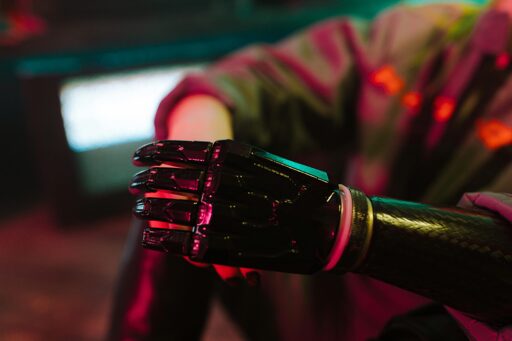
Rather, the absurd transhumanist should seek to harness cybernetics to replace worn out limbs or deteriorating organs. Such bodily augmentation dispenses with the perfectionism of techno-asceticism in favour of life affirmation, ensuring that our body does not succumb to that peculiar defect of a premature death.
Absurdist transhumanism is thus an invitation to embrace the struggle of living without a master. It aspires not to overcome humanity; it only seeks to extend the temporality of our lucid revolt within the torment of time. In this way, it affirms life by ensuring that we prolong the vitality of our body and mind. Through an anguished awareness of the world’s primitive hostility, absurdist transhumanism beckons us to sustain our mental and physical faculties so as to maximise our freedom to live and not to conquer death.
Notes:
[[i]] Nietzsche, F. [1887] 2013. On the Genealogy of Morals: A Polemic. Translated by Michael A. Scarpitti. London: Penguin Classics, p. 107.
[[ii]] See: Kurzweil, R. 2024. The Singularity is Nearer: When We Merge with AI. New York City, NY: Viking.
[[iii]] Camus, A. [1942] 2013. The Myth of Sisyphus and Other Essays. Translated by Justin O’Brien. London: Penguin Classics, p. 37.
[[iv]] Camus, A. [1942] 2013. The Myth of Sisyphus and Other Essays. Translated by Justin O’Brien. London: Penguin Classics, p. 8.
[[v]] See: Fukuyama, F. 2003. Our Posthuman Future: Consequences of the Biotechnology Revolution. New York City, NY: Picador.
[[vi]] Nietzsche, F. [1887] 2013. On the Genealogy of Morals: A Polemic. Translated by Michael A. Scarpitti. London: Penguin Classics, p. 34.
[[vii]] Nietzsche, F. [1887] 2013. On the Genealogy of Morals: A Polemic. Translated by Michael A. Scarpitti. London: Penguin Classics, p. 110.
[[viii]] Camus, A. [1942] 2013. The Myth of Sisyphus and Other Essays. Translated by Justin O’Brien. London: Penguin Classics, p. 40.
[[ix]] Camus, A. [1942] 2013. The Myth of Sisyphus and Other Essays. Translated by Justin O’Brien. London: Penguin Classics, p. 47.
[[x]] Nietzsche, F. [1882] 1974. The Gay Science: With a Prelude in Rhymes and an Appendix of Songs. Translated by Walter Kaufmann. New York City, NY: Random House, p. 331.
The post Beyond Ascetic Transhumanism appeared first on The Philosophical Salon.
From The Philosophical Salon via This RSS Feed.