


This story was originally published by South Dakota Searchlight.
Meghan O’Brien
South Dakota Searchlight
A plan to drill exploratory holes in search of uranium near a southern Black Hills canyon lined with ancient Native American rock art has raised tensions ahead of a hearing to determine the project’s fate.
At a procedural hearing in January, a tense exchange with project opponents led to an outburst by a member of the board considering the project’s permit application.
“Your goal in life is to be a jerk,” board member Bob Morris told a member of the public attending the hearing.
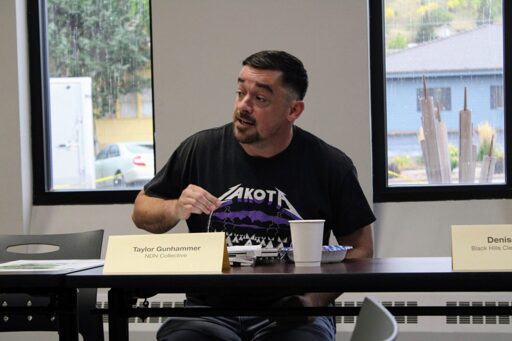
The comment was directed toward Taylor Gunhammer. He’s an Oglala Lakota community organizer.
“It was just profoundly unprofessional,” Gunhammer said afterward, reacting to the exchange.
Gunhammer and other project opponents were arguing for the relocation of a permit hearing from the state capital city of Pierre, in central South Dakota, to a location closer to the proposed project in the southwestern part of the state. Morris’ fellow board members ultimately agreed to move the hearing to the city of Hot Springs. The hearing was scheduled to begin April 13, but a notice issued this week says the hearing has been postponed, with no further details.
The hearing will be a continuation of a long-running struggle over proposed uranium mining in the southern Black Hills.
Project scope
Uranium is a metallic, radioactive element used as fuel in nuclear weapons and nuclear power plants.
Uranium mining became common in the 1950s to supply the United States with materials for Cold War nuclear weapons. That included the southern Black Hills of South Dakota, where mining and milling occurred in the Edgemont area until the 1970s. Much of that mining took the form of open pits, some of which were never reclaimed to a natural condition.
In the early 2000s, a new proposal arose to mine uranium near the southern Black Hills map dots of Dewey and Burdock. That plan, from Texas-based enCore Energy, has met staunch opposition from Native Americans and environmental activists and has been in regulatory and legal limbo for two decades. The project would utilize the “in situ” method of drilling wells and injecting a solvent to loosen underground uranium deposits and draw them to the surface.
Last year, the federal government’s Permitting Council selected enCore’s project for inclusion in FAST-41, a process intended to improve coordination among permitting agencies and hold them accountable to deadlines.
Interest in uranium exploration and mining has risen recently, in response to nuclear energy’s potential to meet the growing electricity demands of data centers handling the computing needs of artificial intelligence.
In March 2024, Clean Nuclear Energy Corporation and its Canada-based parent company Nexus Uranium filed an application to drill exploratory holes in search of uranium near Craven Canyon in the southern Black Hills, about 3 miles southeast of the proposed Dewey-Burdock mine.
Nexus says it has claims on a total of nearly 10 square miles of land along the southern edge of the Black Hills. Its proposed exploration project, called Chord, spans a mix of federal and state land totaling nearly 6 square miles. The company has a lease on 1 square mile of state land in Fall River County, which is the portion of the project under consideration by the state Board of Minerals and Environment.
Clean Nuclear Energy plans to use 50 drilling sites to drill holes up to 700 feet deep on the state land, according to its 2024 application. Each hole will take approximately two weeks to drill. It’s estimated that the operation will use up to 10,000 gallons of water daily, drawn from nearby municipal and private water sources, to help lubricate drills.
A part of the Chord exploration project would also take place on U.S. Forest Service land, where the agency is determining whether an environmental assessment is necessary. It would use an additional 17 drill sites. The federal agency has fielded nearly 1,000 public comments about the project, including opposition from six tribal nations.
The citizens of Fall River County, where much of the historical mining took place and new mining is proposed, voted in 2022 to declare mining for uranium a public nuisance. But Clean Nuclear Energy attorneys argue that state law supersedes county ordinances, and the Minerals and Environment Board agreed.
Morris, appointed by the board to rule on motions, said the decision hinged on the difference in South Dakota’s legal definitions of a “mining operation” and a “uranium exploration operation,” which “constitute separate actions.”
Water and rock art concerns
More than 40 people and organizations have formally raised concerns about the drilling on state land. The area holds cultural and religious significance to Indigenous people, for whom the Black Hills is a sacred site in their spiritual traditions. The drilling sites are near Craven Canyon, which is home to ancient rock art, including petroglyphs and pictographs.
Some of the rock art is thought to be about 7,000 years old, according to NDN Collective, an Indigenous rights organization based in Rapid City. The canyon itself has been there for “generations immemorial,” said Duane Two Bulls, a lead organizer with Black Hills Clean Water Alliance.
“It predates our people,” Two Bulls said. “It was one of the first spots that, in our creation stories and in our history, it was always there.”
Some of the rock art depicts ceremonies and creation stories, Two Bulls said.
“The main concern that would come to my mind right away is that whenever they start drilling, like on top of the canyon, then it’s going to affect the soundscape. And it’s going to cause like an internal vibration where that drilling, that drilling may possibly cause the pictographs on the canyon, the petroglyphs to pretty much shale off the canyon.
Gunhammer said the drilling proposal is an affront to Indigenous people.
“You would never drill for uranium in the lawn of the White House,” Gunhammer said. “You would never mine for lithium at Arlington National Cemetery.”
A report from the State Historic Preservation Office found that vibratory effects from drilling will be minimal and that the “the risk of damage to these sites is low.”
Other opponents worry that further drilling in the area could disrupt holes left from past exploration projects, leaving underground water deposits known as aquifers vulnerable to possible contamination.
Lilias Jarding is the executive director of the Black Hills Clean Water Alliance.
“It’s a multi-faceted set of problems,” she said. “All the things that drive our economy, our health, our ability to have communities here — because we need water — are all things that are being impacted by the mining rush.”
The drilling will take place in Fall River County, the tenth most impoverished county in the state, according to the National Institute of Minority Health and Disparities. It neighbors the Pine Ridge Reservation and Oglala Lakota County, the state’s most impoverished county.
“We are the people who live downstream,” said Mashanaposhe Camp, from Porcupine, South Dakota. “Whenever the water is affected, anything downstream, we’re going to be the ones to drink this water.”
Native Americans also have treaty claims to the area. All of western South Dakota was set aside as a Great Sioux Reservation by the 1868 Treaty of Fort Laramie. The United States broke that treaty during the 1870s Black Hills gold rush and subsequently forced tribes onto smaller reservations.
“Every single cultural resource in that one square mile of the project area, the area of potential impact, belongs at least to the Sioux Nation, and possibly to others who’ve also traversed that particular sacred site area known as Craven Canyon,” said Chase Iron Eyes, an attorney for the Great Plains Tribal Water Alliance.
Company responds
Jeremy Poirier, CEO of Nexus Uranium, said the company’s project would not impact Craven Canyon.
“This idea that we’re going to be doing exploration anywhere near or in Craven Canyon is false and factually incorrect,” Poirier said. “We’re not doing any exploration in Craven Canyon or near it.”
In permitting materials, maps of the proposed drill sites show them to be above and back from the western rim of the canyon. A letter from the Board of Minerals and Environment says the proposed operation is located within a quarter-mile of the canyon’s edge.
About 160 acres of the canyon are protected from mining by the U.S. Forest Service, but Two Bulls said there are still many scientifically and culturally important sites throughout the area that are unprotected.
The nearest protected site is a little more than 500 feet from a drill site, according to a letter from the State Historic Preservation Office.
That letter also found that the proposed exploration “will not encroach upon, damage, or destroy a historic property which is included in the National and State Registers of Historic Places.”
“There will be temporary effects,” according to the letter, including one drill pad “within the boundaries of a suspected burial site.” That drill pad has been removed, Poirier said, and the state Department of Agriculture and Natural Resources has approved all other proposed drill pad sites.
Poirier, of Nexus Uranium, said he’s “never, ever experienced” this kind of delay on a permit for exploratory uranium drilling.
“We’ve been having those conversations, we spent hundreds and thousands of dollars on studies to follow the state guidelines and the permitting process,” he said. “We’re doing that, and we’ll continue to do that.”
Poirier knew the project would raise concerns.
“We knew that it was going to be a little bit of a longer process than maybe some other processes that I’ve been involved with,” he said. “We’ve gone above and beyond in what we’ve done as far as spending all this money before we even drill a hole.”
The Board of Minerals and Environment can deny an application to explore for uranium for several reasons, including negative impacts on historical, archaeological or recreational aspects of an area, if those impacts outweigh the benefits of the exploration. Members can also deny the permit if it will negatively affect the productivity of aquifers.
This story has been updated with new information about the postponement of the hearing on the uranium exploration project.
The post Historical, cultural and environmental tensions mount ahead of uranium exploration hearing appeared first on ICT.
From ICT via This RSS Feed.