

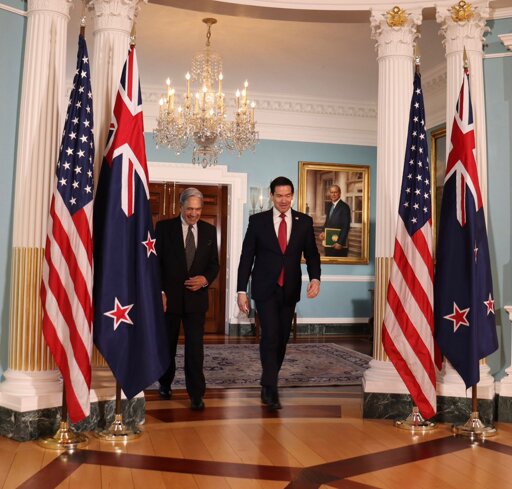

Foreign Minister Winton Peters met with US Secretary of State, Marco Rubio, earlier this week. New Zealand’s relationship with the US, writes John Hobbs, is part of what prevents it challenging Israel’s human rights violations. (Photo supplied)
In the face of expanding aggression and killing, scholar John Hobbs asks why New Zealand continues to have diplomatic relations with Israel.
Israel is a state that continues to commit documented human rights violations — including torture, and plausible genocide as determined by the International Court of Justice. It also institutionalises apartheid laws that privilege Israel’s Jewish citizens over Indigenous Palestinian people.
Why then does New Zealand maintain diplomatic ties with such a nation?
The short answer is that this is what settler-colonial states, such as New Zealand, invariably do. Such settler states are defined by Indigenous dispossession, and typically identify with “like-minded” others. These states also privilege individual wealth and accumulation over an equitable distribution of wealth. They function in a way designed to protect such arrangements — their own and those of their settler allies — at the expense of the Indigenous peoples, whose land they’ve appropriated.
The longer answer is that such states are doing more than just protecting their economic interests or creating a sense of safety through military protection. They’re also choosing to identify with the “values” of a group of countries, including the US, UK, Australia, and Canada, rather than with others, such as China and other non-western states. This grouping is typically racially driven, but that is never acknowledged.
Israel is one such settler-colonial state, which New Zealand protects through deliberate inaction. This is evident in New Zealand’s unwillingness to challenge Israel on genocide in Gaza, its silence on Israel’s documented programme of torture of Palestinian prisoners, and its very weak response to the recent imposition of the death penalty, which is targeted exclusively at Palestinians.
The law change, passed by the Israeli Knesset on March 30, requires Israel’s military courts in the occupied West Bank and East Jerusalem to impose the death penalty on Palestinians who are convicted of deadly acts of terrorism. It also authorises civilian courts throughout the country to apply the death penalty to terrorism charges.
The Israeli paper Haaretz observed that the law has been drafted in such a way as to “all but guarantee it will never be used against Jews.” Rather, it is targeting Palestinian citizens of Israel.
On April 2, New Zealand, as part of a small group of countries — Australia, Germany, France, Italy, and the UK — issued a statement that:
express[es] our deep concern about a Bill that would significantly expand the possibilities to impose the death penalty in Israel. We are particularly worried about the de facto discriminatory character of the Bill. The adoption of this Bill would risk undermining Israel’s commitments with regards to democratic principles.
Israel ignored this statement and passed the death penalty into law.
The statement reflects New Zealand’s ongoing obfuscation and silence on the question of Palestine. It contains several features that point to its insincerity.
If the language of “expressing our deep concern” and “we are particularly worried” is not backed by concrete actions, it can only be performative. To date, New Zealand has been unwilling to impose any sanctions on Israel.
By referring to Israel’s commitment to “democratic principles”, the statement ignores reports by human rights organisations — Amnesty International, B’Tselem, and Human Rights Watch — that identify Israel as an “apartheid state”.
The reference in the statement to the “discriminatory” nature of the legislation is vague and weak. It fails to provide a clear statement that the death penalty is targeted at Palestinians to the exclusion of Israeli Jews. This is patently clear and needs to be explicitly called out by New Zealand and its allies.
The American-born Palestinian writer Mariam Barghouti argues that it’s not the “discriminatory structure” of the legislation that is so dangerous, but rather the logic it contains. The law imposes the death penalty or a life sentence on “a person who intentionally causes the death of another with the aim of harming a citizen or resident of Israel, with the intent of rejecting the existence of the State of Israel.”
Barghouti points out that this is not about criminalising violence*,* but about criminalising the political condition of being Palestinian under Israeli occupation.
“As a settler-expansionist state, what Israel is saying is that a people being systematically dispossessed do not even have the right to resist that dispossession,” she says.
The joint statement also fails to call out the illegality of the death penalty law under the Fourth Geneva Convention on Human Rights. The convention imposes obligations on occupying powers to protect those under their occupation. Israel has been subject to the Fourth Geneva Convention since 1967, when it forcibly occupied the West Bank and East Jerusalem, but has consistently failed to uphold its obligations.
It’s clear that the death penalty is a deliberate part of the Israeli state’s settler project to make life so unbearable for the Palestinian people that they leave their land. In this sense, the death penalty is part of a process that is not new to the Palestinian people — Palestinians are already being summarily executed in their homes and on the streets. There is no court process when this happens — the IDF and Israeli settlers who perpetrate such acts are given impunity.
The recent report by the Special Rapporteur, Francesca Albanese, to the United Nations Human Rights Council, on the human rights situation in the Palestinian Territories since 1967, details the torture inflicted by the state of Israel on Palestinian prisoners. Titled Torture and genocide, it provides another example of Israel explicitly targeting the Palestinian people “as a group,” and found that Israel meets the threshold for genocide, as did the United Nations commission of inquiry and others.
Indeed, Albanese notes that the torture of Palestinian prisoners is “not incidental, it is the architecture of settler-colonialism, built on a foundation of dehumanisation and maintained by a policy of cruelty and collective torture.”
Albanese’s report documents both Israeli political incitement to cruelty and the deliberate process of torture. For example, Israel’s National Security Minister Ben-Gvir described the degradation of prisoner conditions as one of his primary goals. He has ordered drastic reductions in Palestinian prisoners’ caloric intake, defended this starvation policy before the Supreme Court of Israel, and vowed to provide detainees only the “minimum of the minimum”.
Regarding acts of torture, Albanese documents the following:
Israeli guards subject detainees to waterboarding, suspend them for prolonged periods by cuffed hands and subject them to severe beatings, including with batons and other weapons. They burn detainees with cigarettes, force them to kneel on gravel, hold prolonged stress positions and to take hallucinogenic drugs. Pepper spray, tear gas, electric shocks, and assault dogs are also used.
This begs the question: at what point does the New Zealand government feel moved to counter Israeli violence?
There is no doubt that international refusal, including by New Zealand, to sanction Israel for genocide in Gaza, has emboldened Israel’s sense of impunity and led to further violence in the West Bank. More than a thousand Palestinians have been killed by Israel in the West Bank since October 7, 2023, and another 75,000 are estimated to have died in Gaza since that date. This amounts to the systematic “ethnic cleansing” of the West Bank.
It’s clear that the New Zealand government has no intention of supporting the Palestinian right to self-determination through substantive action. It seems the priority for New Zealand is to align with western settler-colonial states and to not differentiate itself from the US and its close allies.
But now is the time to do the right thing. New Zealand must actively challenge Israel over its systemic violence, which has now escalated to the killing of civilians in Lebanon and Iran.
Removing the Israeli Ambassador to New Zealand and imposing sanctions on Israel would constitute a minimal response.
New Zealand must do this not only for the Palestinian people, but, critically, to provide a check on Israeli and US violence and their blatant disregard for international moral codes and international law.
John Hobbs has been a career public servant, working in a number of government departments (most recently the Department of Prime Minister and Cabinet). He also worked for a number of Ministers on secondment from government agencies. He has a Master of Commerce (Hons) in Economics from the University of Auckland and a Master of Arts (Thesis) with Distinction in Peace and Conflict Studies, from the University of Otago. He is currently undertaking a PhD at Te Ao o Rongomaraeroa, The National Centre for Peace and Conflict Studies – Te Tumu School of Māori, Pacific and Indigenous Studies, Otago University.
The post Why doesn’t New Zealand sanction Israel? appeared first on E-Tangata.
From E-Tangata via This RSS Feed.