


Dean (6) and his parents, Stacey and Pita Fainu, at the Raukatauri Music Therapy Centre in Auckland. (Photo Francesca Brugnoli)
Music therapy has been life-changing for Stacey and Pita Fainu and their six-year-old son, Dean, who is autistic and considered non-verbal.
Here they are talking to Atakohu Middleton about how music has helped their only child to connect.
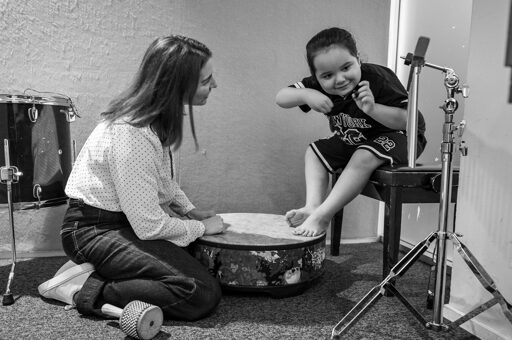
Dean Fainu, aged six, and his music therapist, Rachel Foxell, are sitting on the floor amid the instruments she’s been encouraging him to tap, stroke, and strum: a guitar, a piano, drums, and a set of hanging chimes.
She has sung him a range of songs, from “Old MacDonald Had a Farm” to “AEIOU”, which teaches Māori vowel sounds. Now, Rachel is holding Dean gently, rocking back and forth as she sings “Te Aroha”. Dean is lying still, something that doesn’t come naturally to him, and as Rachel sings, he gurgles loudly with delight.
It looks like a simple and fun interaction, but there is serious neuroscience behind this 30-minute session on a Tuesday afternoon. Dean’s parents, Pita and Stacey, say that music therapy has expanded their son’s ability to communicate, something that’s been life-changing for all three of them.
“Music therapy is a space where he feels safe and confident,” says Pita, who is Māori (Ngāti Maniapoto) and Tongan (Tefisi in Vava‘u). “It’s the one place where he’ll go in on his own, ready to sing, move, and be himself.”

“For Dean, connection doesn’t really happen through words.” Music therapist Rachel Foxell with Dean at the Raukatauri Music Therapy Centre in Auckland. (Photo: Francesca Brugnoli)
After each session, Stacey (Pākehā) and Pita often hear “happy stimming” from Dean. (Stimming refers to the sounds that people with autism-takiwātanga may make, such as humming, squealing and clicking.)
“This is really beautiful for us to hear,” says Stacey. “Those might seem like small things, but for Dean they’ve been really big steps.”
She hopes that perhaps, one day, her only child may speak freely again.
Dean was born in March 2020, a couple of weeks before Aotearoa’s first Covid lockdown. Initially, he hit the usual milestones. He was walking at 10 months and, like all babies, loved music. When Dean started talking — using words like mum, dad, nana, poppa, purple and bubbles — everything seemed to be on track.
However, at 18 months, Dean stopped using his words, and the possibility of autism-takiwātanga was raised. He was diagnosed at two and a half.
Pita and Stacey swung into action, getting help for their son. By the time Dean turned three, he was doing speech therapy and gymnastics, and swimming lessons to keep him safe around water. But, despite Stacey and Pita’s involvement with various health services, no one had mentioned music therapy as an option.
Then, one day, Stacey was at a nail salon, telling the technician about her “awesome little boy”, unaware that Jess Fox, an administrator at the Raukatauri Music Therapy Trust, was within earshot. Jess told Stacey about the trust, based in the central Auckland suburb of Grafton.
Raukatauri was set up by Dame Hinewehi Mohi in March 2004, after seeing the profoundly positive effect that music therapy in London had on her daughter, Hineraukatauri, who has severe cerebral palsy.
Intrigued, Pita and Stacey took three-year-old Dean to meet the centre’s clinical manager, Rachel Foxell, a flautist with a master’s degree in music therapy.
At that stage, Dean enjoyed songs about the numbers 1 to 5, so Rachel, who’s been a therapist for 17 years, put together a plan using those activities as a launch pad.
Stacey admits that she and Pita weren’t certain that music therapy would work: “We don’t 100 percent know what Dean understands, so we weren’t sure it would be rewarding.”
Rachel was anxious, too. In the first five sessions, she couldn’t find a way to connect with Dean and didn’t want to disappoint Stacey and Pita. On the sixth week, Dean walked into the therapy room, leaned on the piano keyboard, and made it jangle. And that was it — he was ready to engage.

Rhythm connects us to our “deepest sense of safety”, says music therapist Rachel Foxell. (Photo: Francesca Brugnoli)
Using music to activate the brain
Three years on, Dean is still considered non-verbal. But he now uses sounds and words he’s learned through music and repetition, like many children living with autism-takiwātanga, and he can count from one to 20 and recite the alphabet.
The processes at work here are echolalia, where he repeats words or phrases spoken by others, and gestalt language processing, where children learn language in chunks or phrases called gestalts, such as lines from songs.
“The rhythm and repetition in music make those patterns stick, even though he isn’t using conversational language,” says Stacey. Dean is now getting the hang of counting from 20 to 40, but those numbers aren’t yet as clearly enunciated as the first 20.
Rachel, one of 84 practising registered music therapists in Aotearoa, says that the way music therapy activates diverse brain systems can help with a range of physical, emotional, cognitive, and social challenges in both children and adults.
Science, she adds, shows us that music has a unique and positive effect on our brains and bodies: it releases the bonding hormone oxytocin and feel-good endorphins. Music also increases neuroplasticity, the brain’s capacity to learn throughout life, and can help the brain form new neural pathways.
People with autism-takiwātanga make up nearly a third of the clients at Raukatauri. They’re the single largest group, followed by those living with developmental delay, Down syndrome, attention deficit hyperactivity disorder, and cerebral palsy.
For children like Dean, says Rachel, safety and predictability are paramount. Songs, with their steady beats and familiar sounds, can promote learning and neurobiological safety, the state in which the brain and nervous system perceive the environment as safe, thereby enabling social engagement.
Rhythm connects us to our “deepest sense of safety”, says Rachel.
“That goes right back to the hapū māmā [pregnant mother]. Being in the womb is a universal experience. We get the sound of the whenua [placenta] — that’s the whooshing. Then we have māmā’s heartbeat and our heartbeat, which is where we find this deep, deep connection to rhythm. We never stay still in the womb, because we’re floating and because mum is always moving. It’s very primal. It’s also the safest we’ve ever been.”
And, for children like Dean, it’s in these safe places that magic can happen.

“For children like Dean, it’s in these safe places that magic can happen.” (Photo Francesca Brugnoli)
Inside the therapy room
Dean and Rachel start their sessions sitting on the floor as she recites an opening karakia stuck on the wall, pointing to each line as she recites it. She then hands him cards bearing song titles and a relevant picture, and he sticks those to the wall, choosing a song by pointing to a card. Nursery rhymes and songs like “Tūtira Mai” and “Tohorā Nui” are favourites. If Dean wants to hear a song again, he’ll pick the card off the wall and hand it to Rachel.
Rachel follows Dean’s cues, placing instruments that he tinkers with within his reach. Sometimes she’ll set up a musical dialogue, where she makes a noise and Dean reciprocates. He particularly enjoys sitting back-to-back with Rachel while she rocks backwards and forwards, singing the bilingual song “Row my Waka”.
“He’s always reading off me, even if he’s not giving me eye contact,” says Rachel, explaining the dynamics. “I talk, you talk. I make a sound, you make a sound. I do something, you copy it, I change it. It’s about opening up the connections, whether they’re the neural ones or the human ones.”
There have been some standout moments. One day, during an opening karakia, Rachel started to say a common ending: “Tihei mauri ora.” Before she got to “mauri ora”, Dean responded with an enthusiastic “mau!” Although he hasn’t repeated it since, this remains a thrilling moment for Rachel, Pita and Stacey.
Stacey sees the benefits of music therapy at home. “A few of the really practical things we’ve seen are learning to take turns, even in small ways, and being able to share space, which can be hard for him when his tolerance is quite limited.”
By using visual aids to pick songs, Dean has some choice and control, and the whānau uses a card system at home. Dean has also learned that things can change safely — like singing the same song in different ways, or using different instruments, singing in a different key, or singing in Māori instead of English.
The sessions also help Dean build independence, as it’s the one place where he’s comfortable being without his parents. “We can clock out for 30 minutes. We’re not having to constantly be aware of what he’s doing,” says Stacey.
And after his sessions, Dean is happy. “He’s cheeky. I think it gives him confidence knowing that he has a say. In his world, everything’s decided for him. So this is the space where he can choose.”
She pauses, reflective for a moment. “There’s never a guarantee, but you do hear stories of children who moved from vocal noise to making sounds, and then those sounds becoming words.”

“Music has a unique and positive effect on our brains and bodies: it releases the bonding hormone oxytocin and feel-good endorphins. Music also increases neuroplasticity, the brain’s capacity to learn throughout life.” (Photo Francesca Brugnoli)

“The way music therapy activates diverse brain systems can help with a range of physical, emotional, cognitive, and social challenges in both children and adults.” (Photo Francesca Brugnoli)
The power of music to soothe
Music weaves together all the parts of Dean’s life. At home and in public, he has an iPad with his favourite calming music. At home, Dean and his grandfather, Tonga Liuaki Fainu, sing Tongan songs like “Fo‘i To‘o” and enjoy clapping songs. At the marae, at home, at Raukatauri, and at his school, Central Auckland Specialist School in Mt Roskill, Dean listens to waiata like “Te Aroha” and “Tūtira Mai”.
Says Pita: “When we’re back at the marae, and those songs are around him, they’re already familiar, and that seems to help him settle. He’s not startled by the noise or the sound of a powerful moment like a haka.”
Dean used to be shy at the marae, unsure of all the movement and noise, but he now gallops around like the other kids, says Stacey. “People keep an eye out for Dean. They know to give him space.” On one visit, Stacey and Pita thought Dean had disappeared and spent 20 frantic minutes looking for him. They found him sitting in the wharenui listening to whānau singing.
Pita also encourages Dean to listen to the music of the taiao or natural world. “When we’re at our marae, I try to spend time with Dean down by the awa [river] and the waterfall that’s special to our whānau. That’s where we wash our pounamu and rinse our hands and bodies. We sit for a while, just hearing the water flowing. Sometimes we don’t say much, we just listen together.
“For Dean, connection doesn’t really happen through words. It happens more through sound, rhythm, and being present in those places — hearing the waiata, the water, and the voices of our whānau around him.”
Both Stacey and Pita are grateful that a stranger cared enough to tell them about music therapy, but they’re concerned that many families may not know it exists.
“The support it provides is huge,” says Stacey, “and I think more whānau would benefit from knowing it’s out there.”

Dean with his parents, Stacey and Pita Fainu, at the Raukatauri Music Therapy Centre in Auckland. (Photo Francesca Brugnoli)
Music Therapy Week 2026 runs from Friday, April 10, to Wednesday, April 15, guided by the theme “Weaving Connections | Te Poutama Hononga.” Music Therapy New Zealand says the week “highlights the power of music therapy to break down barriers, build relationships, and support both individual and collective identity in an increasingly disconnected world”.
Various events are taking place around the country. Details are available at www.musictherapy.org.nz/
The post The magic of music therapy appeared first on E-Tangata.
From E-Tangata via This RSS Feed.