

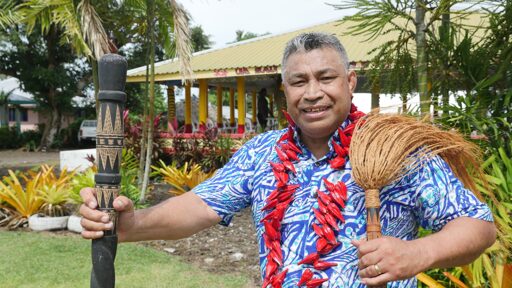

“We know that Pacific underachievement in New Zealand is largely caused by systemic educational inequities, socio-economic barriers, and a lack of culturally responsive teaching.” — Leali’ie’e Dr Tufulasi Taleni, a senior lecturer at Canterbury University, in Vaiafai, Iva, Savai’i, 2024. (Supplied)
For more than two decades, Dr Tufulasi Taleni, a senior lecturer at the University of Canterbury, has been helping teachers become more attuned to their Pacific students. Here he is talking to Dale about his own educational journey, and what he’s learned about untangling the net of underachievement and disengagement among Pacific students in Aotearoa.
Kia ora, Tufulasi. It’s a privilege to have a kōrero with you. Congratulations on your mahi, especially regarding Indigenous perspectives in the education sector, which, to me, is very important. We have to validate our own mātauranga in order to interweave it with western models of education.
But I always like to start these interviews with names, villages and some of the old people who shaped your personality as a tamaiti.
My name is Tufulasi Taleni. I was fortunate enough to be given three matai titles in my family in our village of Vaiafai, Iva, in Savai‘i, where I was born and brought up. All three titles are important to me, but the Leali‘ie‘e title is particularly special to me. It belongs to my birthplace, Utufiu, where I grew up, and it’s the same title held by my father, Leali‘ie‘e Ova Taleni. It was bestowed on me after his passing in 1993. Receiving a family title is an honour, but it also comes with responsibilities.
I was educated in Sāmoa and became a teacher. I taught there for three years before my father told me: “It’s time, young man, to leave the village and go to New Zealand to further your education and look for career opportunities.”
So I left Sāmoa in 1985*,* when I was 24, and moved to New Zealand.
Luckily enough, Invercargill was my destination. It was a great place for me, in many ways. I remember the day I flew down from Auckland. I looked down and saw the beautiful scenery — the mountains and rivers. The landscape was so different from Sāmoa. On my first night, it snowed. I woke up in the middle of the night to see the field outside, covered with snow, a white scene in the darkness.
Ka pai. It’s a very beautiful and interesting concept, the role of the matai, and it has sustained itself through many different pressures and challenges. If I’m reading it right, it’s chiefly status, but while it might be bestowed, it has to be earned.
The matai system is a highly regarded form of local government in Sāmoa. There is a saying: “O le ala i le pule o le tautua.” It means that the pathway to leadership is through service. So, service or tautua is a prerequisite to becoming a matai.
I learned how to be a matai from my father. I always looked up to him for everything — for guidance and knowledge. I would follow him everywhere, including to the village meetings. He would sit in the paepae, while I sat at the back watching and listening to the soalaupulega, the deep talanoa or dialogue that was going on. That was pretty much my education. When we talk about Indigenous knowledge, that was my first experience of learning it.
I come from a family of 15 children. Four were whāngai kids, and 11 were biological — two girls, nine boys. We were all brought up the same by our father, but there was something special about my own relationship with my father in those days. He would always say to me: “I want you to keep your eyes on me all the time during the paepae.” And walking back home, he would ask: “What did you learn?”
One of the things I learned from him was the fa‘alupega or village salutation, a traditional address that you learn by heart. It expresses the mana of your village, your people, and your family. Those things are very much in your head when you speak, and if you don’t capture these elements in your kōrero, it’s not a complete or meaningful speech. That salutation also captures the essence of your whakapapa, your genealogy, your ancestors that you carry with you.
Here, in Aotearoa New Zealand, I carry that with me in my work. You can really feel that you have the spirit or the wairua of your augatama, your ancestors, with you all the time when you speak, and even when you’re writing.
Every time you write, your people are whispering to you about things that you need to write. And that is an amazing experience.
You’ve mentioned your father. What about your mother? What’s her name?
My mum’s name is Valaei Faloa‘i Pritchard Taleni. She came from Tafua, a coastal village. When she married my father, she moved to his village and never looked back.
Traditionally in Sāmoa, when a woman gets married, she’s the one to move over to her husband’s village. I always respected my mum for that, that she never looked back, and Dad’s home is her home. She was laid to rest here last year.

Tufulasi with his mother, Valaei Pritchard Taleni, at the family home in his village in Savai’i, Sāmoa. (Photo supplied)
By the way, who chose Invercargill?
My uncle Tom came to Aotearoa in 1963 or thereabouts. He settled in Invercargill and married a beautiful Māori woman, Colleen. So we all followed him. Three of my older siblings came before me, and they also settled in Invercargill. We lived in Clifton, in South Invercargill. That’s where I worked when I arrived.
There’s always an expectation for us to continue the tautua or service to our family, so I worked for five or six years supporting our family in Sāmoa and also putting some money aside for my tertiary education.
Otago University was my place of study. In 1993, I graduated with a teaching diploma. I taught at Konini School in Bluff and then Aparima College in Riverton, and then I decided to go back to university to complete my Bachelor of Education.
I returned to full-time teaching in 1996, and a year later, I moved to Christchurch after meeting my wife, Jane. We’ve been married for 27 years and have four children — our sons Lehman George, Hiram Tufulasi, and Seth Uatisone, and our daughter Sieni-Jane.
In 2003, I became the Pacific senior educational adviser at Education Plus, which is part of the College of Education at the University of Canterbury. It provides professional development programmes and advice to educators.
That role opened up many opportunities for me. One of them was developing, coordinating and leading the Pasifika Success Talanoa Project, aimed at lifting the engagement and achievement of Pasifika students. I visited schools from Invercargill to Levin and even up north as part of this great project.
In 2016, I took up a role as a Kaiārahi Pasifika at the University of Canterbury, essentially serving as the voice for the Pacific community and students at the university. A few years later, I became a senior lecturer there. I completed my master’s degree in education in 2017 and my PhD in 2023, and this year I’ve just published my first book, Tautai: The Master Navigator, which came out of my PhD thesis.
So that’s my journey in education.
During my time as an educational adviser, I developed a programme called Sāmoa Malaga, a Pacific education initiative to take teachers, principals, school leaders, university students and staff to Sāmoa.
My family and my village were the hosts for this initiative. It ran from 2003 to 2019, and then Covid hit. About 300 educators took part during that time.
Developing the Sāmoa Malaga was one of the highlights of my career. It benefited so many educators in New Zealand, particularly those who teach and work with Pasifika students. Many of them said it was a life-changing experience. It helped them to understand their Sāmoan students’ way of being and learning.

With Associate Professor Billy O’Steen at the launch of Tufulasi’s book Tautai: The Master Navigator, in December 2025. (Photo supplied)
I’m interested in your observations about the place of indigeneity in our educational frameworks: the respect that is due to sophisticated systems of mātauranga that have been sidelined over the decades by western models of education, and how we can move forward more positively with an integration of these age-old concepts.
I wonder if you might speak to some of the concepts that you developed to share that line of thinking. What are some of the stepping stones or foundations we need to truly advance Pasifika within our educational framework?
I had a long association with Angus McFarlane, and I am especially motivated by his He Awa Whiria concept of the braided river, bringing Indigenous knowledge to life.
So if I go back to my master’s, my research area was educational leadership, because there’s something so invaluable about having effective leaders to drive change for Pacific education, countering the longstanding narrative of disengagement and underachievement.
We know that Pacific underachievement in New Zealand is largely caused by systemic educational inequities, socio-economic barriers, and a lack of culturally responsive teaching.
For instance, the education system uses Eurocentric standards, which devalue Pacific languages and knowledge. Pacific students face higher rates of poverty, which directly affects their ability to learn. And there’s a mismatch between teaching practices and the content being taught in the classroom, and the experiences that Pacific students bring to learning. They’re not always valued or understood by teachers.
I believe effective educational leadership can make a difference.
The topic of my master’s thesis was E saili i tautai se agava‘a. A true leader masters the art of navigation. I looked at the role of what is called a tautai, which is also the title of my book. Tautai comes from two words. “Tau” means to battle, and “tai” means the ocean. So it means to battle with the ocean or the challenges that the ocean presents.
Another saying I use refers to the master builder who goes out to the forest to look for the right wood to build a house, and that is akin to the role of leaders. You’re very much looking for solutions, especially relating to the disengagement and the lack of achievement of Pacific students in schools.
I use the metaphor of the tangled net, which comes directly from village life. When my father came back from fishing, he would throw the net at us to untangle. “I’ll give you a day to untangle that,” he said. “Prepare for fishing tomorrow.”
I bring that metaphor into my research. The underachievement and disengagement of Pacific students is like the tangled net that needs to be untangled. Through effective leadership, I believe we’ll find solutions that can untangle those issues.

The Taleni family, from left: Lehman, Tufulasi, Seth, Jane, Sieni-Jane, and Hiram. Pictured in Christchurch, in 2023. (Photo supplied)
What about the Pacific students you see at Canterbury University? I imagine there weren’t many Pacific students when you were first there. Has that changed since you’ve been there?
Yes, I’ve seen significant growth since I was first here in the early 2000s, in both the number of Pacific students enrolling and graduating from this institution. And more Pacific students are now pursuing postgraduate qualifications.
I think this reflects both a shift in mindset among Pasifika parents and the community about the importance of higher education, and a strong focus by the Ministry of Education through its Pasifika Education Plan to increase the number of Pacific students in tertiary education. In recent years, we’ve also had a dedicated Pacific development team at the university, and that’s contributed immensely to the growth and retention of Pacific students here.
To wrap up our kōrero, I wonder if you might tell us what you do to keep yourself fresh?
I’m sure you’re like me, Dale. Once you’re a rugby player, you’re always a rugby player in some way. I’m also a golfer and very much into the outdoors with the family.
My wife and I enjoy any downtime that we have, but to be honest, as the result of this book, I’m in trouble now because I’ve found something that I’m really enjoying. I turned 65 this year, but I will continue, hopefully for a few more years, to produce some resources for this kaupapa.
As I see it, Māori lead the way, and I’m so grateful that I work quite closely with them in this space. That really motivates me to carry on doing these kinds of things.

Tufulasi and Jane in Savai’i, Sāmoa, in January 2026. (Photo supplied)
(This interview has been edited for length and clarity.)
Leali‘ie‘e Dr Tufulasifa‘atafatafa Ova Taleni**is a senior lecturer in the School of Leadership and Professional Practice, Faculty of Education, University of Canterbury. Tautai: The Master Navigator — Navigating Pacific students’ education, health, and wellbeing from a Pacific leadership perspective was published by NZER Press last year.
The post Tufulasi Taleni: Untangling the net of underachievement appeared first on E-Tangata.
From E-Tangata via This RSS Feed.