

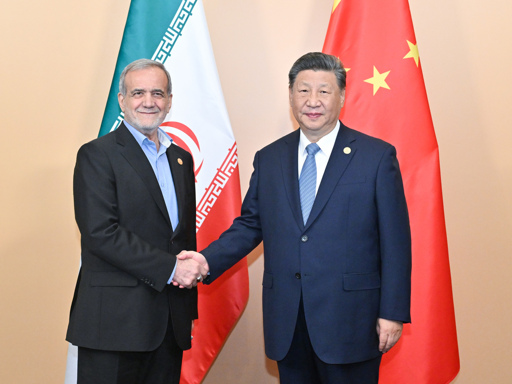
There is a parallel between China’s conduct and the maxim attributed to Napoleon Bonaparte, who, upon observing the Austrians abandoning a favorable position at Austerlitz, remarked: “Never interrupt your enemy when he is making a mistake.”
China has adhered to this piece of political wisdom. It has watched Donald Trump blunder and accelerate the strategic decline of the United States through imperialist aggression against Iran. As The Economist notes, “Not every war has a winner. But every war has at least one loser and if — a big if — the ceasefire marks the end of the war in Iran, the biggest loser will be Donald Trump.”
Of course, China has seen disruptions to its energy supply. But inconveniences aside, the country is so far the biggest beneficiary of the war. What matters most to President Xi Jinping is making the U.S. embarrass itself in the conflict.
That is the picture emerging at this moment. Trump has arrived at the fragile ceasefire agreement from a position of negotiating disadvantage, having failed to achieve his stated political objectives. This has exposed the limits of U.S. military coercion as it remains a mere spectator to Iran’s military control over the strategic Strait of Hormuz.
But China was also indispensable to reaching the ceasefire agreement, decisively influencing Pakistan’s mediation. Why? Every stage of the war has its own logic. China did not passively watch Trump’s mistakes, nor did it wish for this paroxysm in a region where it has major strategic interests.
China Wants a Middle East Open for Business
It is one thing to watch its greatest rival fail in Iran; it is another to allow this strategic self-destruction to affect China’s serious economic interests in the Middle East. It is in this context that Beijing has adjusted its policy: pressuring Iran to accept an agreement that, under current conditions, would necessarily be disadvantageous to the United States, and could prevent further escalation.
More than that, the end of the war allows Chinese capitalism to reap the rewards of yet another chapter in the demoralization of imperialism in the Middle East.
After the failure of the initial bombings to achieve “regime change,” and the reopening of energy flows from the Gulf, the strategic initiative shifted to Tehran. China seized the moment, working behind the scenes to aid Iran’s efforts, just as it had done in support of Russia against Ukraine. Under the guise of neutrality, Beijing became a key supplier of perchlorates, chemicals essential for the production of solid rocket propellants. The country also supplied microelectronics and BeiDou 3 satellite modules, the Chinese GPS system for precision strikes, so that Iran could strike U.S. targets and those of its regional allies.
For all intents and purposes, China assisted Iran in shutting down the Strait of Hormuz.
The situation took a different turn for the Chinese when Trump threatened to destroy Iran’s electrical infrastructure if an agreement were not reached. The consequences of destroying the energy sources that power the oil and natural gas extraction and refining system (like the Damavand thermal power plant or the Bushehr nuclear power plant) would pose enormous problems for China. Retaliation against the entire energy infrastructure of the Middle East — the Ras Laffan Industrial City in Qatar, the world’s largest center for natural gas production and export, or the Ghawar oil field in Saudi Arabia — would alter the global economic balance for an indefinite period.
The threat of escalation is a problem for China. First, because it could grant the U.S. something it had previously been unable to secure: the precedent of the forced opening of the Strait of Hormuz. China’s top foreign policy official, Wang Yi, made a series of calls to his counterparts in the region emphasizing the need for a ceasefire and urging countries not to resort to force to reopen the strait. China, along with Russia, vetoed a UN Security Council Resolution that would have justified the use of force against Iran. This would have presented consequences not only for the Middle East but would have encouraged similar actions by the United States elsewhere in the future, even in the Asia-Pacific region.
The main concern, however, is economic. Although a major oil producer, China imports more than 70 percent of the oil it consumes (11 million barrels per day), and 40 percent of these imports come from the Middle East via the Strait of Hormuz. China is the largest buyer of Iranian oil (13% of its maritime imports come from Iran via the Strait of Hormuz), as well as fertilizers and strategic inputs like helium gas, a byproduct of natural gas production, which is critical for the manufacture of semiconductors and artificial intelligence technologies.
A prolonged conflict could therefore not only disrupt trade routes and raise import costs but also lead to supply issues for China’s tech industry. By pushing for a ceasefire, Beijing has protected not only its strategic relationship with Tehran but also its energy security.
Iran as a Piece of China’s Political Strategy
Furthermore, the decision to act reflects a broader political strategy: preventing the Middle East from plunging into instability, protecting its economic interests, and consolidating its image as a counterweight to U.S. hegemony. China’s economic investments in the Middle East are vast and multifaceted, spanning energy, infrastructure, technology, and finance, and constitute a fundamental pillar of the New Silk Road.
In Saudi Arabia, China has invested billions in petrochemical projects and renewable energy ventures, aligning with Riyadh’s Vision 2030 while securing long-term oil supplies. In the United Arab Emirates, Chinese investments span electric vehicle production, aviation, and digital technology. In Qatar, natural gas supply agreements involve ownership of extraction fields, such as North Field East and South.
The interest in securing raw material supplies from Iran, Saudi Arabia, the UAE, Qatar, and also Israel — China has become the largest exporter of goods to Tel Aviv, and has investments in ports and high-speed railways within that genocidal colonial enclave — makes the Middle East Beijing’s second most important sphere of influence, alongside Africa. Beijing has no interest in seeing the destruction, over many years, of an infrastructure from which it increasingly benefits.
No less important is the possibility of advancing yuan-denominated transactions in the energy sector. Some are already referring to the phenomenon as the petroyuan. Without yet having the capacity to displace the dollar’s hegemonic position, China is taking advantage of the chaos caused by the United States to advance the use of its currency. The China Cross-border Interbank Payment System (CIPS) recently recorded a single-day transaction volume of 1.22 trillion yuan (U$178.5 billion), largely originating from the Middle East. Iran is one of the countries persuaded to use the yuan as a way to mitigate the impact of sanctions imposed by Washington.
As Federico Fubini writes in Le Grand Continent:
The dollar remains strong for very real structural reasons, but these are not grounds for confidence, since there is no alternative. This resilience due to a lack of alternatives is fragile, as it is based more on exit costs than on confidence in the issuer’s soundness. However, this cost is not fixed. It decreases as alternatives gain strength, albeit slowly. Every oil contract signed in yuan, every central reserve partially replenished with gold, every bilateral agreement denominated in renminbi imperceptibly reduces this cost. The process is slow, and invisible in day-to-day markets.
China’s difficulties are overshadowed by Trump’s unforced errors. Amid ceasefire preparations, Xi Jinping demanded that Chinese military commanders take the lead in “restoring and promoting the fine traditions of the Party and the Army,” abandon “misguided stances,” and remain faithful to the national identity. The “Zhang Youxia” problem seems to have taken a back seat. But the training of loyal generals, and the absence of experts and career military officers in the Central Military Commission, appear to be issues with no solution in sight for a country with expansionist goals in the Asia-Pacific and particularly Taiwan.
Perhaps more than Napoleon’s maxim, China follows a classic guideline from Sun Tzu: defeating the enemy in a hundred battles is not the supreme excellence. Rather, the supreme excellence consists in defeating the enemy without a fight. It is achieving this feat courtesy of Trump. The coming episodes will reveal the extent to which reactionary Chinese capitalism will advance against the traditional strongholds of U.S. imperialism in the Middle East.
The post In Iran, Trump Gives China the Opportunity to Win Without Firing a Shot in the Middle East appeared first on Left Voice.
From Left Voice via This RSS Feed.