

The quest for gender liberation and socialism have been linked practically from the beginning. Early utopian socialists criticized women’s oppression and sought to consciously create gender equality through their schemes to remake society. Later, Engels’ Origin of the Family examined patriarchy through the perspective of historical materialism, using anthropological research from the time to argue that the gendered division of labor and inequality were not “natural” but developed historically.
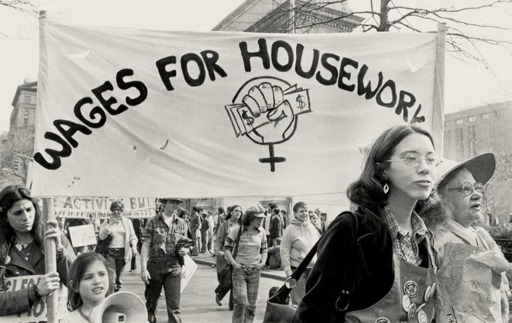
In the 1960s and 1970s, Marxist feminists built on this legacy to produce such landmark works as Margaret Benston’s The Political Economy of Women’s Liberation and The Power of Women and the Subversion of Community by Selma James and Mariarosa Dalla Costa. These texts argued that the subjugation of those gendered as women was not incidental to capitalism but fundamental to it, as the sexual, reproductive, and care work imposed on them created the conditions for the working class’s very existence. This labor makes it possible for any economy to function, yet it goes largely uncompensated and is consistently devalued by society. Meanwhile, the economic dependency on the income of men creates a form of “double oppression,” leading the 19th century socialist feminist Flora Tristan to call women “the proletarian’s proletarian.”
These contributions are critical in establishing how we understand the function of patriarchy under capitalist relations. Yet, to paraphrase Karl Marx, our role as political people is not only to critique the structures of society, but to transform them, and many socialist feminists have attempted to do exactly that.
Utopian Socialism
The utopian socialists of the early 19th century were notable as one of the first movements in modern history to advocate for gender equality. In fact, Charles Fourier is credited with coining the term feminism (although he did not, of course, invent the idea). The embrace of feminist principles, seen as very radical at the time, made it possible for many women, such as Anna Doyle, Frances Wright, Desirée Véret, and Flora Tristan to participate as notable leaders. Building on utopian socialism, Tristan turned to the workers’ movement as the class that could build a liberated society, thus starting the transition to scientific socialism.
Although the early utopian socialist movement was not without its flaws, it is to their credit that some of these leaders attempted to put their ideals into action, such as Frances Wright’s Nashoba Community in Tennessee, which was based on the principles of gender equality and the abolition of slavery. Also notable was the California community Llano del Rio started by the socialist politician Job Harriman in 1914. The architect Alice Constance Austin created a visionary plan for the community which featured collective kitchens, laundry, and childcare.
While these communities ultimately failed and Austin’s elaborate designs were never realized, they reflected the desire to liberate people from an oppressive society.
Sylvia Pankhurst
Sylvia Pankhurst’s life was entirely dedicated to radical causes. Her mother Emmeline Pankhurst was a prominent leader of the Women’s Social and Political Union (WSPU), part of the suffragette movement in Britain advocating for women’s right to vote. Sylvia and her sister Christabel were also heavily involved in this movement, but Sylvia strongly disagreed with her mother’s and sister’s prioritization of middle class, bourgeois, and property-owning women.
Sylvia, in contrast, was always on the side of working-class women, which ultimately led her in the direction of socialist organizing. She staunchly opposed her mother’s social patriotism and support of Britain in World War I. Sylvia’s political principles led her to break from the WSPU and found a new group in 1914 — the East London Federation of Suffragettes (EFLS) — which would later become the Workers’ Socialist Federation (WSF) with its newspaper the Workers’ Dreadnought.
The WSF formed a community center in the East End and began providing services such as not-for-profit restaurants, a free health clinic, and a Montessori nursery. In a time of great poverty and unemployment they also established a toy factory which paid women at the same rate as men, provided free childcare for the workers, and encouraged them to incorporate their own creativity and designs into the process. Notably, the toy factory also created East Asian and African dolls, reflecting an anti-racist ethos.
Inspired by the Russian Revolution of 1917 with its workers’ councils, called soviets, Sylvia developed her ideas for “household soviets” as part of her vision for a society based on workers’ councils in Britain. The household soviets would allow homemakers — a role traditionally imposed on women in the gendered division of labor — to become directly involved in the planning of the new economy based on workers’ control. She also wrote about “cooperative housekeeping,” the idea that the labor time involved in reproductive work could be reduced through its collectivization, a concept that would later be realized in the early Soviet Union.
Constructivism and the Soviet Avant Garde
The Russian Revolution marked a new epoch in world history by founding the Soviet Union as the first state based on socialist principles. The already burgeoning avant garde art scene was infused with new life and revolutionary fervor, inspiring the Constructivist movement — so named because its artists were dedicated to being part of constructing the new socialist society. Constructivism focused on material reality and transforming the conditions of life, which they set out to accomplish in various ways.
Lyubov Popova, already an accomplished abstract artist, transitioned from painting for purely aesthetic purposes to the production of everyday life. Popova, in collaboration with Vervara Stepanova, created futuristic textile patterns for workers’ clothing, designed specifically to be seen while moving with functionality being a primary concern.
In the field of architecture, Moisei Ginzburg and Ignaty Milinis designed the Narkomfin building as a form of experimental housing contributing towards the socialization of culture and domestic labor. The plan was to create more communal spaces to serve as “social condensers” which would break down the divisions of bourgeois society. Notably, the living areas were shared by several families including collective kitchens, childcare, and laundry, with the intention of reducing labor time involved in these tasks, and also to liberate women from the traditional nuclear family structure.
Unfortunately, these revolutionary concepts were later negated in practice due to the conservative policies imposed on the Soviet Union under Stalin’s leadership. They nonetheless serve as an inspiration for the possibility of what can be achieved in transforming culture under socialism.
Learning from Examples
The socialist movement began with such “radical” demands as women’s liberation. Bourgeois society has kept women oppressed, but the socialist feminism movement has sought to eliminate the conditions which produce gender inequality through revolutionary change. By transforming the material reality that subjugates people who are gendered as women, these divisions will eventually wither away.
Throughout history, socialist feminists worked to produce a material basis for gender liberation by striving to create new forms of life. They attempted to accomplish this through, for example, the collectivization of reproductive labor. As scientific socialists, we can learn from these examples as we move to change the world ourselves, using such alternatives to take care of one another and advocate for a better system than currently exists under capitalism.
The post Socialist Feminism and the Transformation of Everyday Life appeared first on Left Voice.
From Left Voice via This RSS Feed.