

By Montreal for a World BEYOND War, April 12, 2026
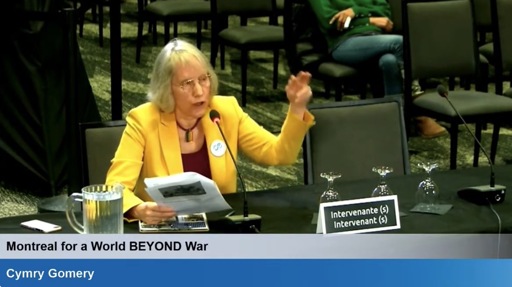
On March 19 Cym Gomery, Coordinator of the Montreal World BEYOND War chapter, presented at the governmental public hearings for the environment (BAPE, Quebec’s environmental review board) regarding the expansion of a General Dynamics facility in Valleyfield Québec. For this expansion to proceed, BAPE requires the project to demonstrate that it has “social acceptability.” The Montréal for a World BEYOND War presentation was one of several presentations challenging GD that their expansion could not be “socially acceptable” for a wide-rangign set of reasons, notably including that the materials produced in this facility are directly linked to the genocide in Gaza.
The plant in Salaberry-de-Valleyfield, Quebec is operated by General Dynamics Ordnance and Tactical Systems – Canada (GD-OTS), a subsidiary of U.S. weapons giant General Dynamics, the world’s sixth largest weapons manufacturer. GD-OTS Canada is a producer of military ammunition, including propellants used in mortars, tank ammunition and heavy artillery, with a handful of manufacturing facilities in Quebec. GD-OTS plans to spend $682 million to add 12 buildings to its 150-building campus in Valleyfield, according to BAPE. As reported by The Maple, the expansion is entirely funded by the U.S. military.
The expansion would allow GD-OTS to more than double its capacity to produce M31A2, a propellant used in heavy artillery. The Valleyfield plant is the sole North American supplier of M31A2 triple-base propellant and is currently fulfilling various contracts to produce this propellant for the U.S. to supply its allies, including Israel. This propellant is used to fire the hundreds of thousands of 155mm artillery shells that Israel has deployed in its assault on Gaza.

Vidéo ici. Le mémoire écrit qui l’accompagne est disponible ici. The video (in French) is here. The full text of the accompanying written brief that was submitted is here.
Montréal for a World BEYOND War’s submission to the review board:
Context
General Dynamics à Valleyfield inc. (GDV) wants to modernize and expand its facility for producing explosives in Salaberry-de-Valleyfield.
The facility wants to increase annual production of around 2,722 million metric tonnes to more than 10,000 metric tonnes. The project cost is $682 million.
GDV describes its mission as being « to provide safe, innovative and reliable products [that is, explosives] to allow Canadian troops, allies and other clients to excel in accomplishing their missions. »
In its BAPE presentation, GDV refers to its explosives euphemistically as “energy materials”, however it is important to note that the International Committee of the Red Cross (ICRC) defines explosive weapons as “munitions activated by the detonation of a high-explosive substance, creating primarily a blast and fragmentation effects, and their delivery systems.”

Israeli strike on a residential building in Nuseirat, central Gaza, on 20 July 2024 (Omar Naaman/Reuters)
These weapons kill or maim many civilians, destroy infrastructure, and damage the natural environment. In myriad ways, they threaten human and global security.
History of accidents at the Valleyfield location
Let us take a moment to consider that GDV is producing a dangerous product at a facility with a history of accidents.
- On August 26 1980, an explosion in a “propulsive 280” drying facility killed two workers immediately, and wounded two others, one of whom subsequently died of his injuries.
- In 1983, a worker died of chemical intoxication.
- In 1993 two workers died of an explosion in a drying facility.
- On May 29 2020, a GDV building used to handle explosive powder was destroyed by an accidental explosion.
- October 29 2024, a worker was crushed by a rail car on the work site.
GDV’s assessment of the environmental effects
GDV has already acknowledged in section 5.2 of the Avis de projet that the project in its preliminary phase will pollute soil and water, and destroy wildlife habitat. Once construction begins, GDV notes that these impacts continue and intensify to include noise pollution, vibrations, dust and increased vehicle traffic, including heavy equipment traffic. Once the explosives production begins, they add, the air and ground and water pollution will continue, and the noise, vibrations and heavy equipment traffic will increase. GDV acknowledges that all these extra vehicles will produce greenhouse gases (GHG).
These effects that GDV has acknowledged are just a tiny fraction of the overall environmental impact of their expansion.
Environmental impact of explosives
The proposal to expand production of GDV is not a straightforward case when it comes to the environment, and thus our consideration of accidents should not stop at the property lines of the GD Valleyfield facility. These explosives find their way to various conflict zones. The elephant in the room is that the government of Quebec is hosting a facility that creates explosives—weapons of mass destruction, whose impact goes far beyond the immediate environment of the production facility.
Historically there has been a lot of secrecy about where the weapons produced by GDV end up, but a recent groundbreaking report by the Arms Embargo Now coalition provides details showing that Canadian arms manufacturers, including General Dynamics, are supplying weapons directly to the Israeli government. A subsequent report shows that Canadian weapons flow to Israel and other destinations that may be committing war crimes, without the usual environmental or human rights oversights, because of a legal loophole that exempts them when they are shipped first to the United States.
Unfortunately, when the horror of the explosions is but a memory, deaths from unexploded ordnance continue.
- For example, in April 2024 the Ukrainian government reported that landmines and other unexploded ordnance had accounted for more than 1,000 civilian casualties since the start of Russia’s invasion.
- Research in Cambodia, which was bombed extensively by the US military during the Vietnam war (1955-1975), suggests that unexploded ordnance continues to harm agricultural productivity there today, where farmers, wary of unexploded bombs, avoid using tractors and other agricultural techniques that could increase agricultural production.
- Studies also show that explosive remnants of war affect soil quality. Unexploded bombs and landmines can leak heavy metals and toxic waste into the soil, polluting land and water.
The world community is already experiencing food shortages—is the Québec government ready to welcome the mass migrations that could result from food shortages brought on by its investments in products like General Dynamics explosives, that reduce the world’s food supply?
Humans are part of the environment
Data assembled by Action on Armed Violence indicates that 90 per cent of those killed and injured by explosions in populated areas are civilians. And this source of harm can linger – sometimes for decades – because some explosive weapons fail to detonate on initial impact. Unexploded ordnance (UXO) can detonate long after a conflict has ended, killing and maiming a new generation.
Harm to infrastructure and nature
These explosives are made to be used, and in fact the economic viability of the GDV facility depends on war and genocide; thus we should consider the human, animal and plant life that will be destroyed by GDV products. Buildings, including hospitals, schools, houses that will be exploded using materials produced at the GDV facility. Even though the people who have been and will be killed, and the aforementioned animals, buildings and nature hospitals destroyed are not in Québec, they are still precious and worthy of protection.
Infrastructure
The damage that explosive weapons cause to human infrastructure threatens the health and wellbeing of people and animals residing in the conflict zone – and sometimes far beyond it. As we see in Ukraine, Iraq, Yemen, Syria, and Palestine, the use of explosive weapons cuts off access to clean water, compromises sewage systems and other critical infrastructure, releases hazardous materials and fumes into the environment, hinders the provision of medical treatment, and contributes to the outbreak of communicable diseases.
The use of explosive weapons in urban areas can release a host of toxic and hazardous chemicals from damaged commercial and industrial units, utility infrastructure, filling stations, workshops, fuel storage, and garages. Explosions create airborne contaminants, negatively impacting human and animal health through direct contact, inhalation, or ingestion of chemicals or contaminated soils. Contaminants like lead, chromium, fuel oils, Polychlorinated biphenyls (PCBs), and polyfluoroalkyl substances (PFAS) can also leach through soils, migrating to underlying groundwater, and flow into streams or rivers.
Nature
Armed conflict has devastating effects on the environment, killing flora and fauna, and damaging forests and fields and wetlands.
Note that international human law includes the Rome Statute of 1998, which labels causing widespread, long term, and severe damage to the natural environment a war crime.
Climate impacts
Explosive weapons harm and destroy the natural environment, causing wildfires and floods. This damage is amplified by the effects of climate change – extremely high temperatures and violent storms.
Wars and climate change are inextricably linked. Climate change can increase the likelihood of violent conflict by intensifying resource scarcity and displacement, while conflict itself accelerates environmental damage. • These explosives will be shipped overseas, and the airplanes and ships used will increase global GHG.
- Some of these ordnance will fail to detonate, and these abandoned munitions can explode in the event of a heat wave. For example, six different munition sites exploded across Iraq during scorching hot summers in 2018 and 2019, when temperatures regularly topped 45°C. Heatwaves were blamed for a similar arms dump explosion in Jordan in 2020.
- In another example of how climate effects of bombs go on long after wars have ended, reports show that wildfires detonated unexploded bombs from World War II in August 2025 in the North York Moors, UK.
- In Libya, Storm Daniel destroyed two dams in 2023, causing flooding in large parts of the eastern city of Derna. The flooding displaced unexploded ordnance and ammunition stores, which complicated recovery efforts.
- Explosives experts had to be deployed during the destructive floods in South Sudan in 2024 to assess whether land was safe for the relocation of displaced people.
These are just a few examples that illustrate the intersectionality of the war industry, environmental damage, climate change and even agriculture and migration.
Conclusion
By expanding the production of the General Dynamics facility in Valleyfield Québec, the Québec government is increasing its own complicity in global wars, and in the resulting damage to human populations, agriculture, climate change, infrastructure, flora and fauna. We invite the government of Québec to look beyond its own borders and its own short term profits. We think that if the government applies a moral and even self-interested lens to General Dynamics’ proposal, it will realize that the health and survival of the natural environment in any part of the world is inseparable from our own… expanding this weapons facility is simply a bad idea.
The post Denouncing General Dynamics Planned Explosives Factory Expansion in Quebec appeared first on World BEYOND War.
From World BEYOND War via This RSS Feed.
Removed by mod