

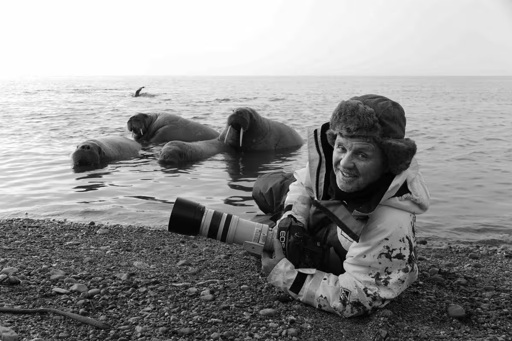
There are moments in natural-history films when the camera seems improbably close: a polar bear’s breath fogging the lens, a seal’s eye lingering, an orca pod moving with intent beneath fractured ice. The illusion is of proximity without disturbance. The reality is colder, slower and less certain. It depends on patience, judgment and a tolerance for discomfort that most viewers never see. Doug Allan spent his career in such conditions. He worked where light is scarce, where equipment fails, and where the margin for error is thin. Much of his footage was gathered in the polar regions or underwater, environments that reward persistence and ingenuity. He liked the constraints. You could only be in one place at a time, he would say; if you weren’t there, you would not get the shot. Allan came to filmmaking indirectly. Born in 1951 in Dunfermline, he studied marine biology and began as a diver, including work with the British Antarctic Survey. A meeting with David Attenborough in Antarctica in the early 1980s redirected his path. He bought a camera, filmed emperor penguins, and sold the footage to the BBC. From there he became a principal cameraman on landmark series such as The Blue Planet, Planet Earth and Frozen Planet. His work helped define how audiences came to see remote ecosystems. The sequences were often brief on screen but long in the making. Allan might spend weeks waiting for an animal to appear, or return empty-handed after a day’s search. He accepted this as…This article was originally published on Mongabay
From Conservation news via This RSS Feed.