


Lyric Aquino
Underscore Native News + Report for America
This story is the first in a new series by Underscore Native News that explores and amplifies Indigenous climate solutions. Underscore is a participant in the Indigenous Climate Solutions Cohort. This five-newsroom cohort is part of the Indigenous Journalists Association (IJA) and Solutions Journalism Network’s Climate Beacon Newsroom Initiative.
As climate change continues to shift and accelerate around the world, seasonal indicators that have been relied on by Indigenous peoples since time immemorial are being tested. In the Pacific Northwest, the traditional ecological knowledge of the Suquamish Tribe is among the knowledge systems being tested as growth cycles shift, leading to unpredictable harvesting dates and bounties.
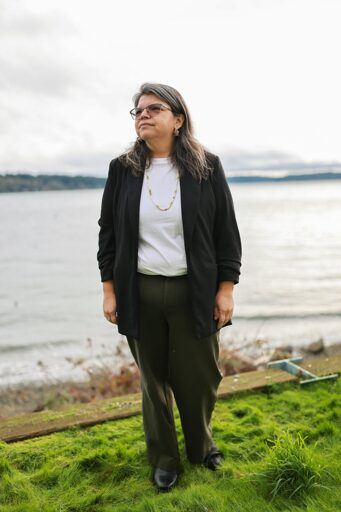
Suquamish Tribal Council Member Azure Bouré, said that as climate change rages on, the plants she annually harvests have changed their growing cycles, leading her to alter the knowledge passed down to her.
“When I was talking with other friends we noticed that the environmental time markers have been changing for us,” said Bouré. “Now we’re having to address the ways we gather.”
From medicinal teas to balms, salves, elderberry syrup, and rotating seasonal and small batch items, Bouré, who also serves as the tribe’s traditional foods and medicine program coordinator, provides tribal members with culturally relevant medicines in a cubby dubbed “Azure’s Apothecary.”
Her work often involves teaching courses on how to find, forage and prepare plants for these medicines — which have become a reliable place for her community to seek cultural care.
The insecurity the Suquamish community faces with this newfound unpredictability has pushed Bouré to constantly update her community classes with accurate information amidst real-time shifts in her traditional ecological knowledge.
Adapting to climate change
Bouré, who has a degree in Native American environmental science from Northwest Indian College, enjoys teaching eager students of all ages to identify, harvest and process plants, make medicines and prepare Suquamish foods.
In her classes, students can be found huddled around her, eager to learn herbal healing methods as Bouré thoughtfully answers questions and provides tips to make the practices easier to replicate.
“I was that weird kid in the woods gathering things and making potions,” Bouré laughed.
With climate change looming over the Pacific Northwest, Bouré’s had to get creative with how she educates her community. In her efforts to share traditional ecological knowledge with the next generation, she’s realized that having students come out with her isn’t always possible anymore.
In spring 2025, she wanted to take students out to harvest maple blossoms, a small edible flower on maple trees that is usually harvested in the spring. There’s a short window when they blossom, and if the weather is off, they bloom too early or late, and the harvesting window can easily be missed. But the seasonal predictions have made it increasingly difficult to schedule.
“Last year didn’t work because the dates are off and you used to be able to practically guarantee they’d be there, but now you can’t, which causes issues for transportation, permission slips, etc., because the maple blossoms are off-site,” Bouré said.
Instead, she’s pivoted to having students help her gather nettle because the different stages of nettle can be gathered for two months. But she said part of her lessons is teaching students about how climate change is affecting when they can and can’t harvest.
“That’s what you talk about with them. It’s the changing world and how things aren’t as certain as they used to be,” she said. “For our ancestors, it was more like clockwork. Now we have to be more in tune and watch for the signs.”
Another way Bouré has managed to work around the shifting climates and plant scarcity is by making herself known in her community. With the success of Azure’s Apothecary medicines rising, Bouré now has people coming to her year-round, telling her she can harvest on their lands, which typically provide a safe space for her to gather.
“As access diminishes to open spaces, clean open spaces, you have to be very careful where you gather,” she said.
However, between medicine kits, scheduled programming and education, for Bouré, there’s always a need to harvest and have access to more spaces to do so. One creative way to continue educating and harvesting was for Bouré to join the boards of two land trusts: Great Peninsula Conservancy and the Bainbridge Island Land Trust. She now has access to gather on those lands and was even able to bring students out to harvest on the Great Peninsula Conservancy property.
“If I know what’s available, I’ll know what to ask for and through those board meetings, I find out what they have, what their assets are, what could work for me,” she said.
As Bouré continues to adapt to climate change, she said it’s important to remember why she started studying plants, and why she created her medicinal apothecary.
“I love being trusted. When people started trusting me with my medicine, that was big,” she said. “But keeping a cultural connection with who we were and who we are is really important.”
Unpredictable climate leading to unpredictable harvests
Bouré’s 2025 harvesting season was a challenge, particularly with rosehips, used for teas and other medicinal products. Normally, rosehips are harvested in late summer and throughout autumn, when the rainy season just starts, but after the first freeze, as the freeze makes them sweeter, according to Bouré. But last year was different. The weather was rainy and warm, causing the rosehips to spoil weeks earlier than they normally would.
Bouré worries that declining plant quality is affecting the potency of her medicines. For instance, licorice root used to bloom once a year in March, but now they’re considerably smaller and bloom four times a year.
“They’re a lot smaller than they used to be,” she said. “Right now, they should be nice and fat, but some of them are not as big as they used to be. When I first started harvesting, they were monsters.”
In addition to rosehips, licorice root and nettle have also become increasingly unpredictable. The plant is often found in riparian areas or wetlands adjacent to fresh water sources, like small streams or lakes. According to Bouré, nettle thrives near wetter roots, so if it’s a dry year, the plant will be more difficult to find. Some years there has been a carpet of nettle, and other years just small patches.
“It all has to do with how much rain we’re having and the heat,” Bouré said. “The heat dome didn’t help anything around here. It killed our cockles [a type of mollusk] and burned our cedar trees. It was bad.”
In 2021, the Northwest experienced record-breaking high temperatures from late June through mid-July, and it was one of the most extreme heat wave events recorded in history. In the United States alone, 250 people died. The regional average daily maximum temperature was nearly 30 degrees Fahrenheit hotter than average of the hottest three months in the previous decade.
While temperatures during the heat dome continued to rise, agriculture began to suffer. In some parts of the Willamette Valley, farmers suffered a total crop loss. In the coast range, trees that were not adapted to such high heat showed scorched leaves and dropped needles, leaving them damaged and bare.
The heat dome, ongoing drought and wildfires have left plants in Bouré’s ancestral homelands drastically changed. She noticed plants no longer taste the same, leading her to fear their potency might have altered, thereby affecting the strength of her medicines.
Reflecting on her youth, Bouré noticed the berries aren’t as sweet, and that red huckleberries are difficult to find, compared to her childhood when they were abundant. Now they’ve been replaced by evergreen huckleberries.
“They’re not getting all the nutrients from the trees,” Bouré said. “They’re not getting the same amount of rain. They’re not getting enough sun.”
Scarce cedar
Suquamish elder Kippie Joe has been harvesting cedar for 30 years. Joe, a longtime friend of Bouré, said they’ve bonded over discussing differences in plant behavior over their lifetimes, leading to shifts in their traditional ecological knowledge.
Her love for harvesting started when she was a young girl, harvesting plants for weaving with her aunts in Canada. Now a seasoned harvester, Joe says she harvests on a case-by-case basis rather than relying on tried-and-true seasonal indicators. The changes have made it challenging for her to teach her grandson how to harvest with her.
“It’s funny how the weather is just messing with the seasons,” she said. “It’s just a lot of different plants changing, and I’m noticing that they’re going out later and later.”
Joe used to harvest cedar in early spring when the dogwood trees were in bloom. However, now she has to look at each tree before she harvests and tries to figure out if a patch is ready. Instead of going out to harvest cedar at the end of March, she is now harvesting in May.
Another issue Joe has tracked is the quantity of cedar she’s able to harvest. Previously, it was typical for her to gather 40 rolls of cedar and on a rare occasion, even 60. Now, she’s lucky to harvest 15 rolls a year. She also noted the harvesting season is unpredictable, either lasting longer than usual or getting cut short. That means she has to harvest enough cedar for a year’s worth of projects with the limited time and sparse harvestable trees.
“I only get to harvest personally, maybe two months, or two and a half months,” she said. “I have to get enough cedar to last a whole year, including cedar for personal use, for giveaways, for teaching and then for potlatches.”
Cedar harvesting is a deeply personal and spiritual experience for Joe. While she can buy cedar from others if she runs out, she doesn’t like to. She doesn’t know what kind of mood they were in while harvesting or which technique they used. For many tribes, harvesting plants, preparing food and creating art should only be done when grounded and mentally clear, to ensure only positive energy in the materials. This is why Joe likes to harvest her own plants: she makes sure she’s doing so with a clear mind.
Increasing heat has stressed out cedar trees — trees that rely on water to thrive and require consistent, deep moisture — Joe said, and are affected by rising temperatures and back-to-back drought years.
“I find myself praying for more rain and more snow up in the mountains, because that makes it easier for me to pull the cedar,” she said. “I’m wondering how much longer we’ll be here and how long we’ll be able to do it. I’m finding out that I have to start looking for other materials to use. I don’t think anything can replace cedar. And I don’t know what will happen in five years, six years, when my other grandkids are old enough to go out with me and gather. I don’t know what to tell them.”
“Passing on our traditions to the next”
In Bouré’s arthritis salve-making class, she moved gracefully and with purpose, captivating over half a dozen students. She shared that a little ginger essential oil and cayenne pepper can be used for a heating effect, and further explained that mixing those with rosemary and peppermint oils can be used as a cooling agent.
Vincent Chargualaf, a citizen of the Suquamish Tribe, is the recreation program manager for the Suquamish Family and Friends Center. He watched Bouré closely as she prepared the salve, writing it down to add to his collection of recipes he’s learned. An avid student of Bouré, Chargualaf consistently uses Bouré’s all-purpose healing salve. One of the main ingredients, plantain, is good for injuries like small cuts and scrapes — a fact Chargualaf recalled from one of Bouré’s past lessons.
He even keeps his salves in a first aid bag that he takes on hikes, canoe journeys and other events where the attendees are mainly Indigenous.
“If I’m at an organized event where it’s primarily Native people, there’s going to be an abrasion towards using commercialized products that have a bunch of chemicals that come from pharmaceutical companies,” Chargualaf said. “Whereas something that came from home, something that’s tried and true ancestrally, people are a lot more open to using that.”
Reflecting on how climate change is affecting the traditional plants and medicines in his community, he’s afraid to think about plants that have existed for so long potentially being wiped out within a few generations.
“It’s very daunting, because it’s like these are tried and true methods that our tribe has relied on for so long, since time immemorial, to the point that we have words for them in our language that go back with the stories that can be told about why each of these things are important,” Chargualaf said.
Samantha Robson, a citizen of the Suquamish Tribe and cultural specialist for their early learning center, is an advocate for Azure’s Apothecary and holistic healing. Robson’s family has a difficult past with doctors. For a long time, they were a source of fear and anxiety, and for them, Azure’s Apothecary was a substitute.
While Bouré suggested going to see a physician, she also acknowledged that a lot of Indigenous people have medical trauma and a lack of access to healthcare, and Bouré’s medicines can help aid in the health of tribal members and their families.
“I don’t feel like I need to always run to the doctors to figure something out,” Robinson said.
“My family has a hard time with doctors, and honestly, a lot of fear. For a while, my family wasn’t seeing doctors. It was a big anxiety for us, and so Azure was our substitute.”
Although Bouré always recommends seeing doctors when needed, providing traditional medicines to her community was a way to help people like the Robson family.
After first using the medicines at Azure’s Apothecary for smaller medical needs, Robson, who often comes to Bouré’s workshops, said she hopes to one day have the wealth of knowledge that Bouré has, so she too can become a cornerstone in her community.
“When I come to watch her, the confidence builds in me. And I know that I’m worthy enough to also pass on our traditions to the next,” Robson said. “I hope that one day I can be standing where she is and offering it to the next generation.”
The post Readjusting traditional plant knowledge appeared first on ICT.
From ICT via This RSS Feed.