

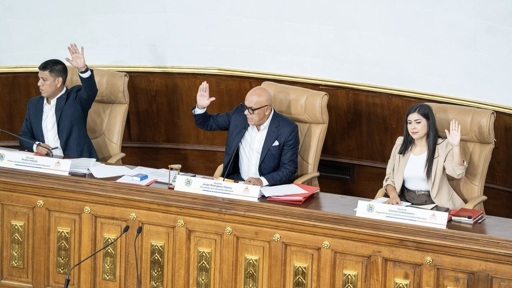
Venezuela’s National Assembly unanimously approved a new Organic Mining Law on Thursday, April 9. According to the Venezuelan government, which sponsored the bill, the legislation aims to modernize mining activity in the country and attract international investors at a time of economic opening.
“With the Organic Mining Bill, we ensure that every resource from Venezuelan soil translates into well-being for the population. During Tuesday’s debate, we addressed the articles that establish the foundations for creating consortia, environmental protection guarantees, and the sustainability of the sector,” said president of the National Assembly, deputy Jorge Rodríguez, following the law’s approval.
The new legislation replaces previous frameworks and extends concession terms from 20 to 30 years. The text guarantees that the Central Bank of Venezuela (BCV) holds the right of first refusal over all gold extracted on national territory.
According to national deputy Iris Varela, the changes comply with constitutional norms and seek to restore the country’s development after more than a decade of sanctions and blockades that severely impacted the Venezuelan economy. She notes that the country’s economic recovery had already been initiated by the government of President Nicolás Maduro – whom she describes as a prisoner of war of the United States – and that the new law is aimed at promoting foreign investment in Venezuela’s mining sector “under attractive conditions.” She also denies that the new legislation entails any loss of sovereignty.
“Is there a danger that sovereignty will be lost? Absolutely not, because there is a Constitution of the Bolivarian Republic of Venezuela, and everything being done is subject to the Constitution. Nothing can go against what the Constitution establishes. This is our highest guideline, it is the supreme norm. And what is being reformed with these laws – for example, with the Organic Mining Law – are decrees and prior laws that came after the Constitution of the Bolivarian Republic of Venezuela,” the deputy emphasized.
“So what this is about is a reform of a law so that the State can enter into contracts of interest and benefit for our people with individuals who feel they can invest their capital and can have the guarantee that their capital will be well protected and will yield a return that benefits them – but that also, exclusively and under legal conditions, as must be the case in contracts and concessions, benefits above all the Venezuelan people,” the lawmaker told Brasil de Fato.
One of the points debated was the definition of royalties paid to the government, which can reach up to 13% of gross production under the new law. This represents a significant reduction compared to the 30% guaranteed by the law in effect since 1999, the year the country’s Constitution was enacted.
Deputy Orlando Camacho, president of the Federation of Chambers and Companies of Venezuela (Fedeindustria), defended the bill and explained that the goal was to build a balanced model for the country. He compared royalty rates applied in neighboring countries, arguing that under the new law, Venezuela still maintains one of the highest resource transfers to the State in the region.
“We compared nearby Latin American countries – Ecuador, Peru, Brazil, and neighboring nations – and we are above average in terms of royalties and taxes. Because we need to attract capital, but we also need to attract capital that brings foreign currency to the Republic, not just capital that takes away raw materials. So an article was incorporated today whereby industrialization processes that generate national added value will also have certain benefits that allow for exports, the attraction of foreign currency, and Venezuela’s industrial development,” the politician stated.
According to the lawmakers, the law also tightens oversight and environmental protection. Those who carry out mining in protected areas may face prison sentences of 10 to 15 years. To avoid conflicts of interest, public officials and their family members are prohibited from holding mining titles for up to five years after leaving their positions. These rules aim to bring order to a sector that has drawn Washington’s attention for strategic minerals such as bauxite and coltan.
First published on Brasil de Fato.
The post Venezuela approves mining law to attract foreign investment under state control appeared first on Peoples Dispatch.
From Peoples Dispatch via This RSS Feed.