

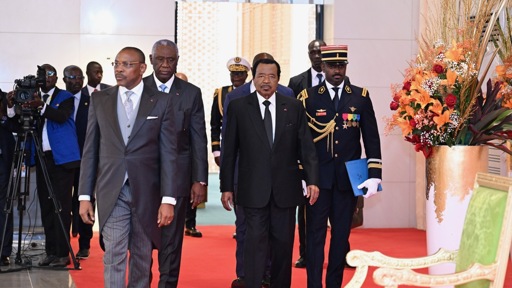
On April 8, the government of Cameroon refuted reports published in several newspapers that Franck Biya, the son of President Paul Biya, had been appointed as vice president.
Reports appeared after the position of vice-president was reintroduced via a constitutional amendment passed by the parliament on April 4, in what the opposition parties described as a move for further consolidation of power.
Then, on April 6, Arise News reported an alleged presidential decree from April 4, appointing Franck Biya as vice president, head of the Central African country’s armed forces, and minister delegate at the Ministry of Defense.
Although the publication qualified that it had not independently verified the authenticity of the document, multiple other news websites carried reports on this supposed decree, without the qualifier about its unknown authenticity.
The claim also went viral on social media, reflecting the anxiety in the country over Paul Biya’s consolidation of power and the likelihood of a dynastic succession. The 93-year-old, ruling Cameroon since 1982, is the world’s oldest head of state.
Last year, amid rumors of his failing health, Biya was sworn in for an eighth, seven-year-long presidential term, after an election in which his main opponent, Maurice Kamto of the Cameroon Renaissance Movement (CRM), was barred from contesting.
Issa Tchiroma Bakary, a regime loyalist who has served Biya since 1996, resigned as the employment minister only months before the election and positioned himself as the main opposition candidate.
In his campaign, he appealed to the Anglophone minority in the North-West and South-West (NWSW) regions, despite having dismissed the military atrocities against that population as the communications minister. He had promised a return to federalism – a word earlier he had banned from use in the media.
The Constitutional Council gave him just over 35% of the votes, declaring Biya the winner. It dismissed eight separate petitions filed by opposition parties and civil society groups, seeking annulment of the results, alleging widespread irregularities, including ballot stuffing and voter intimidation.
Mass protests erupted in multiple cities across the country. Security forces killed 48 people, violently suppressing the protests.
Read more: Protests erupt in Cameroon as the 92-year-old president gets another seven-year term
Against this tumultuous backdrop, a joint session of both houses of parliament, dominated by Biya’s Cameroon People’s Democratic Movement (CPDM) party, passed a law amending the constitution to create the position of vice-president.
The vice-president’s office was scrapped in 1972, when the federal structure, which respected the autonomy of the Anglophone regions, was replaced with a unitary state. The Anglophone communities have since been complaining of marginalization and economic disenfranchisement.
Tensions peaked in 2016 when mass protests broke out in NWSW against the government’s imposition of French-speaking lawyers and teachers on the courts and schools in English-speaking regions.
When Biya’s regime unleashed the military, peaceful protests gave way to an armed separatist insurgency. At least 6,000 people were killed in the subsequent confrontations, displacing over half a million, and leaving 1.3 million in need of aid.
While reintroducing the vice-presidency, the new law passed by the parliament does not require that the posts of President and Vice-President must be shared between an English-speaking and a French-speaking leader.
Advocating for a return to the pre-1972 system where both the Francophone and Anglophone communities were represented in the two top posts, the Social Democratic Front (SDF) party’s chairman, Joshua Osih, called the new law “a missed historic opportunity” to mend relations.
The vice-president, under the new law, will not be elected but appointed by the president, and will serve out the rest of Biya’s term until the next election, should he be incapacitated in the meantime. Prior to this amendment, the speaker of the parliament held this responsibility.
The Cameroon Bar Association warned that the amendment undermines the constitution and “erodes the democratic legitimacy (of) the presidential office”. Condemning the “constitutional and institutional coup”, Kamto said that Biya is creating a “republican monarchy”.
It is amid this fear of dynastic succession that reports claiming Paul Biya has appointed his son as vice-president began circulating over the last few days.
Foreign Ministry officials told The Cable, “As of now, no one has been appointed” to the position of the vice-president. The possibility that he might be appointed for the position cannot be dismissed. However, the vice-president cannot contest the next election after serving out Biya’s remaining term period in case of the president’s incapacitation. This may not make it ideal for dynastic succession, which remains a major concern in the country that has only had two presidents since independence.
The post Is Cameroon’s presidency headed for a dynastic succession? appeared first on Peoples Dispatch.
From Peoples Dispatch via This RSS Feed.