

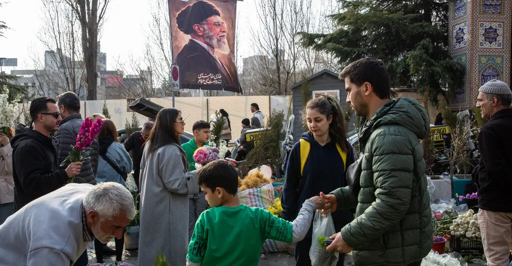
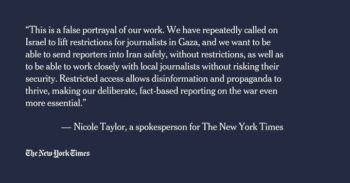
The New York Times posted this image in response to a tweet by attorney/journalist Dimitri Lascaris (3/30/26), who cited FAIR’s March 30 report.
A New York Times spokesperson issued a statement on X (3/31/26) in response to a FAIR article, “NYT Covers Iran War With No Reporters in Iran” (3/30/26). The Times‘ Nicole Taylor wrote:
This is a false portrayal of our work. We have repeatedly called on Israel to lift restrictions for journalists in Gaza, and we want to be able to send reporters into Iran safely, without restrictions, as well as to be able to work closely with local journalists without risking their security. Restricted access allows disinformation and propaganda to thrive, making our deliberate, fact-based reporting on the war even more essential.
Taylor claimed that FAIR’s article was a “false portrayal” of the Times’ work, but she failed to directly challenge any of the article’s claims.
First, FAIR never claimed that the Times didn’t call on Israel to “lift restrictions for journalists in Gaza.” Indeed, the paper did so in late July 2025, along with multiple other news organizations (New York Times, 7/27/25, 7/27/25).
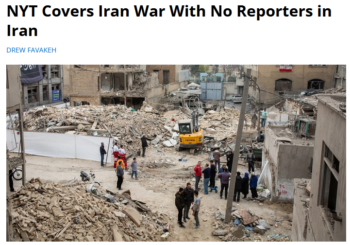
FAIR.org (3/30/26): “It has been easy to spot the stark difference between the New York Times’ distant coverage of Iran and its up-close and personal coverage of Israel.”
Rather, FAIR criticized the Times’ decision to cover the Iran War without any reporters on the ground in Iran. We pointed out that multiple Times employees are reporting from and currently living in Israel, providing up-close and personal coverage of that country, in sharp contrast to its long-distance coverage of Iran.
Can the Times send reporters “safely” to Iran? As FAIR pointed out, CNN reporter Frederik Pleitgen—the only reporter for a US outlet to be granted a visa from Iran—recounts having no major issues reporting there (Guardian, 3/14/26). Other foreign journalists, like Canada-based Dimitri Lascaris and Reuters‘ Ahmed Jadallah, have also reported from Iran in recent weeks.
If the key criterion is instead that journalists must be able to report “without restrictions,” it’s unclear why they allow reporters to report from Israel, which has always been under military censorship (CJR, 3/25/26); it doesn’t allow foreign journalists into Gaza unless they are embedded with its military (NPR, 11/25/25).
Getting a visa to report from Iran can be a problem. However, as FAIR pointed out, there are many Iranian journalists already in the country that the Times could hire, as other outlets have done.
The Times wrote that it wants “to be able to work closely with local journalists without risking their security.” This is a much greater concern in Israel/Palestine, where the government systemically killed more than 200 journalists in 2023–25 (Al Jazeera, 2/23/26), than it is in Iran—where the three journalists killed during that time period were each victims of Israeli airstrikes.
‘I wish I could work safely inside Iran’
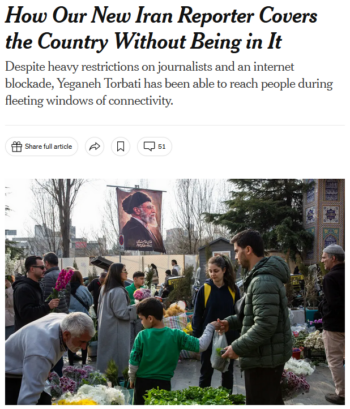
Yeganeh Torbati (New York Times, 4/4/26): “Not being there presents enormous challenges in understanding what day-to-day life is like for Iranians, and makes it more difficult to reach a diverse set of sources from across Iran’s fractious political divides.”
A few days later, the New York Times (4/4/26) published an article headlined “How Our New Iran Reporter Covers the Country Without Being in It.” In lieu of on-the-ground reporting, many of correspondent Yeganeh Torbati’s interviews with Iranians have been based on phone calls, text messages and voice memos. Such journalism, of course, inevitably presents a narrower set of perspectives, limited by the reporter’s pre-existing contacts.
Torbati wrote, “I wish I could work safely inside Iran,” noting that her last trip to the country was in 2010, which “coincided with a round of protests against what many Iranians believed to be a fraudulent election.”
Torbati admitted that she’d “rather be on the ground, seeing this for myself”:
But given the pressures faced by journalists inside Iran, one significant upside of being outside is the ability to deliver strong accountability reporting on an authoritarian government, without fear of retribution.
The reporter wrote: “Even though we are not there, we can still produce ambitious investigative journalism that holds the Iranian government to account.”
Torbati’s premise seems to be that when a country is undergoing an unprovoked attack from two nuclear powers, facing explicit threats of genocide and promises of war crimes, the prime mission of foreign journalists is not to witness the devastation being inflicted, but to deliver “accountability reporting” on that country’s “authoritarian government.”
Meanwhile, FAIR (e.g., 9/27/25, 5/1/24) has repeatedly documented the New York Times‘ failure to “deliver strong accountability reporting” on Israel’s apartheid government, despite the large number of journalists it has based there.
ACTION ALERT: You can send a message to the New York Times at letters@nytimes.com or via Bluesky*:@NYTimes.com. Please remember that respectful communication is the most effective. Feel free to leave a copy of your message in the comments thread here.*
From FAIR via This RSS Feed.