

Reader support is what makes Drop Site possible. Without it, this journalism wouldn’t exist. If you’re able, please consider making a tax-deductible donation or upgrading to a paid subscription today.
SUPPORT DROP SITE - DONATE TODAY
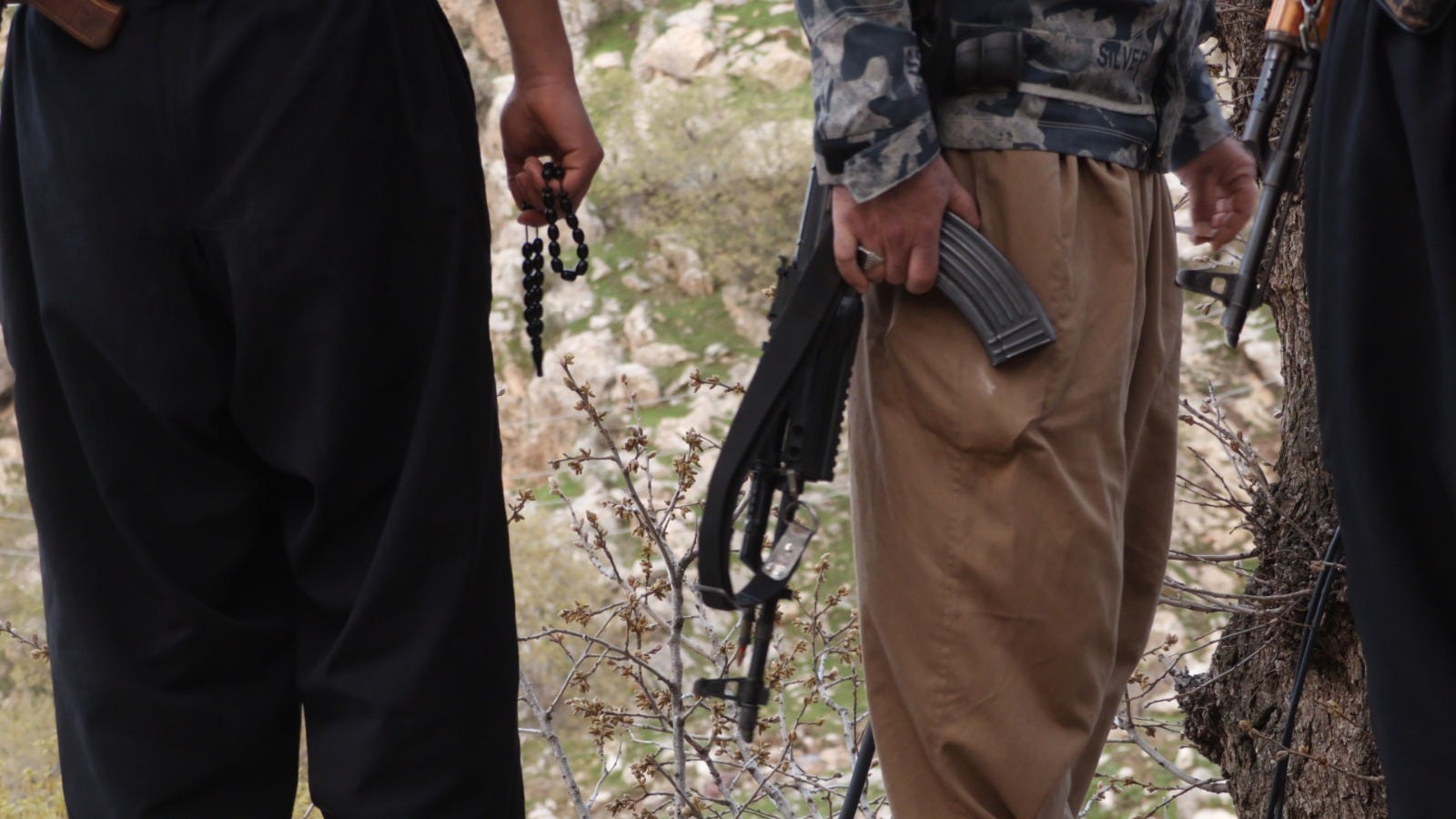
Soldiers at Komala (CPI) camp near Suleymaniyah. Photo: Alexis Daloumis.
Story by Alexis Daloumis
SULEYMANIYAH, KURDISTAN REGION OF IRAQ—On April 5, during an interview with Fox News journalist Trey Yingst, President Donald Trump apparently confessed to trying to foment an armed uprising by dissidents inside Iran earlier this year, suggesting that the effort had only failed due to the betrayal of unnamed Kurdish groups. The U.S. government had, Trump said, “sent guns to the protesters, a lot of them. We sent them through the Kurds, and I think the Kurds took the guns.”
The claim of an ill-fated Kurdish role in attempting to topple the Iranian government triggered immediate denials by all major Iranian Kurdish parties. In comments to Drop Site, the Free Life Party of Kurdistan (PJAK), one of the largest and most organized Kurdish parties, denied Trump’s claim that they or other Kurdish groups—six of whom had formally announced the formation of a new alliance days before the start of the war—had received U.S. weapons to fight or transfer to other opposition factions in the country.
“No, we have never received weapons or assistance from the United States or any other country. As far as we know, all Kurdish parties have rejected Trump’s statements and are not aware of such claims,” said Zegrus Enderyarî, a member of the PJAK External Relations Committee. “It is possible that Trump intended to do such a thing or wanted to test the reaction of Iran and other regional countries. However, the time he referred to was when thousands of protesters in Iran were killed by the regime, and at that time, this alliance had not yet been formed.” (Drop Site could verify neither Trump’s claim he sent weapons nor the Kurds’ denial.)
The Alliance of Iranian Kurdistan Political Parties—involving six out of the seven active Kurdish parties in Iranian Kurdistan—was announced on February 22, six days before the start of the war. The timing of the pact has led many to suggest that it was intended as preparation for an alignment with Israel and the U.S. in the coming conflict. Enderyarî, without directly refuting that narrative, pointed out that the relevant discussions between the parties had started in the aftermath of the 2022 anti-government “Woman, Life, Freedom” movement in Iran—significantly predating the current war. “Although political conditions also played a role, the formation of this alliance was a historical necessity, and it can even be said that it was delayed,” said Enderyarî.
RELATED: “It Seems Like Blind American Ignorance”: The New U.S. War on Iraq
Regardless, Iranian Kurds quickly found themselves thrust into the forefront of the U.S. and Israeli war against Iran. In the first week of fighting, the U.S. and Israel bombed numerous government positions in Kurdish regions of Iran, while making public calls to Kurdish groups to launch an uprising against the government. That uprising, intended to drain the resources and attention of the Iranian military, while potentially causing the ethnic dissolution of the country, did not come to pass.
Other Iranian Kurdish groups who spoke to Drop Site expressed suspicion over attempts to maneuver them into a conflict at the behest of foreign powers.
Ebrahim Alizadeh, General Secretary of Komala (CPI), also known as the Kurdistan Organization of the Iranian Communist Party, the only party of the seven that didn’t join the alliance, stated that one of the reasons his group had not joined the February 22 announcement was out of belief that the alliance had been hastily formed in the shadow of U.S. and Israeli war plans.
“We asked to have a trial period of collaboration…but we realized that there was external pressure to do it faster. Afterwards we understood that this pressure was related to the war that started,” he said. ”When the war started, the Americans and Israelis asked them to enter Iran to liberate a region and put pressure on the central state. The plan didn’t work and they withdrew from it, partly because Turkey convinced them.”
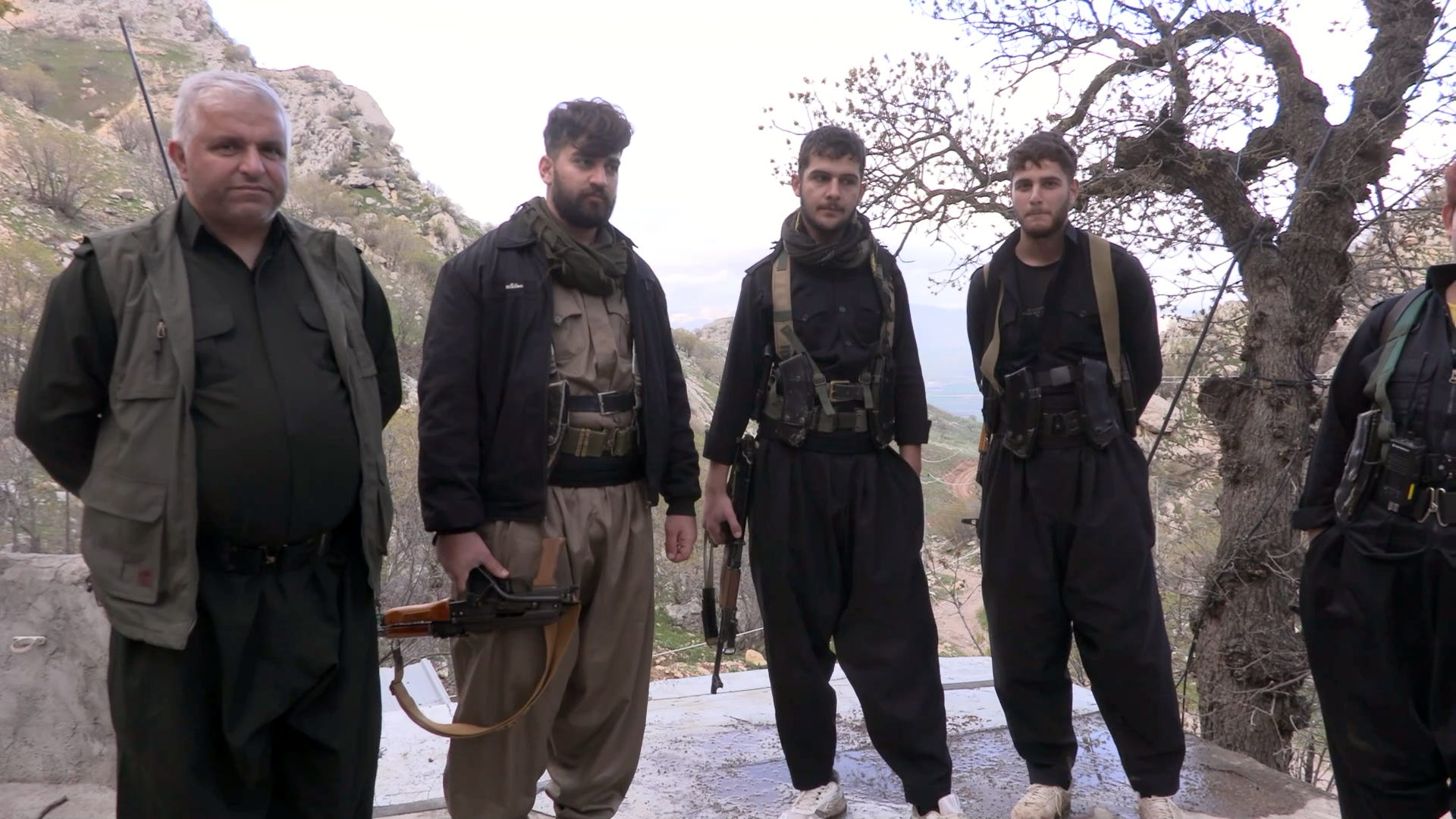
Soldiers at Komala (CPI) camp near Suleymaniyah. Photo: Alexis Daloumis.
The Iranian portion of Kurdistan, where Israel and the U.S. have tried to encourage revolt, has several distinctive features setting it apart from the other three parts. Unlike Kurdish regions in Turkey, Iraq, and Syria—all once part of the Ottoman Empire—Iranian Kurdistan has been under continuous Iranian rule for at least four centuries, with the Safavid Empire dismantling Kurdish principalities far earlier. Most Iranian Kurds are also Sunni in an emphatically Shia state, making them a double minority.
The failure to trigger a Kurdish uprising was one of many factors that contributed to transforming the war into a quagmire for the U.S. By early April, Trump’s frustrations over the war had begun publicly boiling over, leading to public accusations of betrayal by Kurdish groups.
On April 6, Trump fulminated that U.S. arms “were supposed to go to the people so they could fight back against these thugs. You know what happened? The people that they sent them to kept them because they said, ‘What a beautiful gun. I think I’ll keep it.’ So, I’m very upset with a certain group of people and they’re going to pay a big price for that.”
Trump’s references to “the Kurds,” as well as, “a certain group of people,” has led to confusion about whether his allegations are leveled against a specific Iranian Kurdish party, factions based in Iraqi Kurdistan, or the Kurdish people in general.
“He has still not clarified which Kurds he was referring to: the Kurds of Iraq or the Kurds of Iran?” Alizadeh told Drop Site. “All Iranian Kurdish parties have denied it. We reject cooperation with the American project in Iran. Other parties, by contrast, have sought weapons from the United States and are saying that they did not receive them. Were those weapons given to the Kurdish parties in Iraqi Kurdistan? They have remained silent on this matter. In the end, someone here is clearly lying.”
“Leave the Kurds alone”
Trump’s claims, which have been treated with disbelief by several regional journalists and experts, come amid intensified attacks on Iranian Kurdish parties and other targets within Iraqi Kurdish territory by Iran and its proxies. The attacks reflect a recurring tendency by the U.S. and Israel to “out” the Kurds and expose them to violent Iranian retaliation. This portrayal of Iranian Kurds as a perpetual fifth column working at the behest of foreign states has been devastating for Iranian Kurdish parties, who operate across the border in Iraq where many have been hosted by the autonomous Iraqi Kurdish government.
On March 4, false reports began circulating from journalists and others that thousands of Kurdish fighters had already crossed the border into Iran to begin a ground operation against the Iranian government.
The next day, Shanaz Ibrahim Ahmed, the wife of Iraqi President, Abdul Latif Rashid, as well as a long-standing Kurdish politician and a senior figure of the Patriotic Union of Kurdistan (PUK), denounced the idea of an intervention egged on by Tel Aviv and Washington. In a public statement decrying the effort to involve Kurds in the war, Ahmed said, “Leave the Kurds alone, we are not guns for hire.”
Ahmed’s statement, celebrated by many Kurds in the region, was released on the anniversary of Raperin, another famous Kurdish uprising against Saddam Hussein in 1991. That rebellion, which had also been tacitly encouraged by the U.S., was brutally suppressed by the Iraqi military, adding another chapter to a long history of perceived betrayals by Western powers.
When asked about the influence of Ahmed’s intervention, PJAK’s representative Enderyarî told Drop Site that despite a history of betrayals, Kurdish groups were still ultimately divided on the broader issue of foreign support. “The statements made by Shanaz Ibrahim Ahmad received wide attention among Kurds and others. However, not all political groups share the same view. Some believe that without foreign support—especially from the United States—it is not possible to change the regime in Iran, and therefore they support external intervention to some extent,” he said. “However, we, as a force based on grassroots organization and public awareness, believe that change must come from within society.”
Enderyarî added, “We do not see ourselves as part of this war. For us, this is a conflict between two hegemonic forces: one at the global level, the United States, seeking to maintain its dominance, and the other at the regional level, such as Iran and Israel, seeking regional hegemony. We do not choose either of these paths. Instead, we choose a third path based on self-governance and peaceful coexistence among the peoples of the region.”
This idea of the “Third Path” is not new, nor a product of the latest developments. PJAK belongs to the same political ecosystem as the Kurdistan Workers Party, or PKK. The historical Kurdish leader and founder of PKK, Abdullah Ocalan, has long expressed concern about the possibility of the Kurdish movement falling into Israel’s sphere of influence and being weaponized by it. Other top leaders of PKK such as Duran Kalkan have recently been explicit about it as well, stating in a recent interview that Israel and the U.S. were merely seeking a new, undemocratic hegemony in the region, and “preparing a new Shah” to replace the Islamic Republic.
Despite this stance from most of the leadership, there seems to be a real current among the base as well as some senior figures that see potential benefits in aligning with Israel.
“It is true Reber Apo and Duran Kalkan said those things, but there are indeed a lot of people within the movement that see Israel favorably,” Kawa, a 32-year-old construction worker in Suleymaniyah who’s ideologically aligned with PKK/PJAK told Drop Site. “If you ask me, is Israel good? No it isn’t. But it looks like Israel wants to give some respect to the Kurds—that’s why people think like that.”
The discourse around potential Kurdish involvement in the war is happening in the aftermath of recent developments in northeastern Syria, where a Kurdish-led project in autonomous governance known as the the Democratic Autonomous Administration of North and East Syria (DAANES) was dissolved by force in a military offensive by the new Syrian government based in Damascus. Despite working for years with U.S. forces as a counterterrorism partner, the Kurdish-led Syrian Democratic Forces (SDF) found itself abandoned at this critical moment—an episode viewed by many Kurds around the region as the latest chapter in a long history of betrayals.
The forcible integration of the DAANES into central government control came about after numerous Arab tribes that had previously fought alongside the SDF switched sides and pledged allegiance to Damascus. That decision has helped trigger a renewed sense of unity among Kurds across different factions, alongside sentiments of ethnic nationalism and resentment towards Arabs.
“I can’t, I’m done. I’m done with the Arabs,” said Marwan, a seasoned Kurdish fighter of the SDF, who spoke to Drop Site in the Syrian city of Haseke this February. The veteran of the historical Kobane battle against the Islamic State emphasized the sense of betrayal many Kurds felt from their former Arab partners. “It was not the government forces that attacked us in Shedadi and killed so many friends. It was our formerly allied Arab tribes that stabbed us in the back. How can we trust them any more?”
In the Kurdish-majority Syrian cities of Haseke and Qamislo, the Kurdish national flag is now everywhere—something which until recently was forbidden by the SDF because of policies stressing ethnic inclusion. Banners featuring Ocalan, together with Iraqi Kurdish leaders Massoud Barzani and Jalal Talabani, or of SDF chief Mazlum Abdi and Massoud Barzani, have become visible in some areas.
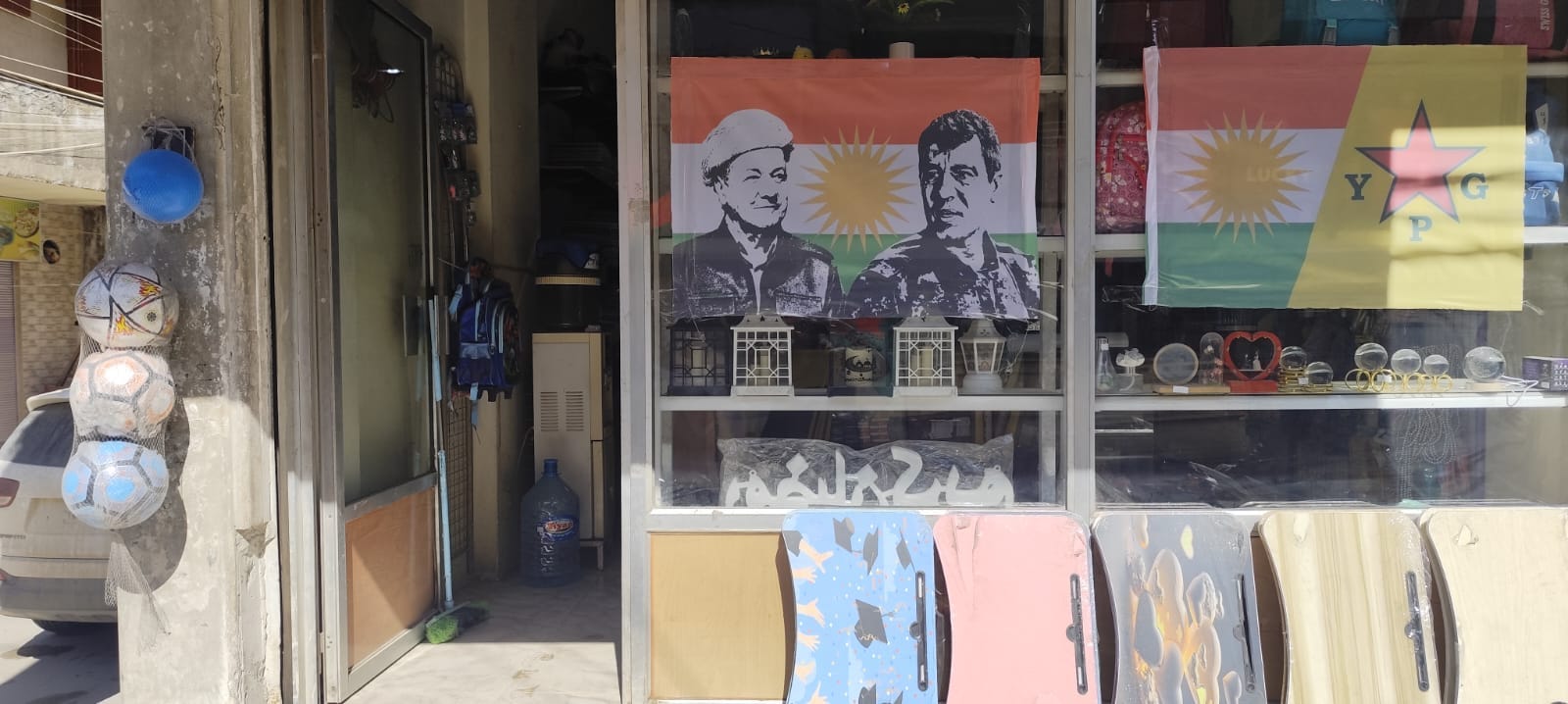
Store showing political posters in Qamislo, Syria. Photo: Alexis Daloumis
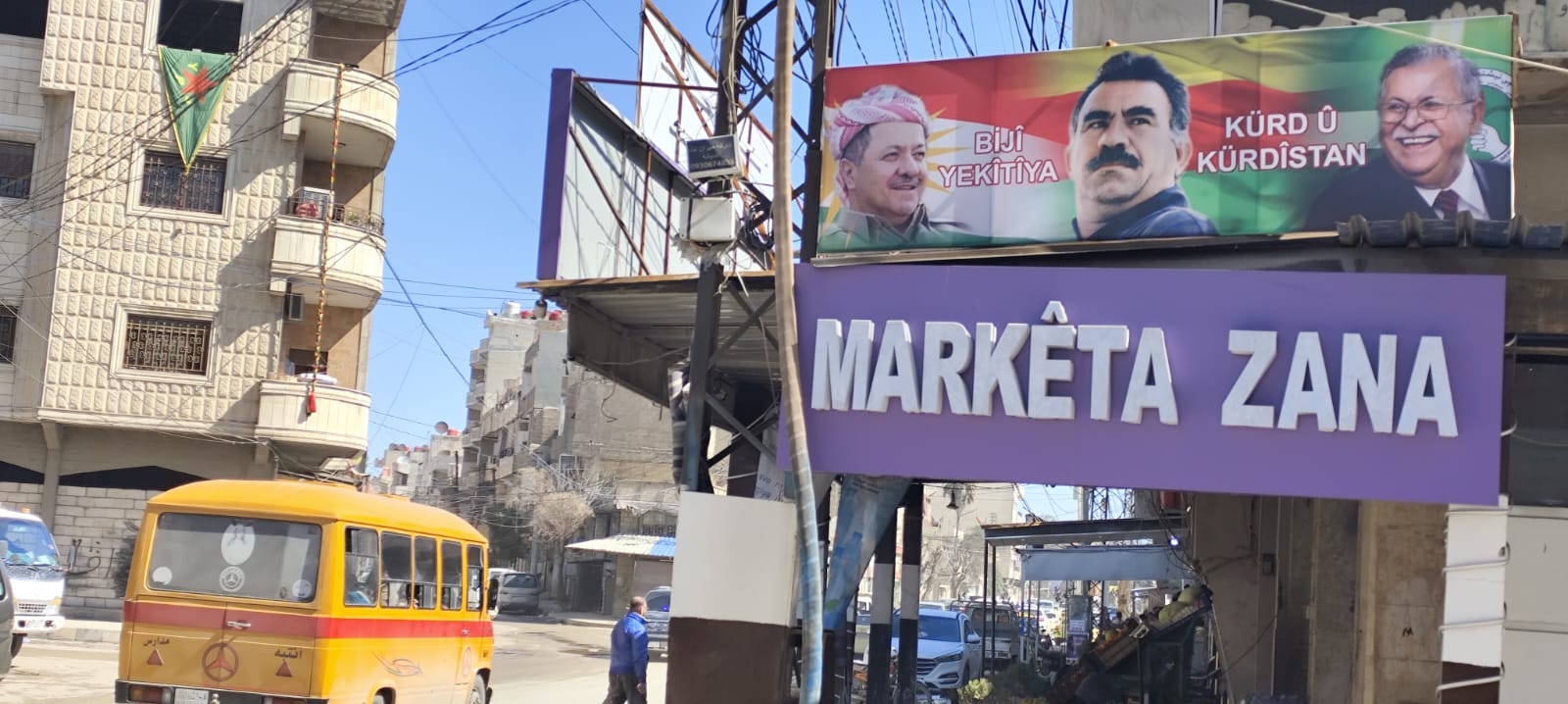
Banners in Qamislo. Photo: Alexis Daloumis.
A sense of newfound ethnic unity and resentment has become particularly prevalent in Iraqi Kurdistan , where recent developments in Syria have been seen as a vindication of the nationalist conservative politics that dominate the regional government.
“Before, in my social group there were Arabs and Kurds and we were all just friends, but after all this we became Arabs and Kurds” said Sevak, a 24-year-old metal worker who spoke to Drop Site in Erbil. “Now the Kurds are united, before they were divided along party lines, ‘You are with Ocalan, or you are with Barzani.’ Now they are one.”
The increasing debates about the future of the Kurdish liberation movement comes as Iraqi Kurdistan has faced hundreds of missile and drone attacks from Iran and pro-Iranian militia groups in Iraq. In one of the latest incidents, a drone strike killed a Kurdish civilian couple in a rural agricultural village with no military presence—Musa Anwar Rasool and his wife Mujda Asaad Hassan, leaving behind two orphaned daughters.
The attacks, many of which are believed to have been carried out by groups associated with the Popular Mobilization Forces, an official part of the Iraqi security establishment, have further raised tensions between Iraqi Kurdistan and Baghdad. For the time being, the tentative ceasefire in Iran may give time for the Kurdish movement to reassess its future. The events of the past months will not soon be forgotten.
Alexis Daloumis is the director of the documentary “Belkî Sibê,” that follows leftist Western fighters—of which he was one—who fought alongside the Kurdish-led, American-backed Syrian Democratic Forces in their battle against ISIS.
From Drop Site News via This RSS Feed.