

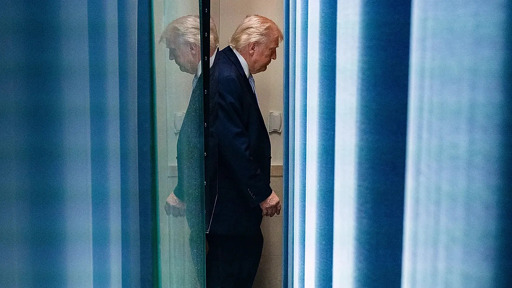
Just one day passed after President Trump announced the ceasefire with Iran before the cracks in the fragile agreement began to show. For now, no one can say for sure what course the war will take, but more than a month after it began, it has already severely damaged both Trump’s administration and U.S. legitimacy internationally, exposing the vulnerabilities of an Empire in decay.
Trump must now grapple with the political costs of having started one of the most unpopular wars in U.S. history, just a little more than half a year before the midterm elections, where his party could face serious defeats. The fallout of the war is also contributing to the already simmering discontent among the masses. From the revolt against ICE in Minneapolis to the massive No Kings rallies, which had a strong anti-war sentiment, opposition to Trump and the Far-Right is continuing to grow.
Whatever path the war takes, it is fair to say that Trump has been politically defeated in Iran. This defeat expresses the failure of his strategy of “peace through strength” and “America First” as a way to halt the declining hegemony of US Imperialism. The War in Iran has been a tremendous demonstration of “strength” without strategy, leading to one of the most significant humiliations of U.S. imperialism in recent history. Robert Pape put the depth of this failure in his own words:
Over the past forty days, Washington escalated step by step—expanding targets, increasing tempo, raising threats. At each stage, the expectation was that additional force would produce compliance. It did not. Instead, each escalation generated counterpressure—on energy markets, on allies, and ultimately on U.S. decision-making itself. This is the pattern of strategic failure. Not a single misstep, but a sequence in which more force produces less control.
Furthermore, the failure of the United States to defeat Iran casts serious doubt on its ability to challenge and contain China, which of course has a far superior military than Iran. Indeed, China seems to have played a pivotal role in pushing Iran toward a ceasefire that was disadvantageous for the U.S., and is likely to reap the benefits of further influence within and over states in the region.
For now it is unclear what agenda the American imperialist bourgeoisie will pursue on the world stage after Trump. But, with the Israeli war on Lebanon still unfolding and new contradictions emerging every day, the situation remains very much open. The ceasefire still has to be negotiated and the stakes are high, but whatever happens it is obvious that the outcome of the recent war will have long term repercussions that are difficult to foresee.
The Rise of JD Vance and the Isolationist Wing of Trump’s Coalition
As is widely known, the war in Iran has once again shaken up MAGA. Marjorie Taylor Greene and Alex Jones, among others, have called the President incompetent and called for him to be removed from office under the 25th amendment. Meanwhile, MAGA influencers like Tucker Carlson, Candace Owens, and Joe Rogan have been pushing the idea to their tens of millions of loyal followers that Trump is working for Israel and betraying American interests. As important as these rifts among the MAGA base are, they have not yet touched the upper echelons of the leadership of the Far Right in power. So far the different wings within the government, including Vance’s more isolationist wing, have not yet broken with Trump, but cracks are beginning to develop.
Trump’s inability to achieve any of his objectives in the war have laid bare the weakness of the expansionist logic of a sector of Trumpism and placed Vance and the isolationist wing of the Trumpist coalition in a more favorable position. It’s no coincidence, for instance, that it’s Vance, and not Hegseth or Rubio, who will be leading the negotiations with Tehran in Pakistan this weekend.
However, the strengthening of the isolationist wing of the Trump coalition does not guarantee a change in foreign policy. It is still very possible that, in an effort to reassert U.S. power, Trump could choose to take even more aggressive actions in Latin America as part of his Donroe Doctrine. Despite the U.S. military’s current posture toward the Middle East, Latin America remains a prominent target for Secretary of State Marco Rubio and other more hawkish sectors of the Trump administration. Cuba remains under constraint threat and the U.S. army has been building up infrastructure and accumulating troops and resources in Ecuador and Panama.
Regarding Israel and its relationship with the United States, things could not be more challenging for the bipartisan regime. Even with Iran arising as a serious obstacle for U.S. and Israel aspirations, Israel has nonetheless been able to put forward its own agenda, taking advantage of the war with Iran to push the frontiers of the State of Israel towards the South of Lebanon. Israel has a plan for the Middle East that the United States does not have so they are fighting this war with different agendas. The relationship between the bipartisan regime with Israel has been questioned not only by the increasingly more vocal anti-Israel Far Right but from the Left, with the powerful pro-Palestinian movement that brought hundreds of thousands of jewish people from the diaspora to break with Zionism.
The isolationist wing of the Far Right may have benefitted from the outcome of the war, but who knows what tomorrow will bring. The American ruling class “tested” Trump’s doctrine to tackle the pains of American decay but Trump has shown that his approach is untenable. Rather than strengthening U.S. imperialism, the U.S-Israeli War on Iran has actually accelerated its decline by exposing its vulnerabilities.
Trump’s Actions in Iran Expose the Most Vulnerable Aspects of U.S. Imperialism
Iran politically won this first round of a war that the American army was never keen on to begin with. This has opened what is one of the worst crises between a president and the military in recent history, with high commanders, worried about the use of nuclear weapons, threatening to disobey Trump’s orders. The crisis of the military that think tanks and analysts have been talking about for years was open and clear to allies, friends, and enemies of the United States.
Iran effectively controls the distribution of 40% of the oil in a globalized economy that is deeply interconnected and interdependent, and as a potential outcome of the ceasefire, it may get full control of the Strait of Hormuz. Also included in the negotiations is the possibility of ending the primary and secondary sanctions, as well as financial reparations and other concessions. While Iran seems to have everything to gain from the negotiations, the U.S. failed to effect any real “regime change” or to install a more friendly leadership. If anything the Iranian regime has shown itself to be more resilient.
Although there was no organized anti-war movement in the United States, most Americans, including many Trump voters, are deeply opposed to the war. In fact, no other war in history has been waged with less public support. The recent No Kings mobilization was a warning that anti-war sentiment could spill out onto the streets. Trump does not want to confront the masses because he was defeated in Minneapolis, and the still-developing resistance and the threat of further class struggle could seriously limit his agenda going forward. From the perspective of the working class, Minneapolis demonstrated that Trump can be defeated.
Against this backdrop of deep anti-Trump discontent and a major political and military defeat, it it is quite likely that the Democrats will make big gains in the midterm elections. But hatred of Trump should not be automatically equated with enthusiasm for the Democrats, as the polls clearly show. The Democratic Party remains an unappealing and uninspiring alternative for broad sectors of the masses.
In this context, the Democrats also have no alternative to Trump’s foreign policy. They opposed the War but did nothing serious to stop it. The U.S. establishment as a whole acknowledges the historic decline of the United States. What Trump’s failed strategy lays bare is that neither the GOP nor the Democrats yet have an alternative.
Perhaps the sector best positioned to capitalize on the discontent against both parties is the insurgent wing of the Democratic Party that aims to fight for a left-wing populist solution — a welfare state without wars and with closed borders where American workers can aspire to a gradual, reformist improvement in their living conditions, but without touching the essence of capitalist or imperialist domination. That, however, is an unrealistic fairy tale in an era of crisis, war, and revolutions.
The working class and the oppressed must prepare for the effects of U.S. decline and use the defeats of our oppressors to our advantage. From Iran to Minneapolis, the common thread of our struggles is that we are exploited and oppressed by the same imperialist system administered by the ruling class — the Epstein gang — which is leading us into barbarism.
The struggle against Trump, the far right, and Imperialism, both globally and at home, lies in the blueprints of the resistance led by workers and youth and the growing anti-imperialist sentiment taking root among the vanguard in the United States.
The post Facing Defeat in Iran, Trump Is Weaker Than Ever appeared first on Left Voice.
From Left Voice via This RSS Feed.