

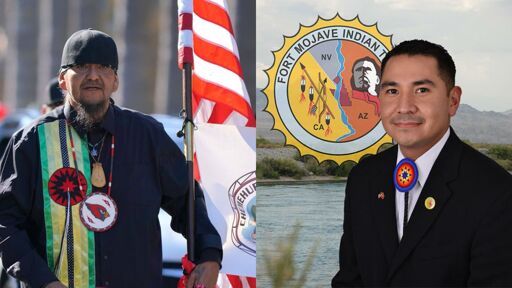

Daniel Leivas, chairman of the Chemehuevi Indian Tribe
Timothy Williams, chairman of the Fort Mojave Indian Tribe
Our tribes — the Chemehuevi Indian Tribe and the Fort Mojave Indian Tribe — have lived and stewarded lands in the California desert since time immemorial. These are our traditional territories, and we are physically and spiritually connected to the land.
Groundwater-fed springs in the desert are sacred to our tribes and give life year-round to plants and animals, including bighorn sheep, mountain lions, and bobcats. All these species and more are part of a connected landscape found in our stories, songs, and ceremonies.
For over 40 years, our traditional territories have been targeted for the corporate extraction of vulnerable desert water resources by Cadiz, Inc., a foreign investor-backed company. We have successfully opposed their efforts to extract and sell desert ground water, but still they continue to pursue an unrealistic scheme to drain the desert to make a profit for their shareholders. Today, we write to urge others – both tribal nations and tribal allies to stand with us – in solidarity against Cadiz’s efforts. Here’s why.
The Cadiz Water Project, also called the Mojave Groundwater Bank, would pump and drain 25 times more groundwater each year than the aquifer can replenish. This depletion would dry up the desert springs sacred to our tribes, and any community sold this water would be left with an unreliable, unsustainable supply, that would drain the desert. No one wants their taps turned off. No one wants to spend billions to pay for a human-made disaster, like Los Angeles ratepayers are now doing to address over-pumping of the Owens Valley in California. We must learn from these lessons and avoid putting people and communities at risk.
Science and commonsense makes clear that pumping more groundwater than is sustainably replenished is not only negligent, but dangerous to the American Desert Southwest. This is why stopping Cadiz is crucial for all those who need real, reliable water solutions.
Cadiz Inc. realizes this problem, admitting that its name is a “poison pill.” They have actively lobbied to convince external actors, including out of region tribes, to serve as the face of this irresponsible water grab.
Thankfully, we are not alone in protecting the desert and the people and communities, who like ours, live here. Civil rights leader Dolores Huerta personally wrote to every member of the California State Legislature and then published a commentary to publicly call out the “deceptive tactics by a group called Groundswell, funded by discredited water company Cadiz, to wrongly use my name and image in their lobbying strategy.”
Desert Southwest states are also paying attention. California Governor Gavin Newsom has been a longtime ally in this fight to protect America’s public lands and water from Cadiz. In 2018, he made clear his position, stating “I don’t support it…I’m worried about what it means to the Mojave Desert. I’m worried about what it means for the environment.” He went on to say, “I don’t like people buying influence. I don’t like money determining the fate of even good ideas, let alone bad ideas,” referencing Cadiz’s well-publicized political influence efforts that subvert science and the voices of tribes. California’s U.S. Sens. Alex Padilla and Adam Schiff have written to the federal administration, stating that federal agencies and peer-reviewed scientific analyses “have warned of the significant and irreversible impacts that Cadiz’s project could have on federal lands and surrounding communities.”
In Arizona, the state’s Water Infrastructure Finance Authority recently rejected a proposal requesting Arizona taxpayers finance the Cadiz project. The authority board took action after learning about the history of the project, determining it non-viable, and repeatedly stating that they will not consider Cadiz again.
For 40 years, our tribes have put forth sustained opposition to Cadiz, to protect our traditional territories that would be decimated by the project. Because of this, Cadiz has approached tribes from outside of our desert region, including within distant states, for financial investments and rebuttal by actively seeking tribal support to secure standing, credibility, and importance on matters impacting our traditional territories. Our truth is simple, their project is a threat to the livelihood of the Mojave Desert and would cause irreparable harm to our people, our way of life, and our traditions.
Cadiz’s efforts to get support from out-of-area tribes to exploit our desert resources is only to make a profit for their shareholders and foreign investors. The new language being used to present their project is not environmental justice. And while continually seeking public funding from multiple states, proposals continually are resoundingly rejected because it is non-viable, unsafe, and a preventable threat to the Mojave Desert.
Despite all this, we must continue to defend our fragile California desert from Cadiz. For 40 years, they have refused to go away, and we do not doubt that they will continue to try new ways to solicit support to extract and sell water from our traditional territories.
Our people, neighboring communities, desert plants, and wildlife depend on the water that Cadiz wants to take and sell. The desert has provided these resources since its inception for our traditional homelands, and we all have responsibility for its care and safekeeping. We will continue to stand strong in opposing Cadiz. We urge you to stand in solidarity with us to protect the Mojave Desert.
Daniel Leivas is the Chairman of the Chemehuevi Indian Tribe, and Timothy Williams is the Chairman of the Fort Mojave Indian Tribe.
The post Cadiz Inc.’s water extraction scheme threatens our traditional territories appeared first on ICT.
From ICT via This RSS Feed.