


Sandra Hale Schulman
ICT
The latest: Bison back from the brink in sculpture, captivating katsinas, basketball as cultural pride
ART: New art and exhibit honor bison history
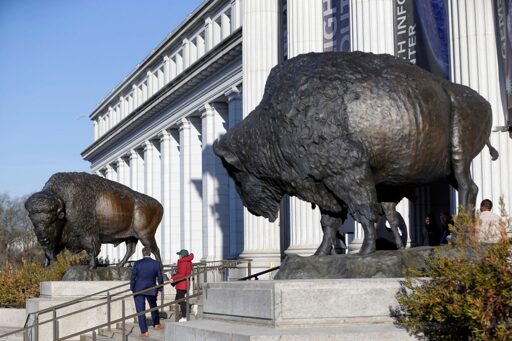
Three endangered bison that were held in a pen behind the Smithsonian Institution Building in the late 1880s and later taxidermied are the model for two massive new bronze sculptures now on display at the Smithsonian’s National Museum of Natural History in Washington, D.C.
The trio — a male, female and calf — became the basis for the sculptures by artist Gary Staab.
A new exhibition, “Bison: Standing Strong,” exploring their cultural and ecological legacy, is set to open Thursday, May 7, with fossils, mounted specimens, anthropological objects, an immersive soundscape, and Native objects and stories from community members.

Artist Gary Staab works to create his bronze sculptures of bison that were installed as a permanent feature in March 2026 at the Smithsonian’s National Museum of Natural History in Washington, D.C. Credit: Photo courtesy of the Smithsonian
When the bison were teetering on extinction because of mass slaughter by the U.S. government as part of an effort to eradicate Native Americans by extinguishing their main food and cultural source, a small herd of bison were brought to live in Washington, D.C., to save them in an early conservation effort.
The national mammal is now taking center stage on the National Mall to commemorate the 250th anniversary this year of the signing of the Declaration of Independence, a document that called Natives “merciless Indian savages.”
The statues are a gift to the museum by Naoma Tate and the family of Hal Tate.
“These bison will have pride of placement,” artist Staab said in a video interview. “They are literally on the outside of the steps of the National Museum of Natural History. It seems very appropriate that the museum and the client chose that we have our national mammal, the bison, to represent your first view of that museum as you approach it.
“It’s an incredible privilege to be able to make work for museums. I’m really passionate about animals in natural history, that’s the main reason that I do this. Bison are a specific North American story, right? It’s a wonderful story of conservation working. It’s a story of people seeing a need and getting behind that … to serve an animal that is specific to North America.”
CRAFT: Katsina competition
With one of the largest and most impressive displays of katsinas in America, the annual Katsina Marketplace returns to the Heard Museumon April 11. The biggest such gathering in the U.S., the free event brings together renowned artists, collectors, and enthusiasts for a juried competition honoring the best carvings of 2026.

The annual Katsina Marketplace returns to the Heard Museum on April 11, 2026, and will include a raffle for the 2026 signature Katsina doll, ”Corn Maiden Katsina,” shown here, by Buddy Tubinaghtewa. Credit: Photo courtesy of the Heard Museum
Katsinas are spirit messengers in Hopi spirituality, they represent beings in the natural world and ancestors. When a Hopi died, his or her spirit lived on in the carved and painted form of a Katsina.
In addition to the elaborate cultural carvings, the event will feature frybread from Emerson Frybread, a Native fashion show celebrating the Heard’s Blue Bird exhibition, and a live concert by Keith Secola, throughout the day from 11 a.m. to 4 p.m. A raffle will be held for the 2026 signature Katsina Doll, ”Corn Maiden Katsina,” by Buddy Tubinaghtewa.
Visitors can be part of the fashion show after they decorate bandanas, adorn T-shirts, tote bags or some textiles. The museum, café, cantina, shop and bookstore are open throughout the event.
FILM: Basketball as medicine
Filmmaker Leya Hale, Sisseton Wahpeton Dakota/Diné, is the 2026 recipient of the Minnesota Filmmaker Award that rewards outstanding achievement by a filmmaker with ties to Minnesota.

Award-winning filmmaker Leya Hale, Sisseton Wahpeton Dakota/Diné, is the 2026 recipient of the Minnesota Filmmaker Award that rewards outstanding achievement by a filmmaker with ties to Minnesota. Credit: Photo courtesy of Twin Cities PBS
The award “celebrates creativity, craftsmanship, and storytelling excellence in work that reflects the unique perspectives and cultural richness of Minnesota’s vibrant creative community” Twin Cities PBS said in a statement.
Hale is a documentary filmmaker, a multiple regional Emmy Award–winning producer for Twin Cities PBS known for her nationally broadcasted films “The People’s Protectors” and “Bring Her Home” (PBS), and “The Electric Indian” (APT).
Her new documentary, “Medicine Ball,” about reservation basketball, will premiere Saturday, April 25, at 6 p.m. at the St. Louis County Depot theater during the Zeitgeist Minnesota Film Festival. It will be distributed nationally in Fall 2026.
“I am grateful for each space that welcomes this story. Every gathering, every conversation, reminds me that this film is not just about the past, but about the strength our young people carry forward today, Pidamaya ye (Thank You),” Hale said in a statement.
The documentary follows two Native college athletes, Lexus and LeRoy, while they navigate both their cultural and athletic journeys. The film explores the deep roots of basketball in Native communities and its relation to the story of boarding schools.
The University of Minnesota provides an historical and compelling setting. Filmed on the site of a former Native boarding school, “Medicine Ball” shows that basketball is not just a game — it’s an enduring symbol of hope, survival, and continued cultural pride in Native communities.
The post INDIGENOUS A&E: Bison back, katsinas at the Heard, rez ball doc appeared first on ICT.
From ICT via This RSS Feed.