

By Cris Fernan Bayaga
Bulatlat.com
CEBU—Residents of Sitio Bato in Barangay Ermita, Cebu City fear they might be driven out of their homes after their community was included in the redevelopment area covered by the Joint Venture Agreement (JVA) between the Cebu City government and Megawide Construction Corporation’s Cebu2World Development Inc. (C2W).
According to Carbon-hanong Alyansa, an alliance of progressive vendors in Carbon Market, over 700 families stand to lose their homes without prior consultation and proper notice that their area would be affected by C2W’s expansion plans.
Read: Cebu vendors oppose public market privatization
The residents said that there has been no adequate public consultation conducted since the JVA’s enactment in 2021, leaving many uncertain about where they would go should demolitions begin.
There is also a threat of displacement and red-tagging against groups who are opposing market privatization.
On March 26, posters appeared in different parts of Carbon Market branding Carbon-hanong Alyansa and those who opposed the privatization as terrorists and calling on them to stop their opposition against privatization.

Red-tagging materials posted in front of the ongoing construction of C2W’s Block 2 building (Photo courtesy of Carbon-hanong Alyansa)
The alliance also reported that there are leaflets red-tagging the organization. These leaflets, they said, are bearing contact numbers of Philippine National Police Station 6, or the Pasil Police Station where residents could supposedly report concerns related to the group’s activities.
Carbon-hanong Alyansa condemned this, saying that this is a threat to their liberty and security which is a violation of their rights.
Grave abuse of discretion
In 2021, the alliance, along with other vendor groups, filed charges against both the corporation and the Cebu City government for what they described as “grave abuse of discretion and malice” in pushing through the JVA.
Among the issues they raised was the inclusion of parcels of land in the agreement that they said are owned by the national government.
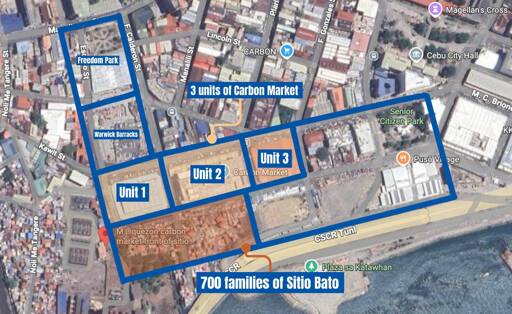
Representatives of the alliance said Sitio Bato falls under Block 6 of the market area slated for redevelopment by C2W. They oppose the plan, arguing that the sitio is a recognized Urban Land Reform Zone under the national government.

A Google Maps overview of the area where the 700 families of Sitio Bato reside, in relation to the existing Carbon Market units (Graphics by Cris Fernan Bayaga/Bulatlat)
They added that before the JVA, the Cebu City government also passed an ordinance declaring the area part of the Slum Improvement and Resettlement (SIR) Program, which was meant to improve living conditions for settlers, not displace them.
Despite the threat, residents of Sitio Bato said they have no plans of leaving.
Many families also refused to accept the Cebu City government’s offer of socialized tenement housing, noting that no relocation site has been identified as of writing. They also asserted that they had been living in the area long before the privatization project was introduced.
For many residents, displacement would mean losing not only their homes but also their livelihoods. Many of Sitio Bato residents work as vendors in Carbon Market, and they fear relocation would push them farther from the place where they earn a living.

A carinderia in Sitio Bato serving lunchtime meals (Photo by Cris Fernan Bayaga/Bulatlat)
This is a familiar concern in Cebu City, where relocation sites are often far from residents’ original communities and sources of income.
Loopholes in joint-venture agreement
During an educational forum organized by Carbon-hanong Alyansa for students from various Cebu universities on March 14, 2026, Renato Rosito, member of the alliance, said the lack of a clear relocation plan exposed the “anti-vendor” character of the agreement.
Rosito said that the JVA had loopholes. “Those loopholes should have addressed the lives of the people who would be affected by privatization, including the vendors and residents near the area. But there was no focus on the human aspect. There were plans for privatization, but no mention at all of relocation,” he said.
The forum sought to raise awareness among the youth on the effects of privatization in the Carbon Market, as well as how recent oil price hikes could further burden vendors through rising costs of goods.

Rosito explains the current situation at the Carbon Market, detailing how privatization has altered vendors’ setup and how conditions are expected to worsen once full development takes place (Photo by Cris Fernan Bayaga/Bulatlat)
Teofila Talledo for one, has lived in Sitio Bato for nearly four decades. She is supporting all her three children who are now college students, through a small sari-sari (variety) store. This could be demolished should the redevelopment push through.
She used to sell fish at Carbon Market, but as she grew older, she shifted to running her store because fish vending had become too physically demanding.
“I am devastated by the privatization plans because we were never informed that our sitio would be included. Even the late former mayor Edgardo Labella never reached out to us, even though it was during his term that Megawide entered.”
Her family is firm with their decision to never leave the home they built. She also fears the possibility that unknown forces might deliberately set their community on fire to force them to leave.

Teofila washes clothes in front of her sari-sari store as she shares her sentiments on the threat privatization poses to her home (Photo by Cris Fernan Bayaga/Bulatlat)
“We don’t know what their plans are or those interested in taking over our area, but being burnt down will allow them to put up barricades to prevent us from returning,” she said.
Her fear is not unfounded. On April 4, 2026, a fire broke out at night in Sitio Proper, Barangay Ermita, an area close to Sito Bato, destroying over 27 houses and affecting around 40 families of 160 residents.
‘Privatization brought harm than good’
Riza Talledo, Teofila’s daughter-in-law and a food stall vendor in Carbon Market since 2021, said the privatization has brought more harm than benefit to vendors like her.
Instead of improving their conditions, she said, it has reduced their selling space while rental fees increased. Now they stand to lose even their homes.
She said that demolition would not only displace their family but also cut off the livelihood passed down to her by her parents.
“If this demolition pushes through, I will lose customers and the livelihood I inherited from my family. Being relocated would also mean more expenses for commuting and for transporting the food I sell,” she said.
She also lamented the lack of support from the city government since the privatization started.
“Instead of consultation and assistance from the government and the private corporation, the only help we have received, so far, has come from the alliance,” she said.
Gorge Lausa, a longtime resident of the sitio said the threat of displacement would not only uproot his family from their home but also destroy the livelihood they have built over decades.

Lausa looks ahead to what he believes will be his greatest loss, his sari-sari store and carinderia, once demolition begins (Photo by Cris Fernan Bayaga/Bulatlat)
He said that five of his six children are now running their own fish stalls in the Carbon Market. It is a lifetime of labor and a source of income that now sustains his children’s families.
Lausa also held the city government accountable for allowing the agreement to move forward without consulting affected residents.
“Even if they pay us to leave, we will not allow them to take our homes away. We were not even asked if we wanted this so-called development. It was as if we did not exist at all.”
He said that residents deserve, at the very least, proper consultation and a clear explanation of how they will be protected, despite the absence of formal land titles.
‘Not backing down’
Riza Talledo meanwhile said that they will not back down and stand alongside the campaigns of the vendors. She also encouraged members to join them in the protest spearheaded by the vendors’ alliance.
On the evening of the same day as the educational forum, they held a candle-lighting protest and a noise barrage across the market, urging vendors to join the campaign against the privatization.
WATCH: https://www.facebook.com/share/v/1Gq77wg4DY/

Vendors hold a candlelight protest across the market, chanting calls for Megawide to leave their premises and halt privatization efforts (Photo by Cris Fernan Bayaga/Bulatlat)
Days after the protest, on March 17, vendors took their appeal to the Cebu City Government through an executive session, calling on city officials to junk the existing agreement and instead uphold the public character of Carbon Market as a space meant to serve the people.
During a courtesy call with Gabriela Women’s Party Rep. Sarah Elago on March 22, the alliance shared that out of the 16 elected councilors from Cebu City’s two districts, only Councilor Sisinio “Bebs” Andales, the lone city council had expressed willingness to file a resolution seeking a review of the JVA.
While awaiting concrete action on the proposed review, the alliance said they would remain firm in carrying out mass actions.

Vendors, progressive groups, and concerned residents gather outside Cebu City Hall as they await the outcome of the March 17 executive session (Photo courtesy of Tug-ani)
They have also prepared a position paper which they plan to bring before the Senate and the House of Representatives and to urge them to call for an inquiry into the privatization of the market.
More questions on the JVA
According to the group, the JVA contains questionable provisions, including the inclusion of areas that are not owned by the city government.
They also raised concern over the use of vague language in the agreement, particularly terms such as “possible part” to describe areas that may be covered by redevelopment, saying this creates uncertainty for communities that may be affected.
Elago said Gabriela Women’s Party would closely coordinate with the vendors in their campaign. She added that once a date is set for the proposed council review, the party-list hopes to join the session.
WATCH: https://www.facebook.com/share/r/1DauQ2VnAQ/
She also stressed that the case of Sitio Bato must involve close coordination with residents who stand to be displaced.
For her, any relocation plan must ensure adequate housing and guarantee that relocation sites are within the city and near the market, where many residents depend on their livelihood.
The vendors shared the same sentiments and said they are now looking to the city government’s next steps as their campaign against privatization continues.
On March 27, as an expression of solidarity, the University of the Philippines Cebu’s Cookout, an annual sociopolitical event that brings together creatives and performers to engage social issues through performances, gave part of its proceeds to Carbon-hanong Alyansa to support the livelihoods of vendors at the forefront of the campaign.

Daisy Jovelyn Gomez, chairperson of Carbon-hanong Alyansa, speaks during the Cookout on why the Carbon Market must remain public to fulfill its purpose of serving the people (Photo courtesy of Dessa Daculan/Tug-ani)
For the organizers, the students are not mere spectators in the fight against the privatization of Carbon Market. They are among those directly affected, especially as rising prices of basic commodities continue to weigh on their daily lives. (AMU, RVO)
The post Over 700 families near Carbon Market face displacement, red-tagging amid privatization appeared first on Bulatlat.
From Bulatlat via This RSS Feed.