

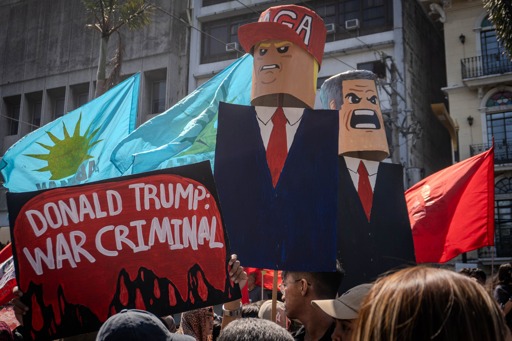
In recent weeks, Donald Trump declared that the United States had already “won” the war against Iran, even as US Secretary of War Pete Hegseth dismissed and reshuffled senior military leadership, signaling instability within the command structure itself. These assertions of control have been accompanied by renewed threats of escalation alongside ceasefire efforts across multiple fronts. Yet these ceasefires—in Gaza, in the aftermath of the so-called “12-day war,” and along the Lebanon front—have been repeatedly undermined by continued Israeli strikes, including recent attacks on southern Lebanon that have caused civilian casualties and displacement. What emerges is not a linear movement from war to peace, but a compressed sequence in which declarations of victory, institutional disruption, coercive escalation, and ceasefire violations unfold in rapid succession. Meanwhile, the forces confronting the United States across West Asia continue to be dismissed as merely Iranian “proxies”—reduced to extensions of a single state rather than recognized as historically rooted formations engaged in a shared struggle, even as it is fought across distinct and locally grounded fronts. What this label obscures is the material and historical life of the region, and the resilience of movements forged through centuries of dispossession, war, and survival.
At the same time, this sequence sharpens a contradiction within U.S. power. A government claiming total victory continues to confront unresolved resistance while dismantling the very leadership expected to secure strategic coherence. Despite repeated claims that the conflict is nearing resolution, economic strain, Iran’s continued sovereignty, and widening global skepticism persist. What emerges is not consolidated dominance, but a form of power that increasingly depends on its own repeated assertion. If imperial power must continually declare victory while encountering its inability to stabilize the conditions of war, what does this reveal about the formations it seeks to contain—and the terms through which they are made intelligible?
Ideological function of “proxies” and knowledge in struggle
The terms through which these formations are understood are not neutral descriptions but instruments in the production of political perception. The persistent reduction of these movements to Iranian “proxies” functions less as analysis than as ideological operation: it flattens historically rooted and locally embedded formations into extensions of a single external actor, erasing the material conditions that produce them. In doing so, it converts a heterogeneous field of struggles—shaped by occupation, invasion, blockade, and state fragmentation—into a simplified architecture of command and control.
What this reduction obscures is precisely what the preceding sequence of escalation and ceasefire breakdown reveals: that these formations persist not as external impositions, but as embedded responses to continuous and uneven war. The “proxy” framework endures not because it explains this reality, but because it organizes it in a way that preserves imperial coherence.
The problem is, therefore, also one of knowledge. As Pierre Bourdieu argues, understanding requires more than external observation; it demands a break with the detached position of the analyst and engagement with the social conditions that produce the object of inquiry. To understand resistance in West Asia is thus not merely to map alliances or attribute command structures, but to situate analysis within the material realities of struggle—above all, ongoing war, occupation, intervention within the project of national liberation.
In Sam Moyo’s work, this takes the form of epistemic sovereignty: not interpretive pluralism or the free market version of academic freedom but grounding knowledge in the historical and collective struggles of peoples of the South. Applied here, it requires abandoning categories such as “proxies” when they obscure more than they reveal, and instead working with concepts that emerge from material conditions of struggle. What appears as external orchestration is better understood as historically produced formations responding to sustained dispossession and violence.
Beyond “proxies”: a historical formation
From this standpoint, the reduction of these movements to Iranian “proxies” obscures the longer historical processes through which they emerge. Across Yemen, Lebanon, and Palestine—where Ansar Allah, Hezbollah, and Hamas-linked formations operate—what is at stake is not a chain of command but a convergence of struggles shaped by occupation, invasion, blockade, and fragmented sovereignty.
Before colonial borders consolidated the modern state system, West Asia functioned as a deeply interconnected social and economic space. Trade routes, migration flows, and overlapping linguistic and religious worlds linked Yemen through the Arabian Peninsula to the Levant and the eastern Mediterranean. Imperial partition reorganized this space into discrete territorial units, but did not erase the historical connections through which social life had long been structured.
These continuities were shaped through successive imperial formations. The incense trade routes and later the administrative systems of the Achaemenid and Abbasid periods integrated the region into uneven but connected political and economic fields stretching from Yemen to Iran and the Levant. While these networks enabled exchange and connection, they were never free of hierarchies or power imbalances. Integration was always uneven, shaped by material and political inequalities, yet they demonstrate that regional history is one of structured connectivity rather than isolated political units.
Contemporary resistance formations emerge within the rupture of these older continuities and the violence of modern fragmentation. Palestine has been subjected to settler-colonial dispossession, Lebanon to repeated invasion and instability, Yemen to blockade and fragmentation, and Syria to prolonged war and external intervention that has severely weakened state capacity. From these conditions, differentiated formations arise—not as external implants, but as historically sedimented responses to sustained coercion.
From this perspective, the so-called “axis of resistance” is not a unified command structure but a differentiated regional formation shaped by shared conditions of imperial pressure and divergent local trajectories of struggle.
Ceasefires, Lebanon, and the logic of deterrence
Recent developments in Lebanon further clarify the limits of the “proxy” framework. Despite ceasefire arrangements along the southern border, Israeli strikes have continued to target Lebanese territory, including border villages and civilian infrastructure, resulting in deaths, injuries, and renewed displacement. Ceasefires here do not mark an end to war but function as temporary intervals within a continuous structure of asymmetrical violence.
Within this context, Hezbollah cannot be reduced to an external extension of Iranian strategy. Formed in the 1980s in response to Israeli invasion and occupation, it emerged as a hybrid formation combining military resistance, political organization, and social infrastructure. Its role in ending Israel’s occupation of southern Lebanon in 2000 and its performance in the 2006 war established a durable deterrence logic that continues to shape regional calculations.
This deterrence operates at a strategic level rather than a purely tactical one. It challenges the assumption that escalation can remain unilateral by introducing the possibility of responses across multiple fronts. As a result, conflict in one theater can spill into others, turning what appears local into a wider regional escalation. In this sense, Hezbollah operates within a broader regional field where armed formations shape the conditions under which force is projected and contained. This is one expression of what can be understood as armed sovereignty: the uneven distribution of defensive capacity across historically rooted formations that alters how war is fought and constrained under conditions of prolonged conflict.
Iran and the architecture of multi-front deterrence
This strategic field becomes clearer when situated within a wider regional configuration in which Iran functions not as a centralized command center but as a node within a distributed system shaped by shared conditions of war, sanctions, and intervention. What is often framed as Iranian control is better understood as convergence among distinct but interconnected actors: Ansar Allah in Yemen, resistance formations in Iraq, Palestinian armed groups, Hezbollah in Lebanon, and others operating across fragmented theaters.
Iran’s role lies less in command than in sustaining conditions of coordination through military learning, technological circulation, and accumulated deterrence experience since the 1979 Revolution. Rather than hierarchy, what emerges is a distributed field of strategic adaptation under sustained pressure. This configuration restructures how escalation operates across the region. Military action in one theater increasingly risks triggering responses across others, extending from the Red Sea to the Levant and beyond. Instead of balance between actors, it produces greater unpredictability and war that can no longer be contained within one place.
Deterrence thus becomes relational rather than unilateral: produced through interaction among multiple armed actors embedded in overlapping but distinct struggles. What is often described as an “axis” is better understood as synchronized responsiveness under conditions of asymmetric war.
What the present reveals
The present does not show the consolidation of imperialist war, but its fragmentation under conditions of sustained resistance. The sequence of Trump’s victory declarations, escalation threats, fragile ceasefires, and repeated violations does not resolve into stability. Instead, it exposes a continuous cycle in which war, pause, and renewed escalation are structurally intertwined. Within this cycle, the reduction of these formations to “Iranian proxies” functions to preserve a simplified image of command and coherence. Yet this framing collapses under empirical conditions in which multiple historically rooted formations persist across interconnected fronts of struggle.
Framed through a global economic lens, the urgency of ending the war is reduced to stabilizing oil flows, containing price shocks, and averting downturns. This perspective treats war primarily as a problem of market stability rather than a political structure of violence, masking the asymmetry at its core. The US imperialist and Israeli Zionist forces that have disrupted production, circulation, and regional stability now demand that Iran restore equilibrium. Even if hostilities were to cease immediately, the damage to infrastructure, supply chains, and local livelihoods will take years to repair. The consequences of imperialist action persist, yet the responsibility is reassigned to those who have long been its victims.
In this context, the burden of de-escalation is repeatedly displaced onto Iran, as if the resolution of conflict depended primarily on its restraint rather than on the conditions produced by decades of intervention, sanctions, and military escalation. This inversion of responsibility obscures the structural origins of war and reframes cessation as a unilateral obligation of the targeted state.
Against this backdrop, armed sovereignty becomes analytically decisive. It names a condition in which the capacity to defend territory, populations, and political continuity is no longer monopolized by formal state institutions, but distributed across historically rooted formations shaped by prolonged imperialist war. This does not eliminate asymmetry but reorganizes the terrain on which it operates, producing cross-front costs, expanding the temporal horizon of conflict, and limiting the possibility of unilateral resolution.
This formation confronts a central contradiction of our age, as identified by Vladimir Lenin: the antagonism between imperialism and oppressed nations fighting for sovereignty and liberation. The so-called “axis of resistance” is not a network directed from above; it is an asymmetric response to imperialist war imposed from without. In resisting, it reasserts the life of the region itself while contributing to the broader global struggle against imperialism.
From this standpoint, what is often described as the “axis of resistance” is not an external aberration to regional order, but a product of its historical transformation under sustained imperial pressure. Its significance lies not in centralized unity, but in its capacity to render imperial war more complex, more costly, and less controllable than dominant analytical frameworks allow. Seen in this light, resistance to US-led wars is not an abstract or voluntarist call, but one grounded in the evident limits of contemporary imperial power. The fragmentation of US strategy, the expansion of multi-front instability, and the erosion of geographically contained warfare all point to a shifting balance in which imperial dominance is no longer assured. Across West Asia—and in other regions where protracted people’s wars and urban-based anti-imperialist movements persist—these conditions signal not closure but opening. There is no neutral moment from which to act; the present is already structured by conflict. The task is therefore not only to interpret this conjuncture, but to meet it with organized resistance on all available fronts, toward the abolition of the US-led imperialist war itself.
References
Cultural and historical connections before imperialist carving:
Briant, P. From Cyrus to Alexander: A History of the Persian Empire. Winona Lake: Eisenbrauns, 2002
Kennedy, H. The Prophet and the Age of the Caliphates. Harlow: Pearson Education, 2004.
Imperialist wars, resistance , and the recomposition of power in West Asia
Ajl, M. “Iran: Reflections on War, Peoples, and Regimes.” Middle East Critique 34, no. 4 (2025): 889–894. https://doi.org/10.1080/19436149.2025.2578577
Aoudé, I. G. “The Axis of Resistance and Imperialism in West Asia.” Arab Studies Quarterly 44, no. 3–4 (2022): 154–180. https://doi.org/10.13169/arabstudquar
Higgins, P. D. “Gunning for Damascus: The US War on the Syrian Arab Republic.” Middle East Critique 32, no. 2 (2023): 217–241. https://doi.org/10.1080/19436149.2023.2199487
Siklawi, R. “Syria Since 1990: Dimensions of Conflict.” Arab Studies Quarterly 44, no. 3–4 (2022): 181–195. [https://doi.org/10.13169/arabstudquar](https://doi.org/10.13169/arabstudquar)
Daher, Joseph. Hezbollah: The Political Economy of Lebanon’s Party of God. Pluto Press, 2016.
Epistemic sovereignty
Bourdieu, P. “Understanding” In The Weight of the World: Social Suffering in Contemporary Society. Stanford: Stanford University Press, 1999. 607–626.
Jha, P. K., P. Yeros, and W. Chambati. “The Quest for Epistemic Sovereignty in the South: A Tribute to Sam Moyo.” In Rethinking the Social Sciences with Sam Moyo, 1–26. New Delhi: Tulika Books, 2020.
On imperialism and Portracted People’s War
Lenin, V. I. Imperialism, the Highest Stage of Capitalism. Moscow: Progress Publishers, 1916.
Sison, José María. Specific Characteristics of People’s War in the Philippines. International Network for Philippine Studies, 2013.
The post Merely Iran Proxies? Understanding the Axis of Resistance appeared first on Bulatlat.
From Bulatlat via This RSS Feed.