

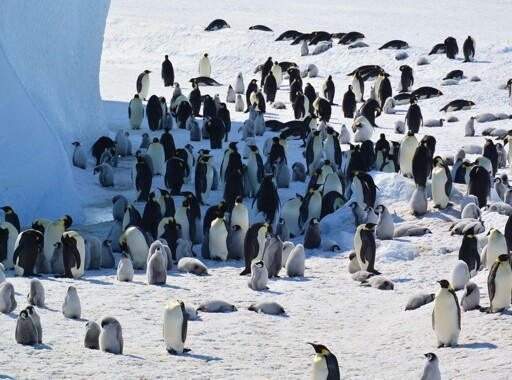
Emperor penguins are native to Antarctica, where record low sea ice over the last decade has dramatically changed their habitat. Populations of the world’s largest penguin have fallen so much that they have now officially moved from near threatened to endangered in the latest assessment by the IUCN Red List of Threatened Species, the global conservation authority, published April 9. “Penguins are already among the most threatened birds on Earth,” Martin Harper, CEO of BirdLife International, which coordinated the emperor penguin (Aptenodytes forsteri) assessment for the IUCN Red List, wrote in a statement. “The emperor penguin’s move to Endangered is a stark warning: climate change is accelerating the extinction crisis before our eyes. Governments must act now to urgently decarbonise our economies.” In 2022, researchers found that four out of five emperor penguin colonies in western Antarctica’s Bellingshausen Sea had died due to a lack of sea ice. In 2019, satellite images found that at Halley Bay, farther North, the colony failed to reproduce for three years in a row. The sea ice broke up before penguin chicks grew their waterproof feathers or learned to swim. They all died before fledging. “It’s very hard to think of these cute fluffy chicks dying in large numbers,” Peter Fretwell, a researcher with the British Antarctic Survey, told The Guardian in 2023 following the Bellingshausen colony losses. “The sea ice loss has been unprecedented and far quicker than we imagined.” Between 2009 and 2018, satellite images of 50 colonies across all of Antarctica…This article was originally published on Mongabay
From Conservation news via This RSS Feed.