

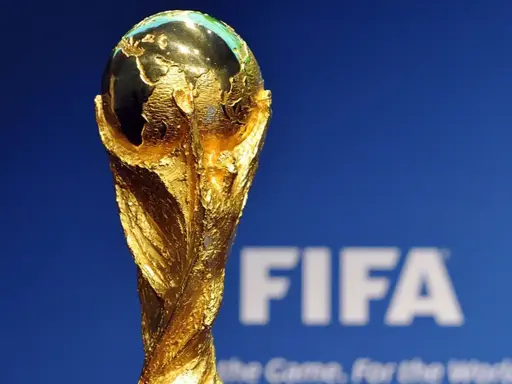

FIFA has announced the list of referees who will officiate at the 2026 FIFA World Cup, following a meticulous, comprehensive selection process spanning three years.
The official refereeing team, ‘Team One’, comprises 52 referees, 88 assistant referees, and 30 video assistant referees, representing the six continental confederations and covering 50 national associations, forming the largest refereeing team in the tournament’s history.
The referees were selected based on the principle of “quality first”, taking into account consistency of performance in domestic and international matches, whether in FIFA tournaments or other official competitions, with candidates undergoing rigorous assessment over the past three years, alongside participation in training seminars and workshops.
According to a FIFA statement, a copy of which was received by the Canary, Pierluigi Collina, FIFA’s Chief Refereeing Officer and Chairman of the Referees’ Committee, said:
The referees selected are the best in the world. They have received comprehensive support from fitness and medical teams, including physiotherapists and mental health support, to ensure they arrive in Miami on 31 May in peak physical and mental condition.
Largest number of referees in World Cup history
Colina added:
The 2026 edition will feature 48 teams and 104 matches across the widest geographical scope in the tournament’s history. ‘Team One’ is larger than any previous squad, with 41 additional referees compared to the 2022 World Cup in Qatar, whilst the representation of women continues to be strengthened through the appointment of six female referees.
The referees are undergoing daily training sessions involving local players, and are receiving detailed briefings from FIFA analysts to ensure they are fully prepared for every match. Technology will support refereeing decisions through goal-line technology, semi-automated offside technology and connected ball technology, whilst fans will, for the first time, be able to follow the action from the referee’s perspective on the pitch.
A structured development programme
Massimo Busacca, FIFA’s Head of Refereeing, explained: “We began preparations for the 2026 World Cup immediately after Qatar 2022, through a structured programme of seminars, workshops and close monitoring, to ensure referees meet the highest possible standards during the tournament.”
Miami will serve as the base for the refereeing team, where a ten-day preparatory seminar will begin, with the video referees subsequently moving to Dallas to complete their work at the International Broadcast Centre, whilst the match officials, assistants and support staff remain in Miami.
New measures aimed at improving the flow of matches and reducing time-wasting will also be implemented during the tournament, in line with the latest IFAB amendments, alongside three updated changes to the VAR protocol, with the use of AI-powered software to improve the quality of real-time footage, giving fans a clearer view from the referee’s perspective.
Controversial refereeing decision in the Champions League
The Champions League quarter-final match between Barcelona and Atlético Madrid at Camp Nou, which ended in a 2-0 win for Atlético, sparked widespread controversy over European refereeing, due to decisions made by Romanian referee Ștefan Covaci at crucial moments.
The most controversial incident occurred in the 54th minute, when an Atlético player handled the ball inside the penalty area, but the referee did not award a penalty to the Catalan side, nor did German VAR official Christian Dingert intervene. This incident angered refereeing experts, who considered it warranted a penalty, and perhaps a yellow card for the goalkeeper.
One rule, different rulings
The controversy intensifies when comparing this situation to a similar incident in last season’s Champions League, during the Club Brugge v Aston Villa match, where VAR intervened and the referee awarded a penalty following a handball by an Aston Villa player. A similar incident also occurred in Argentina three years ago.
This inconsistency raises a fundamental question: are the rules clear enough? Whilst football regulations stipulate that deliberate handballs inside the penalty area warrant a penalty, it appears that practical application varies between referees, depending on their assessment of intent and the angle from which they viewed the incident, which sometimes leads to differing outcomes in similar situations.
The variation in decisions highlights that whilst the laws are the same and the game is similar, application differs from referee to referee, despite the presence of video assistant technology designed to minimise errors. More importantly, such refereeing decisions can have a direct impact on the match result and a team’s progress in the tournament, which increases the pressure on referees and raises questions about the consistency of rule application at the highest European levels.
Expected sanctions – but not for the World Cup
In light of these events, the Union of European Football Associations (UEFA) is considering imposing a sanction on referee Kovač, and possibly excluding him from officiating this season’s Champions League semi-finals, despite the fact that he refereed last season’s final between Paris Saint-Germain and Inter Milan at the Allianz Arena.
Controversy remains over the ability of refereeing to deliver complete justice at decisive moments, despite the use of video technology, highlighting the variation in the interpretation of the rules among referees even at the highest European levels.
Featured image via the Canary
By Alaa Shamali
From Canary via This RSS Feed.