

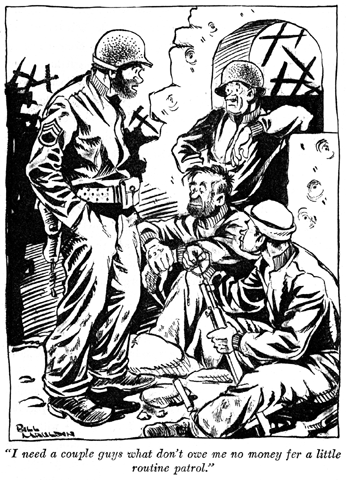
Bill Maudlin (Up Front, 4/17–22/1944)
During World War II, cartoonist Bill Mauldin was summoned to a meeting with Gen. George S. Patton. Mauldin’s Stars and Stripes cartoons drew Patton’s ire over his matter-of-fact depictions of war and American GIs.
To Mauldin, war was no fun adventure. In Up Front, his Willie and Joe were war-weary and disheveled soldiers, not heroes ready for movie stardom. They expressed a darkly comic view of the life of an infantryman. In an exemplary cartoon, one of the duo says to a medic attempting to hand out a medal: “Just gimme th’ aspirin, I already got a Purple Heart.”
Mauldin avoided punishment when Gen. Dwight Eisenhower circulated a letter instructing all officers “not to interfere” with “such things as Mauldin’s cartoons” (Oklahoman, 4/16/82). Mauldin won the Pulitzer twice for his editorial cartooning, once during the war and once afterwards.
Perhaps Donald Trump’s Pentagon saw itself as acting in the Patton tradition when it eliminated comics from Stars and Stripes. As FAIR (3/20/26) previously documented, Pete Hegseth has taken steps to crack down on the independence of the Pentagon’s own newspaper. Among the new guidelines to promote “good order and discipline” is a ban on syndicated material, including comics (Stars and Stripes, 3/13/26). US servicemembers have now been saved from the woke, subversive influences of Doonesbury, Pearls Before Swine and, perhaps worst of all, Beetle Bailey.
A global trend
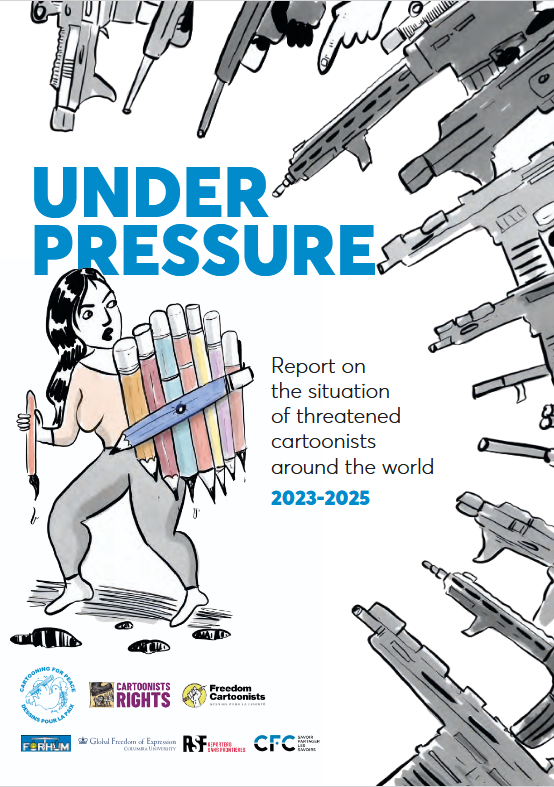
Cartooning for Peace/Cartoonists Rights (3/2/26)
Hegseth’s anti-comics viewpoint is part of a global trend. Cartooning for Peace, Cartoonists Rights, Reporters Without Borders and several others have teamed up to produce Under Pressure; the March 2 report surveys the status of caricaturists around the world.
Under Pressure collects the stories of some of the most grave casualties in the global war on satire. Egyptian Ashraf Omar has been imprisoned for over a year, awaiting trial under specious charges of terrorism (Committee to Protect Journalists, 3/2/26). Saudi Cartoonist Mohammed Al Ghamdi (pen name Al Hazza) faces a 23-year sentence for “sympathizing with Qatar” (Reporters Without Borders, 7/23/25)—reflecting a since-resolved quarrel between the two governments—and because he allegedly “insulted the kingdom of Saudi Arabia” . In 2024, Palestinian cartoonist Mahasen al-Khateeb was killed in Gaza by Israeli bombardment (Middle East Eye, 10/20/24).
When the survey turns to the United States, things remain ominous. Kak, the president of Cartoonists for Peace whose work appears in L’Opinion, found the “same tactics” that appear in authoritarian regimes, or those headed in a dictatorial direction, “are being used” in the US. He continued that “the ‘Land of the Free’ is now flashing bright red on our threat map,” putting the US in the same crowd as Iran, India, Turkey and Russia.
It’s quite a shift from the 2023 report Cartoonists on the Line, which had no section dedicated to the United States. Much has changed for the worse in three years.
Trump has long mused about using official pressure to suppress satirical responses to his government. In 2018, he threatened to sue Saturday Night Live over their mockery of his administration (Mother Jones, 12/16/18). His FCC chair, Brendan Carr, argued that it was in the “public interest” to threaten Jimmy Kimmel’s late-night ABC show over the host’s comedy (Variety, 12/17/25). These words and deeds have created a climate of fear in the United States, one that political cartoonists are feeling.
‘Long overdue for a housecleaning’
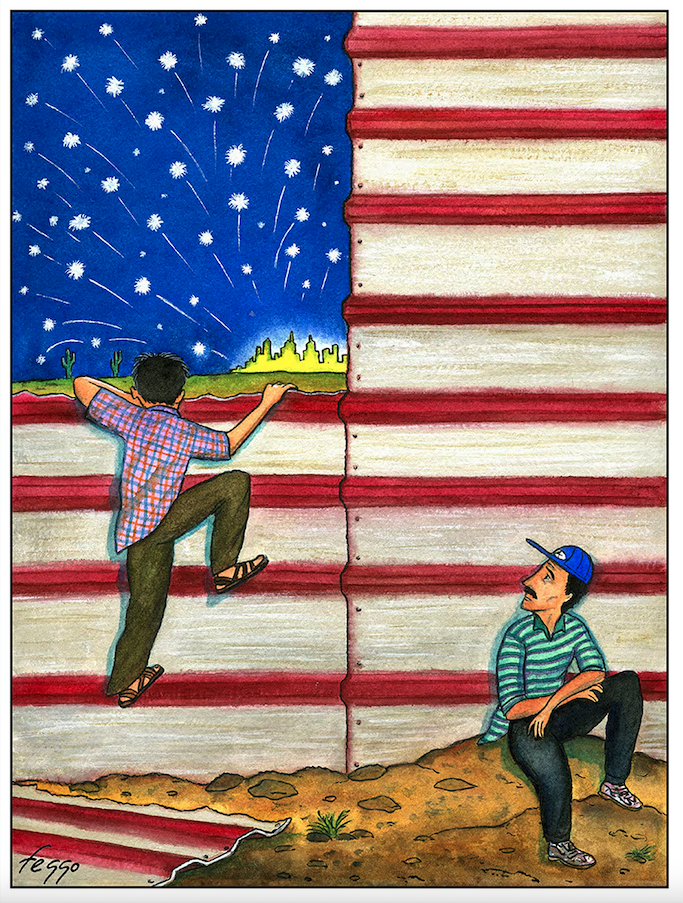
Cartooning for Peace (8/21/25)
The report cites a few US examples that paint a dark portrait of freedom of expression under the second Trump administration. Some of them have previously been covered by FAIR, including the resignation of Ann Telnaes from the Washington Post (FAIR.org, 1/7/25), the firing of Palm Beach Post editorial page editor Tony Doris (FAIR.org, 3/27/25) and Bob Whitmore’s firing and belated reinstatement to Creative Loafing (FAIR.org, 9/30/25). There are other examples, however, that deserve more examination.
In 1999, Felipe Galindo (Pen name Feggo) drew “4th of July From the South Border,” an endlessly reproduced and reprinted piece criticizing the militarization of the border with Mexico. Starting in 2022, Feggo’s work hung in the Smithsonian’s National Museum of American History as part of the ¡Presente! A Latino History of the United States exhibit.
Feggo’s illustration was taken down after the Trump White House (8/21/25) attacked it as part of an “anti-American exhibition” that showed the US’s legacy of “colonization” and the history of Latino “victimhood and exploitation.” A crowing editorial in the Washington Examiner (8/24/25) asserted “the Smithsonian is long overdue for a housecleaning” over its “fashionable, culturally Marxist ideas.” The New York Times (3/28/25) described Trump’s interference with the Smithsonian as seeking “a more positive view of American history.” More positive for whom, is a question left unasked. Artist Rigoberto Gonzalez, whose “Refugees Crossing the Border Wall Into South Texas” was likewise removed, compared the administration’s censorship to the Nazi campaign against “degenerate art” (NPR, 8/24/25).
Julie Trébault of Artists at Risk Connection, who wrote Under Pressure‘s section on the United States, said it was a “rare and significant move” for the executive branch to single out “a specific work for removal from a federal museum.”
‘Direct threats’
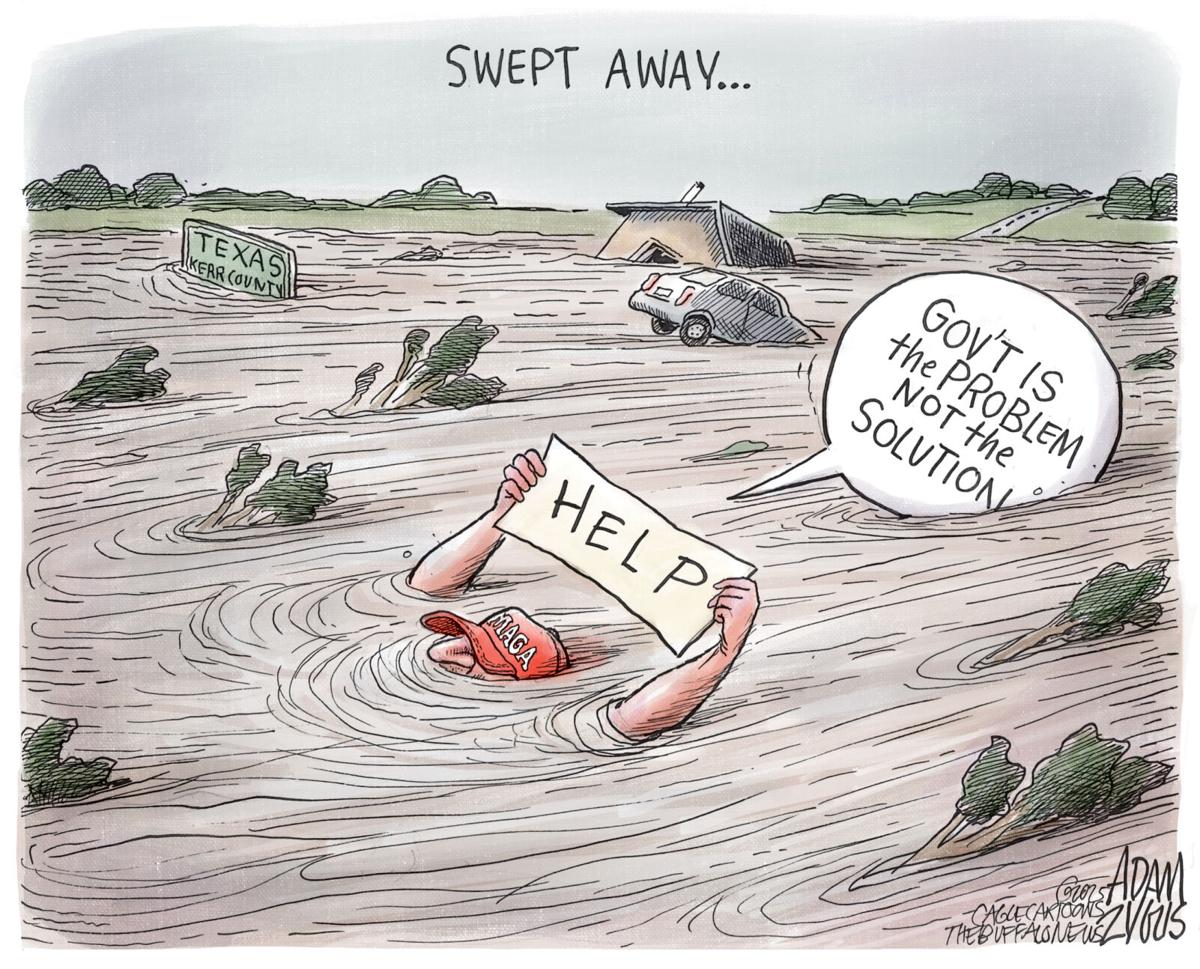
Adam Zyglis (Buffalo News, 7/7/25)
The report cited another Pulitzer winner, Adam Zyglis, in its section on the United States. His July cartoon for the Buffalo News (7/7/25) on flooding in Texas showed a MAGA hat-sporting Texan being swept away while proclaiming, “Gov’t is the problem not the solution!”
The New York Post (7/10/25) reran a Fox News piece (7/9/25) that slammed the cartoon as “vile.” The Post’s conscience is an interesting development, considering that the paper ran a cartoon in 2009 comparing President Obama to a chimpanzee (Guardian, 2/18/09), echoing a well-known racist trope.
The slings and arrows of press criticism were nothing compared to what was to come. In response to this cartoon, Zyglis was subject to numerous death threats. An appearance at Buffalo Museum was canceled over public safety concerns (Politico, 7/11/25). The Association of American Editorial Cartoonists, the Society of Professional Journalists and the Committee to Protect Journalists all released statements condemning the threats and supporting Zyglis (Daily Cartoonist, 7/17/25).
Trébault notes this as a sinister development. To criticize “the government’s actions or positions,” she wrote, “now exposes artists to direct threats.”
Heads in the sand
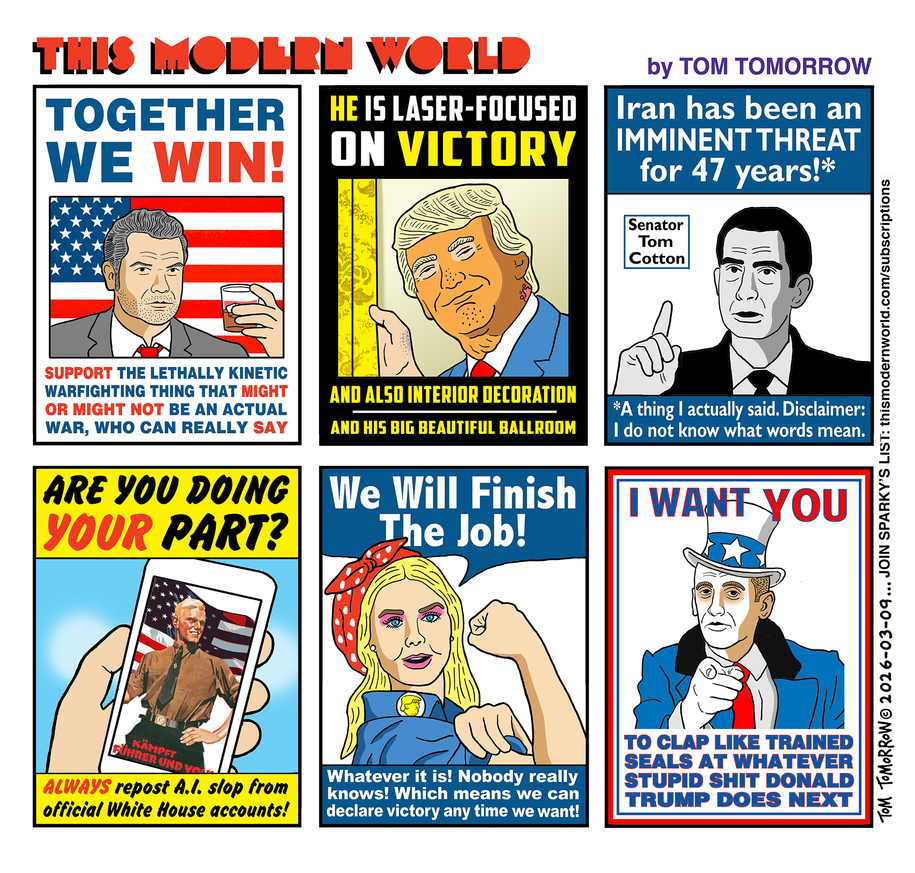
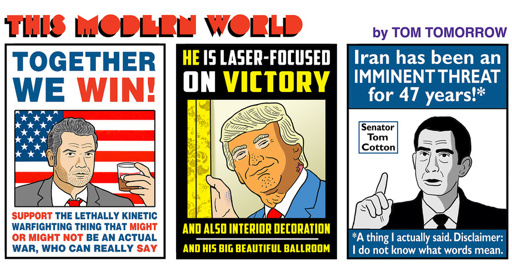
Tom Tomorrow (Daily Kos, 3/9/26)
Unfortunately, Under Pressure has received little coverage in the United States, excepting the Daily Cartoonist (3/4/26). This contrasts with the coverage in New African Magazine (3/2/26), which gave the incidents the report highlights on that continent wider publicity.
The lack of attention media outlets gave to Under Pressure comes at a dangerous time for press freedom. The Inter American Press Association, a hemispheric media watchdog, recently classified the United States as a nation with “‘restrictions’ on freedom of speech” and of the press (AP, 3/10/26). By not giving reports like Under Pressure attention, media outlets are placing their heads in the sand.
Beyond open political censorship, there are also economic pressures on political cartoonists. Many newspapers do not employ their own cartoonists. Instead they choose material from syndicates, which reduces the amount of total cartoonists employed. It’s simple math. Why hire a dedicated cartoonist when syndicated material can be purchased for a fraction of the price?
The venues for cartoonists are also shrinking and sometimes disappearing. Since 2005, around 3,500 newspapers have shut down (Poynter, 10/20/25). Publications like the Atlantic Journal-Constitution, the Newark Star-Ledger and the Pittsburgh Post-Gazette are either ending their print editions or shutting down entirely. Cartoonist Walt Handelman (Editor & Publisher, 2/18/26), recently retired from the New Orleans Times-Picayune and the Advocate, said he was “optimistic about satire…. The real question is, how do you make a professional living doing it.”
Are there still political cartoonists out there worth looking for? Of course. In These Times has a vibrant comics section with witty and insightful commentary from the likes of Mattie Lubchansky, Jen Sorenson, Tom Tomorrow and others. The annual collection World War 3 Illustrated provides a perspective not likely to be found in other outlets, as exemplified by last year’s issue dedicated to Palestinian cartoonists. In between winning awards for Insectopolis, his comic study of creepy crawlies, Peter Kuper’s work enlivens The Nation. Cartoonists may be “under pressure,” but the best of them are capable of rising to the challenge.
From FAIR via This RSS Feed.
You must log in or # to comment.