

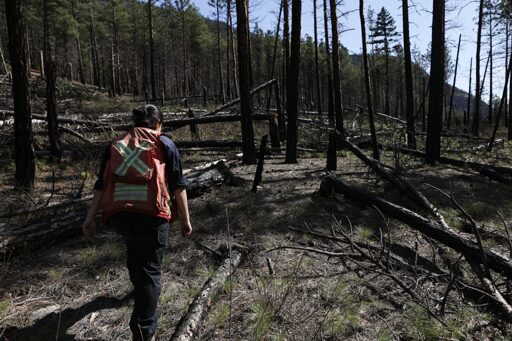
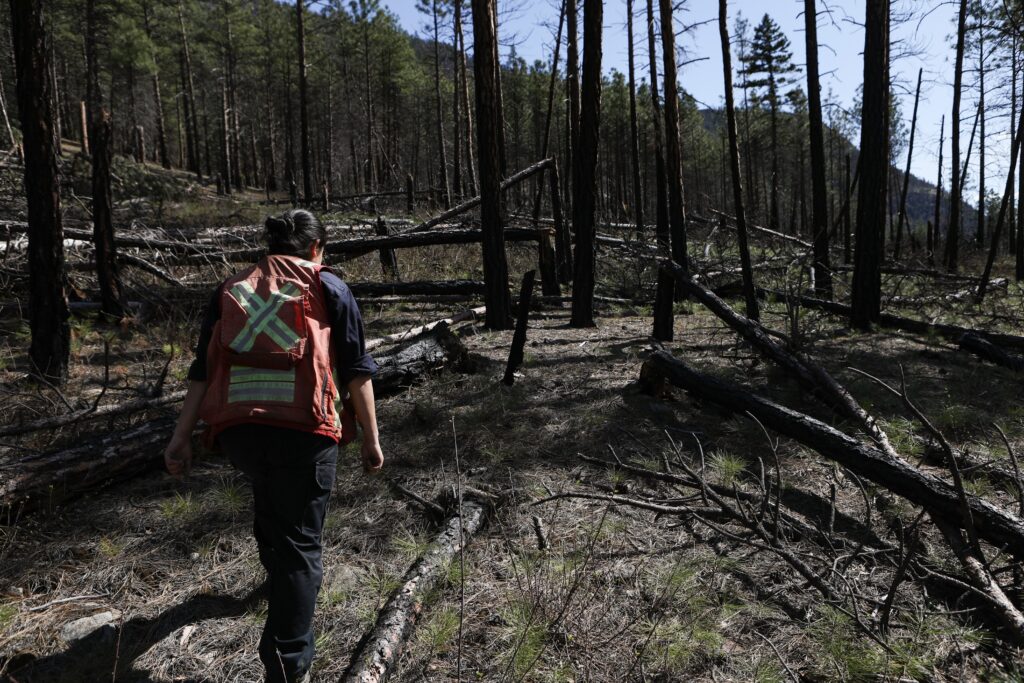
Sheresa Brown is pictured in Lytton First Nation. She is a 31-year-old Nlaka’pamux woman who has been deployed on numerous fires with the BC Wildfire Service, both fighting fires and as a cultural values expert. Photo by Aaron Hemens
Santana Dreaver, The Narwhal’s 2026 Indigenous Journalism Fellow, and Aaron Hemens attended the Salish Fire Keepers Society gathering on March 17 and 18. This is the second of two stories about the gathering, published in partnership with The Narwhal.
Jaci Gilbert was 12 years old when she was evacuated from Tsq’escen’ First Nation because of a wildfire in 2017. Four years later, more wildfires impacted her community, located in “B.C.’s” central interior, prompting some Elders to be evacuated to the Lower Mainland.
Gilbert, who is Secwépemc and Tsilhqot’in, volunteered both at the emergency operations centre during the partial evacuation in 2021, and as a fire camp logistics assistant near 100 Mile House during those fires.
“After being involved in the emergency operations centre I caught the bug of wanting to do emergency and wildfire management,” Gilbert said.
Gilbert works for First Nations Emergency Services Society as a cultural and prescribed fire specialist. She is part of a cohort of First Nations women in the province who are leading the way in wildfire management in their communities — demonstrating leadership and stewardship as blazes continue each year.
Being a young person, and a woman, Gilbert struggled to get into the field of emergency management, but reaching out to organizations and women in the field is a good place to start, she said.
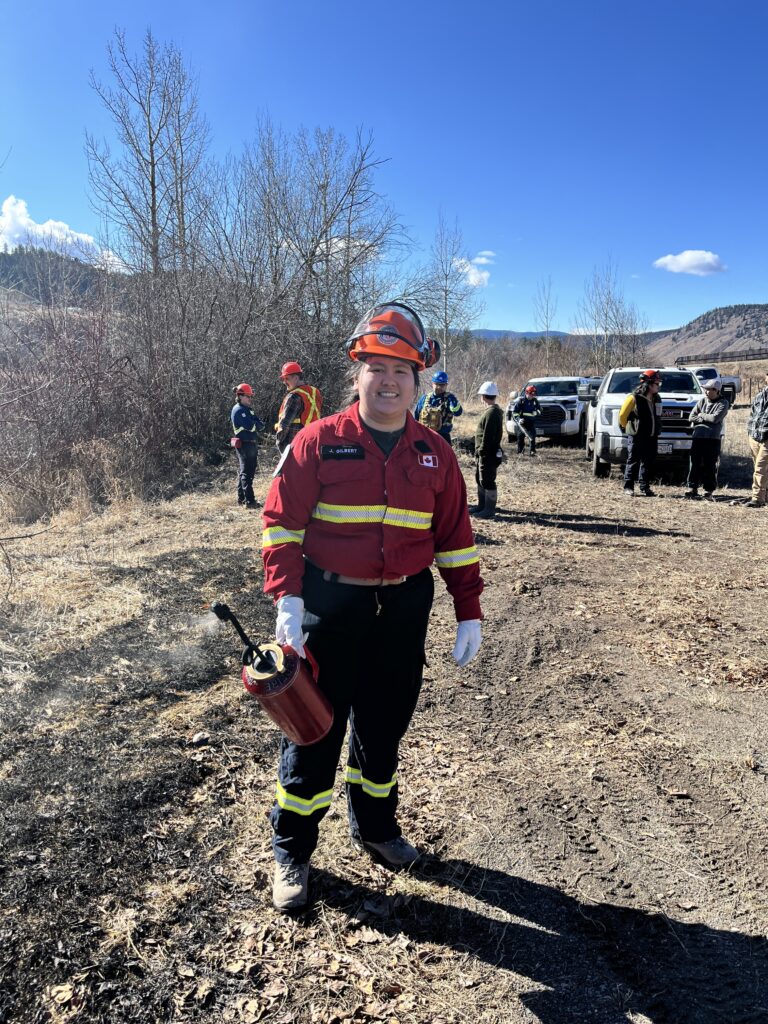
Jaci Gilbert in the field. Photo submitted
“Youth have been managing emergencies in their personal lives for a long time, especially Indigenous youth, so using these skills I developed on reserve I’m able to handle [emergencies] well, whereas with a typical office or customer service job I don’t handle [those] very well,” Gilbert said.
“We’re seeing a shift in dynamics. I’m noticing a lot more Indigenous women in fire research and in the fire community.”
Indigenous firefighters bring cultural knowledge to their work
Sheresa Brown, a Nlaka’pamux woman from Lytton First Nation, has been involved with fire since firefighting in high school. Brown works as a field technician and archaeological monitor with Nlaka’pamux Nation Tribal Council, specializing in protecting cultural heritage values.
After her hometown of Lytton was devastated by fire in 2021, Brown evacuated to Merritt and was looking for a job when she called her former boss from the BC Wildfire Service.
Back on the frontlines, Brown noticed a crew member cut down a culturally modified tree in Vernon, commonly referred to as a CMT, to clear a pathway for a hose.
“[First Nations] make that [symbol on the tree] so they can come back to harvest the sap, they can use it to make different types of medicines. And it was a very utilized tree that just got cut down,” Brown said.

Sheresa Brown is pictured in Lytton First Nation. She is a 31-year-old Nlaka’pamux woman who has been deployed on numerous fires with the BC Wildfire Service, both fighting fires and as a cultural values expert. Photo by Aaron Hemens
She recommended scanning for culturally modified trees before clearing to her crew lead, who received it well. A year later Brown was deployed on another fire near Lytton, teaching BC Wildfire Service crews about the land’s cultural values.
She said she’s willing to take people on the land if they are willing to learn and be respectful, noting that sometimes people do not know they are in a culturally significant area, especially when firefighters are deployed from another province or country.
“I know if a man can do it, I can do it too, and probably even better,” Brown said, reflecting on her experience being a First Nations woman in the fire industry.
Bringing back cultural burns
Brown and Gilbert are carrying the torch lit by trailblazers in the field like Leona Antoine, who has 30 years of experience. Antoine is a Nlaka’pamux woman who is no stranger to cultural burning or firefighting.
She practices traditional burning, is a registered forest technologist, a Type 1 (or first-response) firefighter with the BC Wildfire Service, and is a board director and chair of the Salish Fire Keepers Society.
When Antoine’s firefighting journey with the BC Wildfire Service began in the early 2000s, she was one of few women on a 20-person unit crew.
“Because there were no women on the crews before, they didn’t know how to have a woman around,” Antoine said.
“It took probably about a month for the crew to get used to women being on the crew. You know, putting all the women’s posters and magazines away,” she said.
Although men on the crew were initially uncomfortable around women, and had to be taught boundaries, “I broke those barriers,” she said.

Leona Antoine is director and chair of the Salish Fire Keepers Society, a non-profit organization founded in 2016, advocating for cultural burns to be revitalized in B.C. Photo by Aaron Hemens
Another barrier at the time was getting the province and general public to see the value of cultural burning. B.C. was the first province in “Canada” to ban the practice in 1874.
After a year of devastating fire in 2017, and following the release of a report, Addressing the New Normal: 21st Century Disaster Management in British Columbia, in 2018, cultural burns started being taken more seriously by the province, with official amendments to the Wildfire Act in “B.C.” to support the practice taking effect in 2024.
This is work that the Salish Fire Keepers Society has been advocating for since its inception in 2016. The non-profit is made up of Interior Salish nations who experience some of the country’s hottest wildfires, and promotes the restoration of cultural burning practices.
Gilbert contributed to a cultural burning guide, Workbook to Create a Cultural Burn Pathway, made in partnership with the Indigenous Leadership Initiative.
“As I’ve become more involved with emergency and wildfire management, cultural burning comes up a lot, especially as an Indigenous person that’s interested in Indigenous solutions to modern problems,” she said.
First Nations Emergency Services Society is an emergency management non-profit organization in “B.C.” “We were initially created as a result of a lot of Indigenous deaths related to structural fires,” Gilbert said during her presentation at the Salish Fire Keepers Society gathering in Kamloops on Mar. 17.

Around 100 people attended in-person, with more turning in virtually, for the Salish Fire Keepers Society’s 2026 “Reigniting The Land” spring gathering in Tk’emlúps (Kamloops) in Secwepemcúl’ecw on March 17 and 18. Photo by Aaron Hemens
The workbook guides readers through different considerations when planning a cultural burn, and was created through a series of community interviews by Amy Cardinal Christianson and Natasha Caverley.
“My role in [its] creation has been trying to make sure that it’s accessible for First Nations. I’m not much on the technical side, I’m … looking at the art and how that can help tell the story for people without strong English backgrounds,” she said.
During the March 2026 gathering, Antoine and the rest of the society’s board gifted each guest speaker with sweetgrass and sage, two traditional medicines among many First Nation cultures across “Canada.”
There were many women in attendance, underscoring how things are beginning to shift.
This is an initiative she championed. “We are taught by our Elders when you ask for information or stories, you validate their teachings and what … they have taught. You honour them with medicine,” she said.
Prioritizing traditional protocols, ceremony, and medicine at this year’s fire gathering is an example of how Antoine brings balance to the fire space.
Not only has she broken down barriers for women to come after her, she also creates opportunities for those in the fire industry to connect, heal, and share knowledge – work that can be forgotten for those in the heat of fire.
Antoine said “we’re in fire dependent ecosystems, the land needs fire.”
The post Interior Salish women are reclaiming fire — and protecting their homelands appeared first on Indiginews.
From Indiginews via This RSS Feed.