

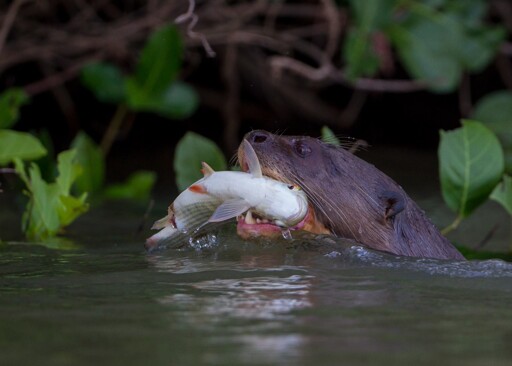
With evidence that the giant river otter is in an increasingly perilous state, delegates to the United Nations Convention on the Conservation of Migratory Species (CMS) listed it as an animal requiring urgent conservation action at its March 2026 meeting in Campo Grande, Brazil. The giant otter (Pteronura brasiliensis), endemic to tropical river systems in South America, once lived east of the Andes mountains from northern Venezuela to Argentina, a territory covering 9,021,590 square kilometers (3,483,255 square miles). The proposal advocating for stronger protection, submitted by France, noted that it was listed as endangered on the IUCN Red List in 2021, though it is extinct in Uruguay and Argentina, is critically endangered in Paraguay and Ecuador and vulnerable in Brazil. The same document mentions a 50% decline in the giant otter population over the last 25 years. Individuals’ size has also been reduced, indicating a decrease in pups’ survival rates. Using climate projections such as reduced rainfall due to climate change, specialists point out that the downward trend in the species’ population will continue for a few decades. Illegal hunting for their fur wiped them out in large parts of their range; many populations never recovered, according to a 2025 report published by the Wildlife Conservation Society, a U.S.-based nonprofit. Although commercial hunting is no longer a serious threat, these otters still face serious challenges. Conflict continues, with local people competing for the fish that otters eat. Their habitat continues to disappear, frequently converted to farmland and cities. Rivers are dammed…This article was originally published on Mongabay
From Conservation news via This RSS Feed.